In the rapidly evolving digital ecosystem of 2025, search engine results pages (SERPs) are no longer static lists of ten blue links. Driven by artificial intelligence, multimodal search features, localized optimization, and hyper-dynamic content blocks, organic visibility has become exponentially more complex to measure. For digital marketing agencies, in-house enterprise SEO teams, and ecommerce brands alike, relying on manual spreadsheets or outdated weekly ranking reports is a recipe for missed opportunities and misallocated budgets.
Accurately tracking keyword movements, monitoring fierce competitor shifts, and measuring the presence of advanced elements—such as AI Overviews, People Also Ask (PAA) boxes, video carousels, and local map packs—demands specialized software. This comprehensive review examines the critical features required in modern rank-tracking infrastructure and evaluates the seven best SERP tracking tools for 2025. Whether you require an on-demand, standalone powerhouse or a scalable module within an all-in-one SEO suite, this guide provides the clarity needed to optimize your tracking stack and tie organic performance directly to your bottom-line revenue.
Detailed Chronology: The Evolution of Rank Tracking
The methodology of tracking search engine positions has undergone a radical transformation over the past two decades. Understanding this trajectory highlights why modern tools operate the way they do today:
The Early Era (Pre-2010): SEO professionals relied heavily on manual lookups or basic desktop-installed scrapers. These tools were prone to IP blocks, lacked geographic precision, and offered little insight beyond a simple numerical position.
The Cloud & Daily Updates (2010–2018): As search engines grew more sophisticated, cloud-based SaaS platforms emerged. Tools began automating daily checks, introducing device segmentation (desktop versus mobile), and scraping basic SERP features like universal search results and local packs.
The Feature-Rich & Localized Landscape (2018–2023): SERPs diversified dramatically with the introduction of structured data, zero-click answers, and hyper-local intent parameters. Rank trackers evolved to capture features like featured snippets and People Also Ask modules, while enabling zip-code-level tracking for local businesses.
The AI & Real-Time Era (2024–2025): Today, search engines integrate generative AI experiences (such as AI Overviews) directly into the results page. Modern SERP trackers must now process dynamic SERP layouts on demand, handle massive international search engine ecosystems, and integrate seamlessly with business intelligence dashboards and analytics platforms to measure true conversion impact.
Investing in enterprise-grade SERP tracking software is not merely about vanity metrics or celebrating a jump from position four to position two. It is about validation, forecasting, and risk mitigation.
According to recent digital marketing benchmarks, over 70% of high-intent search queries now trigger at least one non-traditional SERP feature before a user ever reaches a traditional organic link. This structural shift means that a drop in numerical ranking does not always equate to a loss of traffic if a brand successfully captures a featured snippet or an AI Overview citation.
Furthermore, data granularity is paramount. Modern campaigns require visibility across multiple search engines (such as Google, Bing, Baidu, Yandex, and YouTube), diverse geographic radii (from national campaigns down to precise city and zip-code levels), and distinct device categories. Without these capabilities, organizations risk making strategic content decisions based on skewed, generalized averages.
9 Essential Features to Look for in SERP Tracking Software
When evaluating solutions for your tech stack, ensure the platform delivers on these nine foundational requirements:
1. Access Accurate On-Demand Ranking Updates
SERP positions fluctuate rapidly throughout the day due to algorithmic micro-updates, competitor testing, and personalization. Waiting days for a scheduled weekly or batch update is unacceptable. Leading tools offer automated daily refreshes coupled with on-demand manual update buttons, giving you fresh data the exact moment you need it.
2. Monitor Performance Across SERP Features
Ranking in "Position #0" or securing real estate within AI Overviews, featured snippets, and video carousels can radically alter click-through rates. Your tracker must identify which keywords trigger these features and show you historical trends regarding whether your assets are gaining or losing these high-visibility slots.
3. Track SERP Movement Across All Major Search Engines
While Google commands the lion’s share of global search volume in Western markets, international campaigns often require monitoring alternative search engines. Robust tracking software supports platforms like Bing, Baidu, Yandex, and YouTube to ensure complete global coverage.
4. Granular Tracking (By Location and Device)
Local search intent requires localized tracking. Look for software that allows you to drill down from country and state levels all the way to city and zip-code parameters, while clearly separating desktop and mobile performance metrics.
5. Map SERP Movements to Traffic and Revenue/Conversions
Rankings alone do not pay the bills. The best tools integrate with web analytics platforms (such as Google Analytics or Adobe Analytics) to combine keyword positions, search volume, and Share of Voice with downstream behavioral metrics like organic traffic, bounce rates, and e-commerce revenue.
6. View Historical Rank Performance
Point-in-time snapshots limit strategic analysis. Comprehensive historical data allows SEO teams to audit long-term ranking trends, evaluate the impact of past algorithm updates, and benchmark performance against competitors over multi-year horizons.
7. Run Competitor Comparisons
Search optimization is a zero-sum game. Tracking platforms should group keywords into performance brackets (e.g., positions 1–3, 4–10, 11–50) and provide side-by-side competitive gap analysis to highlight where rivals are eating into your market share.
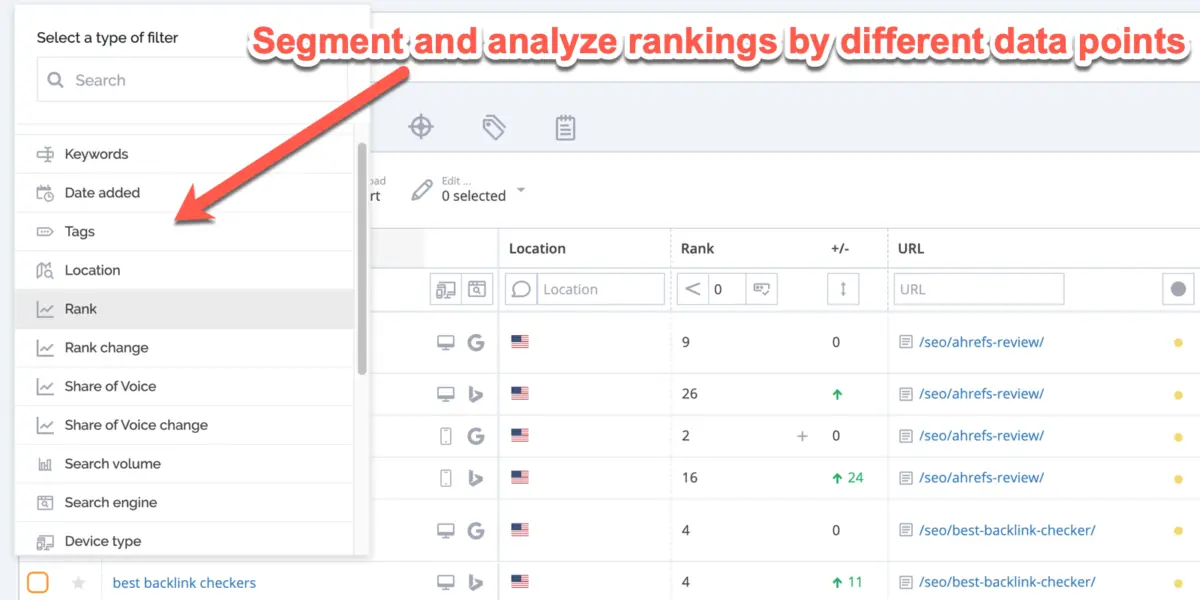
8. Tag and Segment Rankings Data
Not all keywords carry equal business value. Effective software includes advanced tagging functionality, allowing you to segment data by content type, marketing funnel stage, product category, or specific topic clusters.
9. Generate White-Label Reports and Integrations
For agencies and in-house teams reporting to executive stakeholders, the ability to build automated, white-label client reports—or push live data seamlessly into third-party dashboards via API or connectors like Google Looker Studio and Databox—is non-negotiable.
Official Statements & Industry Insights
Industry leaders continually emphasize the necessity of integrating rank data with broader business intelligence metrics. As Ian Howells, Co-Founder of Traffic Think Tank, notes:
"The thing that really got me using them heavily in the last month or two is their data connector. Combining the tag feature, as well as the Share of Voice metric, has been a big help in making these reports immediately digestible."
Similarly, Matthew Howells-Barby, Co-Founder of TrafficThinkTank, highlights the operational necessity of specialized tracking interfaces:
"It’s by far the best keyword ranking tracker in the market and has a ton of great reporting functions. If you want visibility on large volumes of keywords housed within a nice dashboard — this is for you."
The 7 Best SERP Tracking Tools to Consider in 2025
To help you navigate the crowded software market, we have curated a shortlist of the top-performing dedicated trackers and all-in-one SEO platforms available today.
1. AccuRanker
AccuRanker stands out as the premier standalone SERP tracking tool trusted by over 32,000 companies, including global enterprises like HubSpot, IKEA, and Kinsta.
Best Features: Lightning-fast, on-demand data refreshes; comprehensive SERP feature tracking across 50+ variables; deep Google Analytics integration for revenue mapping; and flexible tagging for Share of Voice analysis.
Who It Is For: Agencies, consultants, and enterprise brands that demand the absolute fastest, most accurate real-time ranking data and robust API access.
Pricing: Subscription plans scale based on tracked keywords, starting at approximately $116/month for up to 1,000 keywords.
2. Semrush (Position Tracker & SERP Gap Analyzer)
As an all-in-one SEO and digital marketing suite utilized by over 10 million users (including Samsung and Vodafone), Semrush offers a Position Tracking tool that rivals dedicated standalone options.
Best Features: Hyper-accurate daily rank tracking, granular local map-pack monitoring, and the innovative SERP Gap Analyzer app in the Semrush App Center, which scans search results to uncover under-optimized content and integrates directly with Google Search Console.
Who It Is For: Marketing professionals and enterprises looking for an all-inclusive marketing platform without sacrificing rank-tracking precision.
Pricing: Platform plans start at $139.95/month.
3. ProRankTracker
ProRankTracker is a scalable, cost-effective standalone solution relied upon by over 60,000 users worldwide.
Best Features: Advanced multi-language support, accurate local and international rank monitoring, and comprehensive video ranking analytics.
Who It Is For: SMBs, agencies, and video marketers seeking reliable tracking without enterprise-tier pricing.
Pricing: Plans begin at $39/month.
4. Advanced Web Ranking (AWR)
A long-standing enterprise favorite, Advanced Web Ranking provides robust infrastructure for tracking deep keyword portfolios across complex organizational structures.
Best Features: Unlimited user seats on most plans, exceptional white-label reporting engines, and flexible cloud deployment options.
Who It Is For: In-house marketing teams and large agencies managing diverse client rosters.
Pricing: Subscriptions start at $99/month.
5. SERPWatcher (by Mangools)
SERPWatcher offers an intuitive, visually appealing tracking interface as part of the Mangools all-in-one SEO toolkit.
Best Features: The proprietary Performance Index metric (which estimates organic traffic potential based on current rankings and search volumes) and an exceptionally clean, user-friendly dashboard.
Who It Is For: Freelancers, startups, and small business owners who prefer simplicity and ease of use.
Pricing: Bundled toolset plans start at $29.90/month.
6. SE Ranking
SE Ranking is a versatile all-in-one SEO platform recognized for its high data fidelity and simulation-based tracking accuracy.
Best Features: Precise location and device tracking, comprehensive competitor historical data, and modular pricing customizations.
Who It Is For: Small-to-midsize agencies and growing businesses.
Pricing: Plans start at $52/month for daily tracking of 500 keywords.
7. Nightwatch
Nightwatch is celebrated for its modern interface and massive global reach, tracking search engine performance across more than 107,000 distinct geographic locations.
Best Features: Advanced data segmentation, automated anomaly detection, and robust custom reporting capabilities.
Who It Is For: Freelancers, SMBs, and agencies scaling international campaigns.
Pricing: Plans start at $32/month for up to 250 keywords, backed by a 14-day free trial.
Future Outlook
As we look further into the 2025 digital landscape, SERP tracking technology will continue to adapt alongside artificial intelligence and changing consumer search habits. We can anticipate deeper predictive analytics—where machine learning models forecast potential traffic shifts before algorithms fully roll out—alongside even more integrated reporting frameworks that dissolve the barriers between paid search, organic search, and conversion analytics.
Choosing the right SERP tracker today is an investment in strategic clarity. Whether you choose a dedicated powerhouse like AccuRanker or a comprehensive suite like Semrush, implementing the right tool will ensure your organization remains agile, transparent, and positioned for sustainable organic growth.


![7 Best SERP Tracking Tools for 2022 [In-Depth Review]](https://www.robbierichards.com/wp-content/uploads/2020/05/Best-SERP-Trackers.jpg)
![7 Best SERP Tracking Tools for 2022 [In-Depth Review]](https://www.robbierichards.com/wp-content/uploads/2020/04/image16-2.png)
![7 Best SERP Tracking Tools for 2022 [In-Depth Review]](https://www.robbierichards.com/wp-content/uploads/2020/04/image2-3.png)
![7 Best SERP Tracking Tools for 2022 [In-Depth Review]](https://www.robbierichards.com/wp-content/uploads/2020/04/image6-2.png)
![7 Best SERP Tracking Tools for 2022 [In-Depth Review]](https://www.robbierichards.com/wp-content/uploads/2020/04/image15.jpg)
![7 Best SERP Tracking Tools for 2022 [In-Depth Review]](https://www.robbierichards.com/wp-content/uploads/2020/04/image12-1.png)
![7 Best SERP Tracking Tools for 2022 [In-Depth Review]](https://www.robbierichards.com/wp-content/uploads/2020/04/image13-2.png)
![7 Best SERP Tracking Tools for 2022 [In-Depth Review]](https://www.robbierichards.com/wp-content/uploads/2020/04/image3.jpg)
![7 Best SERP Tracking Tools for 2022 [In-Depth Review]](https://www.robbierichards.com/wp-content/uploads/2018/08/rj-employee_Robbie-color-new.png)
![7 Best SERP Tracking Tools for 2022 [In-Depth Review]](https://www.robbierichards.com/wp-content/uploads/2020/05/Databox-SEO-dashboard-1.jpg)
![7 Best SERP Tracking Tools for 2022 [In-Depth Review]](https://www.robbierichards.com/wp-content/uploads/2020/04/image4-2.png)
![7 Best SERP Tracking Tools for 2022 [In-Depth Review]](https://www.robbierichards.com/wp-content/uploads/2020/04/image5.jpg)
![7 Best SERP Tracking Tools for 2022 [In-Depth Review]](https://www.robbierichards.com/wp-content/uploads/2020/05/AccuRanker-Google-Data-Studio-integration.jpg)
![7 Best SERP Tracking Tools for 2022 [In-Depth Review]](https://www.robbierichards.com/wp-content/uploads/2018/11/Ian-Howells2.png)