

Executive Overview
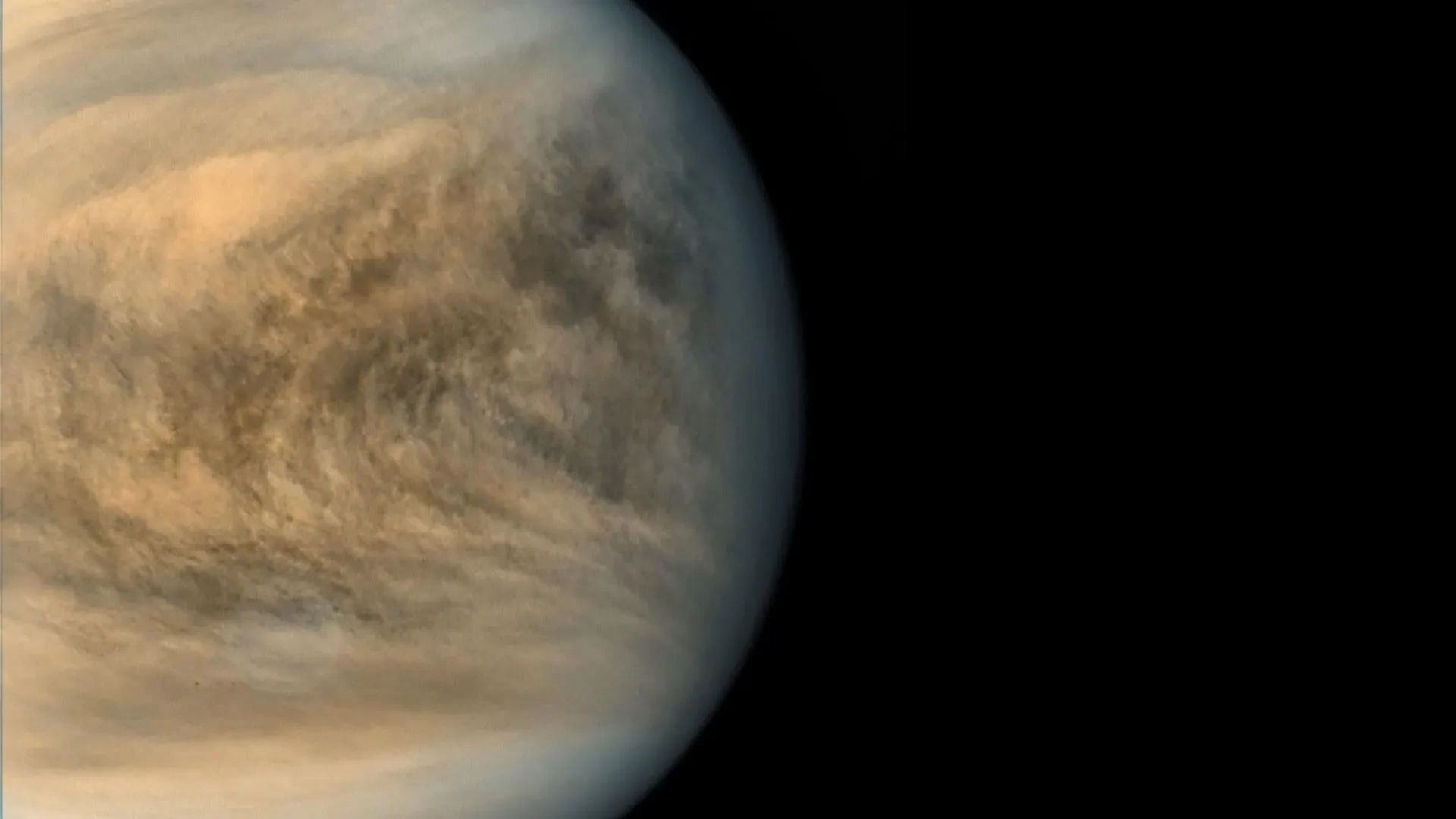
For over a century, astronomers and planetary scientists have gazed toward Venus and puzzled over a striking visual dichotomy. While our planetary neighbor appears as a relatively featureless, pale-yellow orb in ordinary visible light, shifting the perspective to ultraviolet (UV) wavelengths reveals a dramatic transformation. Sweeping across the planet’s dense, upper sulfuric acid cloud decks are complex, mottled patterns of dark and bright features. These enigmatic UV-absorbing structures drift and evolve, yet the exact chemical substance responsible for producing them—commonly referred to in planetary science as the "unknown absorber"—has stubbornly resisted identification since its discovery.
Now, an international team of researchers has broken new ground by establishing strict, quantitative numerical limits on what this mysterious material must be. By combining high-resolution space-and-ground-based observations of Venus with sophisticated radiative-transfer modeling, the scientific team has successfully calculated how strongly the liquid enclosed within the planet’s microscopic cloud droplets must absorb ultraviolet and blue light to replicate the signatures captured by telescopes and interplanetary spacecraft.
Rather than instantly unmasking the culprit, the findings erect a rigorous framework that narrows the field of plausible candidates while sharpening the scientific mystery. The study demonstrates that any proposed substance—whether organic or inorganic—must meet extreme thresholds of optical efficiency and chemical stability. Published in the journal Astrobiology, this collaborative investigation bridges the gap between astronomical observation and terrestrial laboratory chemistry, providing an essential roadmap for upcoming atmospheric probes and robotic missions destined for Earth’s fiery sister planet.
Detailed Chronology & Scientific Journey
A Century-Long Astronomical Enigma
The history of Venus observation is marked by frustration and fascination in equal measure. Early telescopic pioneers noted the featureless nature of the planet’s visible disk, which is rendered opaque by the thick global shroud of clouds residing between 45 and 70 kilometers above the surface. It was not until the advent of ultraviolet photography in the early 20th century that researchers realized Venus was hiding a dynamic, highly active weather system aloft.
These UV images revealed banded structures, chevron shapes, and vast cloud features that circle the planet in a matter of four days—a phenomenon known as super-rotation. Despite decades of spectroscopic analysis, flybys, and atmospheric entry probes from both Soviet Venera and NASA Pioneer Venus missions, scientists have never definitively pinned down the chemical composition of the compounds driving this strong ultraviolet absorption. The identity of the dark markings has remained one of the most enduring open questions in planetary aeronomy.
Reimagining Venusian Clouds in the Lab
To tackle this historical bottleneck, lead author Dr. Jan Spacek and his colleagues approached the problem from a radically different angle. Instead of attempting to directly match the hazy, diffuse appearance of the clouds as viewed from space, the research team asked a foundational question: What would the Venusian cloud material actually look like if those microscopic droplets could somehow be harvested, collected into a spectrometric cuvette, and analyzed as a pure bulk liquid in a terrestrial laboratory?
This conceptual shift is critical because the optical properties of a suspension of particles can diverge wildly from the properties of the substance making up those particles. To illustrate this principle, the researchers point to a familiar terrestrial phenomenon: cigarette smoke.
Cigarette smoke often appears bright white or light grey because its sub-micrometer particulate matter scatters light with extraordinary efficiency. However, if those exact same microscopic particles are captured and condensed inside a laboratory flask, they do not remain white. Instead, they coalesce into a dense suspension of burned tobacco—a dark, tar-like sludge.
Venus’s upper cloud deck behaves according to this exact same optical principle. The size distribution of Venus’s cloud particles is remarkably comparable to that of cigarette smoke, meaning the clouds can easily maintain a pale-yellow appearance from millions of miles away while actually harboring liquid droplets that are surprisingly dark and concentrated when examined up close.
Translating Astronomical Data to Laboratory Metrics
To make this conceptual leap mathematically rigorous, the researchers integrated actual astronomical observations of Venus with a complex radiative-transfer model. This computational tool meticulously tracks how sunlight is repeatedly scattered, reflected, and absorbed by both cloud droplets and atmospheric gas molecules.
By running these simulations, the team successfully converted remote astronomical measurements into a metric routinely used by chemists in laboratory UV-visible spectroscopy: the decadic absorption coefficient of the liquid comprising the cloud droplets. This conversion strips away the confounding optical illusions caused by atmospheric scattering, exposing the true light-absorbing capacity required of the hidden chemical agent.
Supporting Context & Metrics
Breaking Down the Numbers: The Absorption Coefficient
Across the specific modeled wavelength range of 365 to 455 nanometers—spanning the near-ultraviolet to the boundary of the blue visible spectrum—the numerical demands placed on the unknown absorber are extraordinarily high.
According to the study’s models, the required decadic absorption coefficient peaks at a staggering 1,278 cm⁻¹ at the 375 nm wavelength.
To put this figure into perspective, it represents a demanding optical requirement. It dictates that the unknown absorber must satisfy at least one of two severe conditions:
- Extreme Efficiency: The substance must be an exceptionally potent absorber of ultraviolet photons, capable of capturing light with minimal material present.
- High Concentration: The substance must exist in remarkably high concentrations dissolved within the sulfuric acid droplets.
Investigating Carbon-Based (Organic) Molecules
With these strict numerical constraints established, the research team evaluated potential classes of chemical compounds capable of meeting such rigorous thresholds. One prominent class includes highly absorbing conjugated organic molecules. Within this scientific context, the term "organic" simply denotes carbon-based chemistry and carries no biological implication whatsoever.
To conceptualize the required concentration, the team used efficient porphyrinoid pigments—molecules like those found in biological structures, though the researchers are quick to clarify they do not suspect biological pigments are at work on Venus. For a substance with comparable absorption efficiency, the required concentration inside the droplets would be roughly 10 grams per liter.
However, the shape of Venus’s absorption spectrum introduces an unexpected plot twist. Simple organic compounds placed into concentrated sulfuric acid typically undergo rapid chemical reactions, transforming into dark, chemically complex "tar-like" mixtures. These degraded mixtures generally display a broad, indiscriminate absorption profile across the entire visible spectrum, rendering them visually brown or black.
Crucially, this generalized darkening does not match the observed pattern on Venus. The Venusian absorption spectrum exhibits a relatively sharp drop-off and specific profile between 365 nm and 455 nm.
The Narrowing Field of Candidates
Rather than simplifying the quest, these quantitative boundaries render the mystery even more profound. Inorganic explanations face equally steep hurdles; many proposed inorganic compounds would need to exist at physically unfeasible concentrations to match the required absorption profile.
The researchers emphasize that their findings do not confirm the presence of life in the clouds of Venus, nor do they definitively prove that the absorber is organic. Instead, they have erected a comprehensive quantitative matrix. Any future hypothesis—whether organic, inorganic, or exotic—must now answer specific numerical parameters regarding light-absorption efficiency, solubility limits, atmospheric distribution, and particle-size compatibility.
Official Statements & Expert Insights
The collaborative nature of the study brought together leading minds across multiple institutions globally. Reflecting on the conceptual breakthrough, lead author Dr. Jan Spacek of the Foundation for Applied Molecular Evolution (USA) explained the rationale behind the cuvette model:
"Our model effectively asks what would happen if we could collect that cloud material into a cuvette and put it into a laboratory spectrometer. This is important, as light absorption in a bulk liquid may be correlated with the concentration of light-absorbing material in the solution."
Addressing the nuances of the spectral shape, Spacek added further context regarding organic candidates:
"If the observed light absorption is due to conjugated organic matter, the relatively sharp absorption profile is consistent with a chemically defined absorber that resists conversion into the tar-like mixture we typically observe with organics dissolved in concentrated sulfuric acid."
Dr. Yeon Joo Lee of the Planetary Atmospheres Group within the Institute for Basic Science (IBS) in South Korea, who spearheaded the intricate radiative-transfer calculations, emphasized the necessity of correcting for atmospheric scattering:
"The key is that Venus’s cloud particles scatter sunlight very efficiently, so the brightness observed from space cannot be directly compared with the absorption of a bulk liquid measured in the laboratory. By accounting for the scattering and absorption by the cloud particles and atmosphere, the model allows us to estimate how strongly the liquid of cloud droplets itself must absorb light."
Janusz J. Petkowski of Wroclaw University of Science and Technology (Poland) noted the paradoxical nature of the results:
"Paradoxically, by placing additional constraints on the unknown absorber, we might have made the mystery even more intriguing."
Echoing this sentiment regarding inorganic limitations, Paul B. Rimmer of the University of Cambridge (UK) stated:
"The model places a demanding constraint on any proposed absorber. Many of the proposed inorganic candidates would need to be present at very high concentrations to match the required absorption."
Future Outlook & Upcoming Missions
For decades, theoretical models of Venusian meteorology and atmospheric chemistry have operated with wide margins of error regarding the cloud composition. This new study transforms the playing field by replacing speculation with hard mathematical limits.
Planetary scientists and laboratory chemists can now utilize these precise absorption coefficients to test candidate materials under simulated Venusian conditions—subjecting various chemical concoctions to concentrated sulfuric acid environments at elevated temperatures and pressures inside specialized reaction chambers.
More importantly, these theoretical constraints are arriving just in time for a renaissance in Venus exploration. After decades of relative neglect by space agencies, a robust slate of upcoming missions is poised to examine Venus in situ.
Chief among these initiatives is the Morning Star Missions to Venus program, which aims to deploy advanced instrumentation directly into the planet’s atmosphere. Among the planned instruments is the cutting-edge Autofluorescence Nephelometer, engineered specifically to analyze Venusian cloud particles for distinct fluorescence signatures expected from complex organic molecules. This specialized hardware is slated to fly aboard an upcoming Rocket Lab mission to Venus, representing a monumental leap from remote telescopic observation to direct physical sampling.
By harmonizing remote astronomical observations with rigorous laboratory chemistry and preparing the groundwork for upcoming spacecraft encounters, this international research effort has charted a clear, quantitative path forward. The century-old mystery of Venus’s dark ultraviolet markings may not yet be fully solved, but the net is closing in—bringing humanity one step closer to unmasking the true nature of our planetary neighbor’s volatile skies.
