

Executive Overview
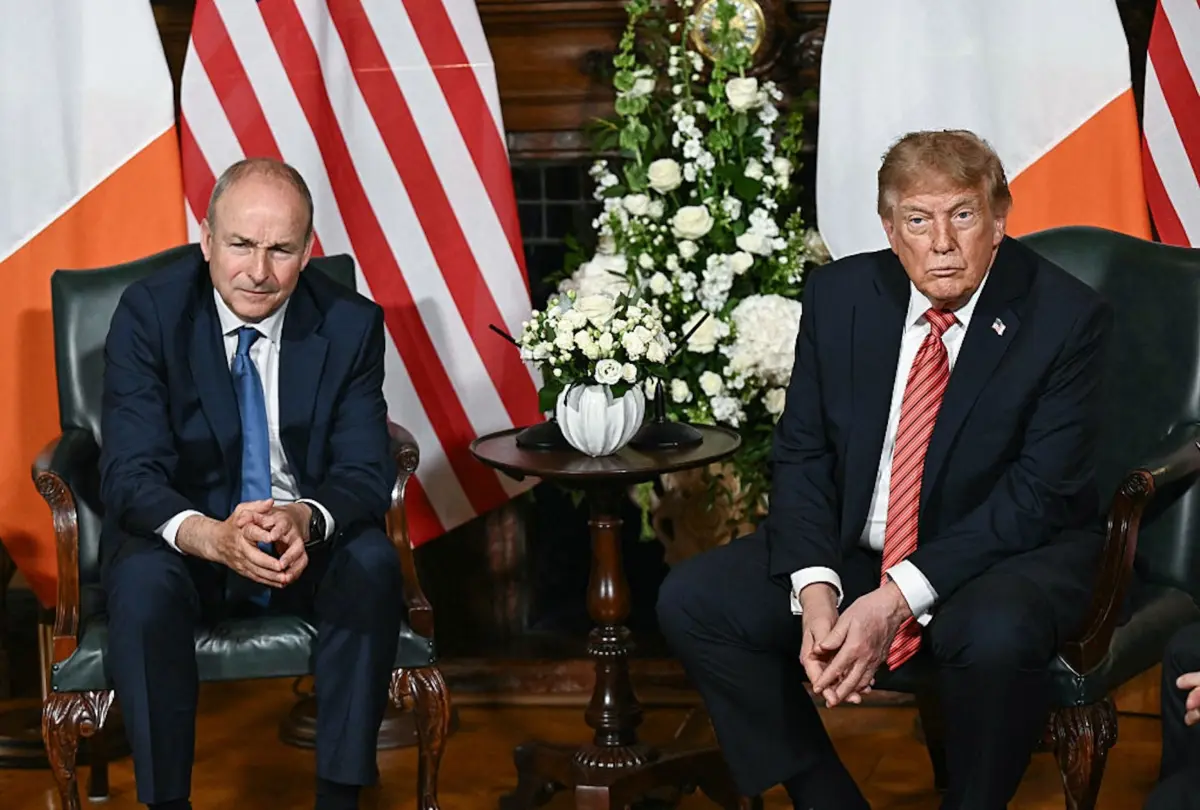
During what was ostensibly a leisure-meets-business excursion to Ireland in mid-September 2026, U.S. President Donald Trump upended diplomatic protocol by enthusiastically endorsing the unification of the Republic of Ireland and Northern Ireland. Dropped casually during a brief photo-op and handshake meeting with Irish Taoiseach Micheál Martin at Farmleigh House in Dublin, Trump’s remarks instantly hijacked the international news cycle.
The comments—delivering an unprompted verdict that a united Ireland "would be a fantastic thing" and "may as well happen now"—blundered into one of the most volatile and meticulously managed fault lines in modern European politics. While thousands of protesters demonstrated outside his County Clare golf resort and in Dublin over broader domestic and foreign policies, Trump’s off-the-cuff musings sidelined local sporting triumphs, confounded his own ideological allies in Northern Ireland, and left mainstream Irish politicians scrambling to manage a diplomatic headache they neither asked for nor welcomed.
This analysis examines the cascading fallout of Trump’s intervention, the complex historical and political architecture of the Irish border question, and the geopolitical subtext of a U.S. president using a European vacation to lob rhetorical hand grenades across the Atlantic.
Detailed Chronology: A Weekend of Golf, Protests, and Diplomatic Hand Grenades
The timeline of the September 2026 controversy underscores how a personal itinerary designed around sport quickly transformed into a geopolitical crisis:
- Friday, September 12, 2026: President Trump arrives in Ireland, bypassing traditional diplomatic channels for an unofficial visit centered primarily on attending the final rounds of the Irish Open golf tournament at a luxury resort he owns in County Clare.
- Friday Afternoon, September 12: Trump holds a brief media availability alongside Irish Taoiseach Micheál Martin at Farmleigh House in Dublin. Responding to an unprompted question from the press regarding the constitutional status of Northern Ireland, Trump declares: "I don’t want to cause any problems, but I’d love to see it unified. It’s going to happen eventually. It may as well happen now. I think it would be a fantastic thing." He adds a brief nod to reality, noting that "the U.K. will have something to say about it, obviously."
- Saturday, September 13: Thousands of anti-Trump demonstrators flood the streets of Dublin and gather near the perimeter of his County Clare golf club. Concurrently, political shockwaves ripple through Belfast and London as unionist leaders and British officials digest the American president’s intervention. Local sports coverage—which should have celebrated Irish golfer Shane Lowry winning the prestigious tournament—is entirely eclipsed.
- Sunday, September 14: Rather than walking back the remarks amid quiet diplomatic appeals from Dublin, Trump doubles down on his position during media engagements before boarding Air Force One. In a parting gesture, he tosses out an offhand promise to unilaterally eliminate U.S. tariffs exclusively on Irish whiskey, bypassing broader E.U. trade frameworks.
- Monday, September 15 onwards: Political analysts, foreign ministries, and trade specialists grapple with the long-term ramifications of Trump’s remarks, analyzing whether the statement was a calculated dig at British leadership or merely a characteristic impulse to dominate the global media landscape.
Supporting Context & Metrics: History, Ideology, and Pragmatism
To fully appreciate why Trump’s remarks caused such acute discomfort in political circles, one must examine the deep historical and socio-economic context that modern Irish and British leaders navigate with extreme caution.
The Partition and the Shadow of the Troubles
When the Anglo-Irish Treaty established the Irish Free State in 1922 following centuries of colonial rule and an intense war of independence, six northeastern counties—collectively known as Northern Ireland—voted to remain within the United Kingdom. This region possessed a distinct demographic majority of Protestant, British-identified citizens who wished to maintain the union.
What was initially envisioned by some architects as a temporary administrative boundary hardened into an entrenched reality. For decades, Northern Ireland operated under a unionist-dominated governance model that systemically marginalized the Catholic and nationalist minority, restricting economic opportunity and civil rights. This structural inequality eventually ignited "The Troubles" in the late 1960s—a brutal three-decade conflict involving republican paramilitaries (such as the IRA), loyalist paramilitaries, and the British Armed Forces.
The violence was only staunched by the historic Good Friday Agreement (GFA) of 1998, a delicate peace accord that sidelined the constitutional question of partition by establishing power-sharing institutions, open borders, and the principle that unification could only occur via concurrent consent-based referendums in both jurisdictions.
The Paradox of MAGA Unionism
One of the most ironic downstream effects of Trump’s comments is the acute ideological confusion it generated among Northern Ireland’s ardent unionists ("loyalists"). Historically, Protestant unionists in the North have aligned themselves with conservative, right-wing movements abroad, frequently embracing MAGA populism and vocal support for nationalist or hardline geopolitical stances elsewhere in the world. Trump’s casual dismissal of the union left these groups bewildered, exposing a disconnect between American populist rhetoric and the complex local nuances of British-Irish identity.
Priorities in the Republic of Ireland
In the Republic of Ireland, political parties—including Micheál Martin’s centrist Fianna Fáil (traditionally styled as the "Soldiers of Destiny" and founded on republican principles)—nominally support the concept of eventual unification. However, practical statecraft has firmly relegated the issue to the back burner.
Modern Ireland is a wealthy, progressive European economy grappling with intense, immediate domestic pressures:
- The Housing Crisis: Crippling supply shortages and soaring rental costs have made housing the primary electoral battleground.
- Healthcare Strain: Wait times and infrastructural deficits in the public health system dominate voter concerns.
- Immigration Pressures: Rapid demographic shifts and integration challenges have strained public services.
In this environment, forced acceleration toward unification is viewed by mainstream politicians not as a glorious nationalist crusade, but as an extraordinarily expensive, logistically nightmarish prospect that could destabilize the fragile peace won through the Good Friday Agreement. Economists estimate that absorbing Northern Ireland—whose public sector is heavily subsidized by the British Treasury—would impose tens of billions of dollars in annual fiscal burdens on Dublin.
Official Statements and Diplomatic Fallout
The international response to Trump’s remarks was characterized by careful diplomatic evasiveness from Dublin and icy silence or muted irritation from London.
- The Irish Government’s Stance: Taoiseach Micheál Martin’s administration adopted a posture of damage control. Privately exasperated, Irish officials emphasized that the constitutional future of the island is exclusively a matter for the people living on it, governed strictly by the mechanisms of the Good Friday Agreement. Publicly, government spokespersons sidestepped direct criticism of the U.S. president to avoid a retaliatory trade spat or a public spectacle.
- The British Reaction: Downing Street initially declined to engage directly with the remarks, though political insiders noted the timing. Analysts widely interpreted Trump’s unprompted commentary as a calculated diplomatic swipe at British Prime Minister Andy Burnham, whose government had recently broken ranks with Washington by executing a dramatic policy pivot regarding the ongoing conflict in Israel and broader Middle East strategy. By threatening the sacred cow of Northern Ireland’s constitutional settlement, Trump signaled his displeasure with British independence on the global stage.
- Trade Implications: Compounding the political friction, Trump’s parting promise to unilaterally lift U.S. tariffs on Irish whiskey—while leaving broader European Union spirits under punitive duties—sent shockwaves through Brussels and trade bureaucracies. Economists and trade lawyers immediately questioned the legality and execution of such a targeted exemption under World Trade Organization rules, though it served its immediate purpose: generating headlines and cementing Trump’s transactional approach to international diplomacy.
Future Outlook: Managing the Aftershocks
As the dust settles on Trump’s whirlwind Irish excursion, the long-term implications of his remarks will likely ripple through transatlantic relations and domestic politics in several distinct ways:
- Re-centering the Good Friday Agreement: British and Irish diplomats are expected to issue joint reassurances reaffirming their absolute commitment to the 1998 peace framework, signaling to international actors that constitutional changes cannot be decreed from a golf course clubhouse.
- Increased Volatility in Northern Irish Politics: Unionist parties, already unnerved by post-Brexit trade arrangements (the Northern Ireland Protocol), may use Trump’s comments to stoke fears of abandonment by international conservative allies, potentially complicating local power-sharing dynamics in Stormont.
- A Cautionary Tale for U.S. Foreign Policy: For future American administrations, the episode serves as a textbook example of the dangers associated with off-the-cuff commentary on deeply entrenched ethno-nationalist conflicts. What a populist leader views as a casual, crowd-pleasing soundbite is, to millions on the ground, a matter of fragile peace and historical trauma.
Ultimately, Trump’s Irish interlude demonstrated that even when operating outside official state protocols, the American president retains an unmatched capacity to disrupt delicate international equilibria purely for the sake of dominating the news cycle.
