

Executive Overview
For decades, frontend development has carried an unspoken, persistent friction. Every developer who has ever attempted to build a smooth, dynamic grid of cards fading in sequentially—the classic staggered cascade effect—knows the quiet frustration of implementation. It is an aesthetic pattern that looks effortless on the surface, yet building it has historically forced engineers into a corner, making them feel like they are engaging in architectural workarounds for a problem that the browser should solve natively.
The traditional options were invariably unappealing. Developers either relied on rigid Sass loops to spit out dozens of hardcoded :nth-child() selector rules, or they bypassed CSS entirely, injecting inline styles (style="--index: 3;") via JavaScript directly into the Document Object Model (DOM). Both approaches shared a fundamental design flaw: they forced engineers to explicitly inform the browser of information the browser already inherently possessed. The user agent constructed the DOM tree; it knew precisely which node was the third child. Yet, until recently, CSS was locked out of accessing that native intelligence.
That era of makeshift tooling is officially drawing to a close. Part of the CSS Values and Units Module Level 5 specification, the introduction of native tree-counting functions—specifically sibling-index() and sibling-count()—marks a structural turning point for web design. Approved via W3C CSS Working Group (CSSWG) issue #4559 after intensive deliberation, these functions allow developers to calculate dynamic layouts, staggered animations, proportional widths, and color wheels in a single line of CSS. They require no JavaScript event listeners, no mutation observers, and no build-time preprocessor loops. They work identically for five items or five thousand.
Detailed Chronology: From CSSWG Issue #4559 to Modern Baseline
The journey toward native tree-counting functions in CSS was neither sudden nor straightforward. It represents the culmination of years of developer advocacy, standards committee negotiations, and the gradual evolution of CSS from a simple styling document into a robust, Turing-complete styling language capable of complex mathematical processing.
The Origins of the Tree-Counting Proposal
The conceptual groundwork for sibling-index() and sibling-count() can be traced back to long-standing frustrations within the developer community regarding the limitations of CSS counters and selectors. While :nth-child() allowed for powerful element selection, it was strictly a matching mechanism, not a data-producing function. It could identify the third item in a list, but it could not output the literal integer 3 for use in a calc() expression.
To bridge this gap, CSSWG issue #4559 was formally opened, proposing native functions that could expose tree position data directly to property value declarations. For years, the proposal sat alongside other advanced layout discussions as engineers experimented with various stopgap solutions. Visionary frontend architects such as Roman Komarov developed ingenious $O(sqrtN)$ and tree-counting strategies using clever structural hacks, proving that complex calculations could be coaxed out of native CSS if developers were willing to sacrifice code readability and maintainability.
The Specification and Modern Browser Support
As the CSS Values and Units Module Level 5 draft matured, the W3C formalized the syntax. Both functions were designed to accept zero arguments, evaluating contextually based on the element’s position within its parent container.
The breakthrough implementation milestones arrived in mid-2025. Following extensive engine work, stable releases of Chrome and Edge (version 138) shipped native support for tree-counting functions in June 2025. Apple’s WebKit team quickly followed suit, introducing support in Safari 26.2.
While Firefox has lagged behind in stable releases, Mozilla’s official standards position remains formally positive, with active development tracking under Bugzilla issue #1953973. This momentum has pushed sibling-index() and sibling-count() steadily toward a true cross-browser Baseline, transforming what was once an experimental specification proposal into a dependable production tool for modern web architectures.
Supporting Context & Metrics: Deconstructing the Technical Mechanics
To fully appreciate the architectural shift represented by sibling-index() and sibling-count(), one must examine how they operate under the hood, how they differ from legacy approaches, and where developers must exercise caution.
The Power of Native Integers
Unlike the traditional counter() function—which returns a string and is artificially restricted to live inside the content property of pseudo-elements—sibling-index() and sibling-count() resolve directly to true <integer> values.
This distinction is vital. Because they output raw numbers, they integrate seamlessly into the modern CSS mathematical ecosystem. They can be piped directly into calc(), min(), max(), round(), mod(), and advanced trigonometric functions like sin() and cos(). When an engineer writes:
li
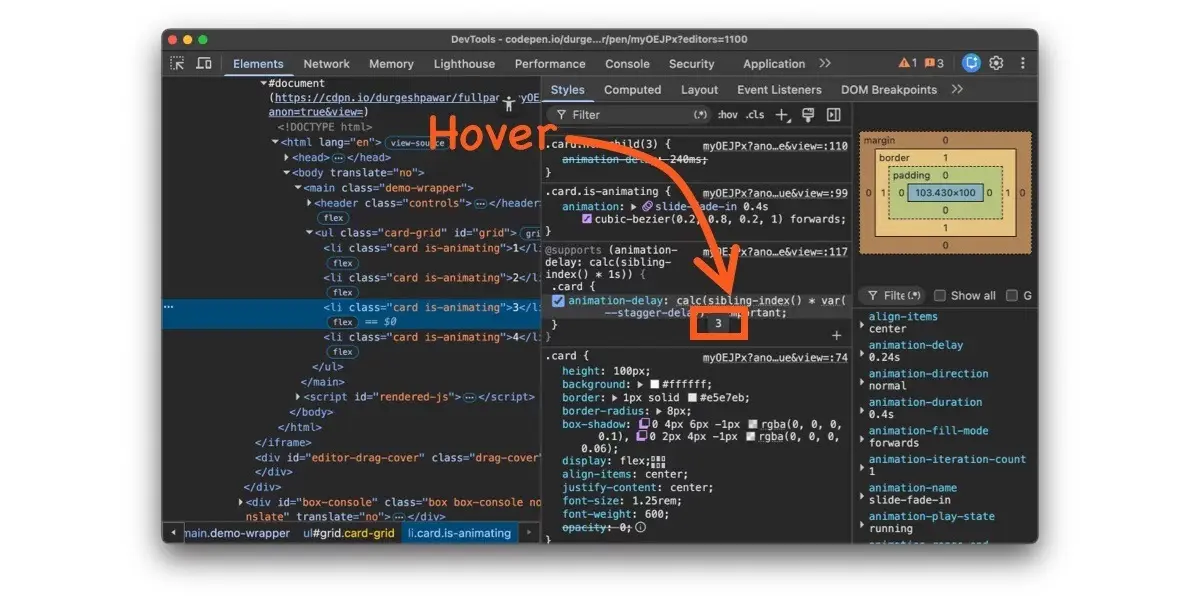
  animation-delay: calc(sibling-index() * 100ms);
The browser handles type coercion natively, spitting out a valid <time> value without requiring preprocessors, inline DOM injections, or runtime script execution.
Advanced Patterns Worth Stealing
Once developers accept that these functions are simply dynamic integers, a vast landscape of layout patterns opens up, effectively eliminating entire classes of utility JavaScript.
- Reverse Stagger Animations: By inverting the mathematical relationship, developers can force the final child to animate instantly while earlier items stagger backward:
.card animation: fade-in 0.4s ease both; animation-delay: calc((sibling-count() - sibling-index()) * 80ms); - Automatic Equal Widths: Tab components and navigation bars can automatically distribute their horizontal space without a single media query or resize observer:
.tab width: calc(100% / sibling-count()); - Dynamic Hue Distribution: Color palettes can be programmatically spread across the color wheel based on the exact number of rendered elements:
.swatch background-color: hsl( calc((360deg / sibling-count()) * sibling-index()) 70% 50% ); -
Pure CSS Radial Layouts: Generating circular or polygon layouts historically required heavy JavaScript coordinate calculation. Combined with native trigonometry, tree-counting collapses this into pure CSS:
.radial-item
  --angle: calc((360deg / sibling-count()) * sibling-index());
  --radius: 120px;

  position: absolute;
  left: calc(50% + var(--radius) * cos(var(--angle)));
  top: calc(50% + var(--radius) * sin(var(--angle)));
  transform: rotate(calc(var(--angle) * -1));
The Architectural Gotchas
Despite their elegance, tree-counting functions introduce subtle traps that can derail an unsuspecting codebase if developers do not account for them.

- Shadow DOM Scoping Boundaries: Tree-counting operates strictly on the DOM tree, not the flattened visual tree. Within Web Components, if a shadow root contains internal structural elements alongside a
<slot>, querying an internal wrapper withsibling-index()will return a static index based solely on the shadow tree’s direct children, ignoring all projected light DOM content. Furthermore, if an external stylesheet attempts to probe a component via::part(), the browser deliberately returns0as a security measure to prevent unauthorized structural inspection. - The Hidden Trap of
display: none: Because these functions evaluate the DOM tree rather than the layout tree, elements styled withdisplay: noneare still counted. If a search-filtering mechanism hides non-matching list items viadisplay: none, surviving visible items will retain their original, non-sequential indexes, creating unexpected visual gaps in staggered animations or radial menus. - Immediate Evaluation of Custom Properties: Centralizing an index assignment on a parent element—such as setting
--idx: sibling-index();on.parent—locks the value to the parent’s own sibling position, passing a single static number down to all children. The function must always be invoked directly on the target child elements that require individual indexing.
Official Statements and Industry Perspective
The architectural community has responded to the rollout of tree-counting functions with a mixture of immense relief and rigorous technical scrutiny.
Standards bodies and browser engineers have emphasized that these functions represent a deliberate shift toward empowering CSS to handle self-referential component styling without JavaScript intervention. In discussions surrounding the CSS Values and Units specification, working group members noted that the separation of layout intelligence from styling logic had become an unsustainable bottleneck for modern web applications. By allowing the styling engine direct read access to tree topology, the W3C has effectively closed a design gap that has persisted since the inception of CSS.
Prominent frontend educators and independent researchers—such as Juan Diego Rodríguez and Roman Komarov—have widely championed the specification while simultaneously publishing detailed guidance on graceful degradation. Industry consensus emphasizes that while tree-counting functions are exceptionally powerful, they must be deployed responsibly using feature queries like @supports (z-index: sibling-index()) to ensure that non-supporting browsers receive clean, static fallbacks rather than broken interfaces.
Furthermore, accessibility advocates have issued important reminders regarding semantic integrity. Because sibling-index() and sibling-count() govern purely visual presentation, they do not inherently alter source order or screen reader behavior. Developers relying on tree-counting math for complex UI reordering must continue to synchronize ARIA attributes—such as aria-posinset and aria-setsize—via JavaScript to ensure that assistive technologies maintain an accurate, accessible representation of the component structure.
Future Outlook: What Lies Beyond Level 5
As sibling-index() and sibling-count() establish themselves in stable browser environments, the CSS Working Group is already looking toward the horizon, mapping out future enhancements that will further expand the computational capabilities of style sheets.
Scoped Counting via Selectors
The most prominent extension currently moving through preliminary discussions (documented under CSSWG issue #9572) is the introduction of an optional of <selector> argument. Similar to how :nth-child(of .active) functions in modern CSS, a future implementation of sibling-index(of .active) would allow developers to count exclusively among siblings matching a specific filter. For dynamic user interfaces characterized by constant filtering and state toggling, this advancement will ensure continuous, gapless indexing without requiring invasive DOM node removal.
Vertical Tree Inspection: Children and Descendant Counts
Looking even further ahead, early-stage proposals such as children-count() and descendant-count() (tracked via CSSWG issues #11068 and #11069) point toward a comprehensive tree-inspection model. While sibling-index() and sibling-count() provide a horizontal view—answering the question of an element’s position among its peers—future vertical inspection functions would allow parent elements to query the volume of their offspring. This would unlock parent-driven container queries capable of radically restructuring layout rules based entirely on child density.
Conclusion
The frustration felt by generations of web developers writing repetitive :nth-child() loops was never a failure of imagination; it was a symptom of a missing primitive. With the widespread adoption of native tree-counting functions, CSS has crossed a major evolutionary threshold. The days of duct-taping preprocessor loops and JavaScript DOM injections to achieve basic staggered animations are coming to an end. The obvious solution finally exists, and web architecture is permanently better for it.