

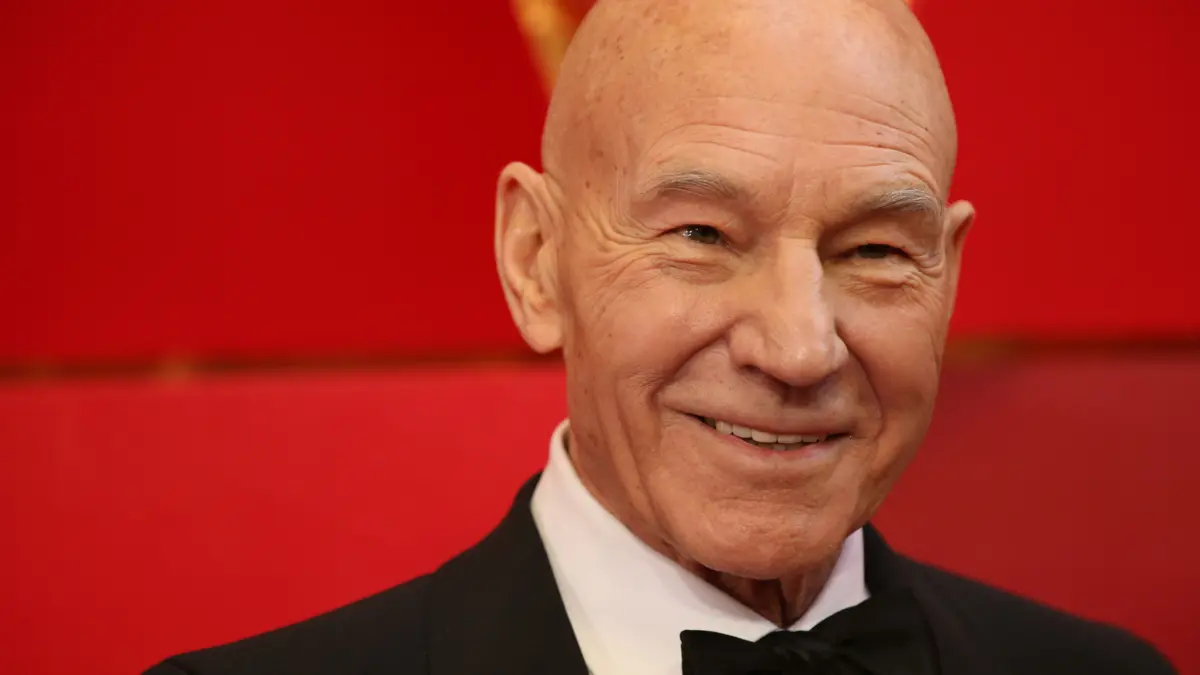
Executive Overview
The entertainment industry is in mourning following the passing of legendary actor Sir Patrick Stewart at the age of 89. Across a career spanning more than seven decades, Stewart redefined the possibilities of classical theater, science fiction, and modern comedy. From his commanding, authoritative presence on the stage with the Royal Shakespeare Company to his iconic television portrayals as Captain Jean-Luc Picard in Star Trek: The Next Generation and Professor Charles Xavier in the X-Men franchise, Stewart established a gold standard for gravitas and versatility.
Yet, as the global entertainment community reflects on his monumental contributions to dramatic arts, recent pop culture milestones have underscored an equally defining trait of his legacy: an extraordinary, self-aware charm that allowed him to effortlessly bridge the gap between high art and contemporary commercial media.
Nowhere was this cultural agility more apparent than in his memorable star turn in Paramount’s 2024 Super Bowl commercial. Deploying his trademark theatricality in a lighthearted, absurd setting—tossing the football-headed character Arnold Shortman across a snowy ridge—Stewart proved that his enduring coolness was matched only by his willingness to laugh at himself.
This retrospective examines Stewart’s life, career milestones, cultural impact, and the profound void his departure leaves in the global entertainment landscape.
Detailed Chronology
Early Life and Classical Foundations (1940s–1960s)
Born in Mirfield, Yorkshire, England, in 1940, Patrick Stewart experienced a difficult working-class childhood marked by poverty and domestic strife. However, his introduction to acting at a local youth theater provided a vital escape. Demonstrating exceptional raw talent, Stewart left school at age 15 to work as a local journalist while simultaneously throwing himself into amateur dramatics. His determination paid off when he won a spot at the prestigious Bristol Old Vic Theatre School in 1957.
By the early 1960s, Stewart was honing his craft on regional stages across the United Kingdom. His breakthrough into the theatrical elite arrived in 1966 when he joined the Royal Shakespeare Company (RSC). Over the next two decades, Stewart became a titan of British classical theater, earning critical acclaim for his intense, psychologically acute interpretations of complex Shakespearean antiheroes, including Macbeth, Antony, and King Claudius.
The Sci-Fi Renaissance and Global Stardom (1987–2000s)
Despite his deep-rooted theatrical pedigree, Stewart’s career underwent an unexpected, history-making transformation in 1987. Approached to star as Captain Jean-Luc Picard in a revived television franchise, Star Trek: The Next Generation, many Hollywood insiders doubted a classically trained Shakespearean actor could anchor a space-faring syndicated series.
Stewart silenced the skeptics immediately. Infusing Picard with moral authority, intellectual rigor, and quiet vulnerability, he transformed the character into a definitive television icon. He led the series for seven successful seasons, subsequently headlining four feature films that cemented Star Trek as a permanent fixture of modern mythology.
Before the dust had even settled on his Starfleet career, Stewart seized another monumental franchise role: Professor Charles Xavier in Bryan Singer’s X-Men (2000). As the empathetic, telepathic leader of the mutant superhero team, Stewart brought a grounded, philosophical weight to the comic book genre, paving the way for the modern cinematic superhero boom.
Late-Career Renaissance and Pop Culture Iconography (2010s–2024)
As he entered his later decades, Stewart defied industry norms by actively expanding his range into comedy, voice acting, and high-profile multimedia ad campaigns. He embraced absurdist humor through recurring voice roles in adult animated comedies like American Dad! and live-action appearances that subverted his serious persona.
This playful cultural ubiquity culminated in his unforgettable appearance in Paramount’s multi-property 2024 Super Bowl advertisement. Surrounded by a generation-spanning ensemble of pop culture royalty—including Drew Barrymore, Jeff Probst, Peppa Pig, and rock band Creed—Stewart stood out not merely as a legacy act, but as the comedic anchor of the piece. Shedding his heavy shearling coat to reveal vintage 1920s football gear, he humorously treated an innocent cartoon character like a pigskin, prompting a whispered, awestruck tribute from Reno 911! star Lieutenant Jim Dangle: "Damn, he’s cool."
Supporting Context & Metrics
To fully understand the weight of Stewart’s cultural footprint, one must look at the quantitative metrics of his career, alongside the economic and creative shifts he navigated across media.
- Longevity and Output: Stewart’s active performance career spanned over 70 years, encompassing more than 150 television and film credits, alongside hundreds of theatrical productions spanning the globe.
- Franchise Box Office Impact: Films featuring Stewart in leading or prominent roles have grossed in excess of $5 billion globally, driven largely by the X-Men series and Star Trek theatrical releases.
- Critical Accolades: Throughout his career, Stewart earned multiple Primetime Emmy Award nominations, Golden Globe nominations, Olivier Awards, and a Tony Award nomination. In 2010, he received a star on the Hollywood Walk of Fame and was knighted by Queen Elizabeth II for services to drama.
- The 2024 Super Bowl Effect: The Paramount commercial featuring Stewart was hailed by marketing analysts as one of the most effective cross-promotional campaigns of the decade. Leveraging nostalgia and cross-generational IP, the ad generated over 50 million digital views within 48 hours of airing, proving that Stewart’s star power remained commercially potent well into his eighties.
Official Statements
The global reaction to Stewart’s passing has triggered an outpouring of grief, respect, and admiration from colleagues, institutions, and cultural leaders alike.
"Sir Patrick Stewart was a giant among actors, a gentleman among men, and a cherished friend to millions. He approached every role—whether commanding the bridge of the USS Enterprise or trading comedic barbs on a freezing fictional mountain—with total commitment, brilliance, and an unmatched sense of joy. The universe is a little less bright without him."
— The Paramount Global Executive Team"Working alongside Patrick was the masterclass of a lifetime. He taught us that true greatness in acting does not come from taking yourself too seriously, but from respecting the audience enough to give them your absolute best, no matter the context. He was regal, he was hilarious, and above all, he was deeply kind."
— Collaborative Statement from the Cast of Star Trek: The Next Generation"We have lost a theatrical titan. Patrick’s contribution to the Royal Shakespeare Company and British drama as a whole is immeasurable. He bridged the gap between classical text and contemporary consciousness like no other actor of his generation."
— The Royal Shakespeare Company Directorate
Future Outlook
As the entertainment industry processes the loss of Sir Patrick Stewart, cultural critics and entertainment economists are left to ponder the legacy of an increasingly rare breed of artist: the classically trained polymath who could effortlessly command the stage of London’s West End, anchor a multi-billion-dollar sci-fi franchise, and wink at the audience in a high-budget commercial.
In an era dominated by algorithmic casting, digital de-aging, and hyper-segmented media markets, Stewart’s career serves as a masterclass in cross-demographic appeal. He proved that audiences do not neatly fit into demographic boxes; the same viewer who spent their youth analyzing his philosophical dilemmas as Captain Picard could roar with laughter watching him throw Arnold Shortman across a snowy ridge during the Big Game.
While future generations will continue to study his performances in Hamlet, Star Trek, and X-Men, it is his undeniable, effortless cool—the combination of uncompromising professional excellence and a profound, self-effacing warmth—that will ensure Sir Patrick Stewart remains an immortal figure in global pop culture. The slopes of Paramount Mountain, and the wider world of entertainment, will never be the same.