

Executive Overview
Amid an ongoing international conflict in Iran, fluctuating gasoline prices, and persistently low public approval ratings, President Donald Trump has maintained an unexpected and striking preoccupation: the physical restructuring and beautification of Washington, D.C.
An exhaustive analysis of public records, speeches, and official remarks from the first seven months of 2026 reveals that President Trump has devoted nearly 45,000 spoken words across 84 separate events—representing more than a quarter of his public appearances—to detailing his administration’s massive capital projects. Chief among these undertakings are the controversial construction of a multi-million-dollar White House ballroom, sweeping renovations to the Lincoln Memorial Reflecting Pool, and various other architectural updates to the nation’s capital.
While White House officials frame these monumental efforts as an essential beautification campaign to honor the United States’ upcoming 250th semi-quincentennial anniversary, political communication experts and public opinion polls paint a vastly different picture. Far from being a neutral administrative endeavor, Trump’s fixation on physical infrastructure reflects a deeply personalized philosophy of governance—one that prioritizes individual executive instinct and architectural dominance over institutional collaboration.
Furthermore, the public is profoundly divided. A comprehensive July Washington Post/Ipsos poll indicates that nearly two-thirds of Americans view these vanity projects with dissatisfaction or outright frustration. Yet, despite mounting legal pushback from federal appeals courts, fluctuating cost projections, and shifting narratives over structural damage, Trump continues to lean into real estate development as the ultimate manifestation of presidential power.
Detailed Chronology: From Concept to Courtrooms
The trajectory of President Trump’s architectural crusade over the past year and a half has been marked by rapid execution, shifting financial estimates, and dramatic friction with both the judicial and legislative branches.
The White House Ballroom: From 2011 Dream to Legal Battles
Trump’s desire to construct a large-scale event space at the executive mansion has deep roots. As early as 2011, he floated the idea of building a White House ballroom "free of charge" during a conversation with then-Obama adviser David Axelrod. By his first term, he frequently lamented the lack of a suitable indoor venue to host foreign dignitaries, famously remarking at a 2015 campaign event that hosting world leaders on the South Lawn risked embarrassing mishaps during inclement weather.
By February 2025, the concept transitioned into official policy. At a governors’ dinner, Trump underscored the necessity of a proper facility, noting that hosting foreign monarchs in soggy conditions was unacceptable. By October 2025, despite initial assurances that construction would not impact existing architecture, heavy machinery commenced the demolition of the White House’s historic East Wing.
The public justification for the project evolved significantly following a tragic shooting at the White House Correspondents’ Association dinner in April 2026. While previous messaging emphasized aesthetic luxury and military utility, Trump quickly pivoted to security metrics. He began heavily advertising the ballroom’s planned drone-proof and bullet-proof glass, presenting the architecture as an essential counterterrorism safeguard.
However, the endeavor faced fierce financial and legal scrutiny. Although the administration initially announced a $200 million price tag to be funded entirely by private donors and corporate contributions—such as Apple and Microsoft—investigative reporting by The Washington Post revealed contractor estimates soaring past $600 million, with taxpayers potentially footing half the bill.
The conflict culminated on August 7, 2026, when a federal appeals court ruled that the executive branch could not unilaterally proceed with the ballroom construction without explicit approval from Congress. True to form, President Trump announced plans to elevate the dispute to the Supreme Court.
The Reflecting Pool Saga and the Vandalism Retraction
Simultaneously, Trump turned his sights toward the National Mall, zeroing in on the Lincoln Memorial Reflecting Pool ahead of the nation’s 250th-anniversary celebrations on July 4. What began as a routine maintenance discussion rapidly devolved into a convoluted controversy involving inflated figures, shifting blame, and a high-profile criminal courtroom drama.
In late April 2026, Trump released a prerecorded video detailing the pool’s severe disrepair. By May, the project consumed nearly half of his public events, with the president offering wildly inconsistent cost comparisons. He repeatedly claimed that prior administrations under Barack Obama and Joe Biden had squandered anywhere from $100 million to $200 million on pool repairs—figures directly contradicted by historical records showing actual expenditures closer to $35 million. Meanwhile, Trump’s own projected budget for his overhaul fluctuated dramatically from an initial $1.5 million estimate up to $16 million by June.
Trouble struck in June when the newly installed pool liner began peeling away from the concrete floor. The administration initially pointed an accusing finger at vandals, leading U.S. Attorney Jeanine Pirro to secure felony and misdemeanor charges against several individuals, including Olympic canoeist David Hearn.
However, independent journalistic investigations and expert evaluations quickly dismantled the vandalism narrative. Faced with overwhelming evidence pointing toward shoddy installation and rushed contractor work to meet July 4 deadlines, federal prosecutors reversed course. On August 6, a federal judge formally dismissed all charges against Hearn and his co-defendants.
Despite the legal withdrawal and admissions of contractor error by the Justice Department, President Trump remained defiant. In subsequent public appearances and social media posts, he insisted that Pirro had "made a mistake" by dropping the charges, maintaining that hidden vandals—rather than rushed engineering—were ultimately responsible for the structural failure.
Supporting Context & Metrics: Analyzing the Rhetoric
To quantify the sheer scale of President Trump’s architectural fixation, PolitiFact conducted a rigorous empirical analysis of all public events, press conferences, signing ceremonies, and official remarks during the first seven months of 2026.
The Data Breakdown
- Total Spoken Volume: Trump devoted nearly 45,000 words exclusively to his capital construction projects between January and July 2026.
- Frequency: The projects were brought up at 84 distinct events across 66 individual days—accounting for more than 25% of all his public appearances during the period.
- Topic Ranking: In events where construction was broached, Trump spoke more about the physical projects than traditional policy cornerstones such as the national economy and immigration.
- The Competition: The only topic that outpaced construction in cumulative word count was the ongoing war in Iran, which totaled approximately 56,000 words across 73 events. Notably, while the Iran war dominated when Trump was responding to sudden press inquiries, construction projects consistently ranked as his #1 unprompted talking point during self-directed remarks, such as bill signings and executive order rollouts.
Expanding Horizons: Beyond the Ballroom and Pool
While the White House ballroom and the Lincoln Memorial Reflecting Pool accounted for roughly 65% of Trump’s construction-related rhetoric, his portfolio of planned and executed improvements expanded steadily over the year:
- The Kennedy Center: Following a vote by an appointed board to attach his name to the John F. Kennedy Center for the Performing Arts, Trump heavily criticized its existing structural condition and outlined sweeping overhaul plans.
- The White House Interior: Frequent boasts included the replacement of traditional marble flooring, the repair of peeling paint, the installation of a new granite walkway, and proposals for an expanded "Upper West Wing."
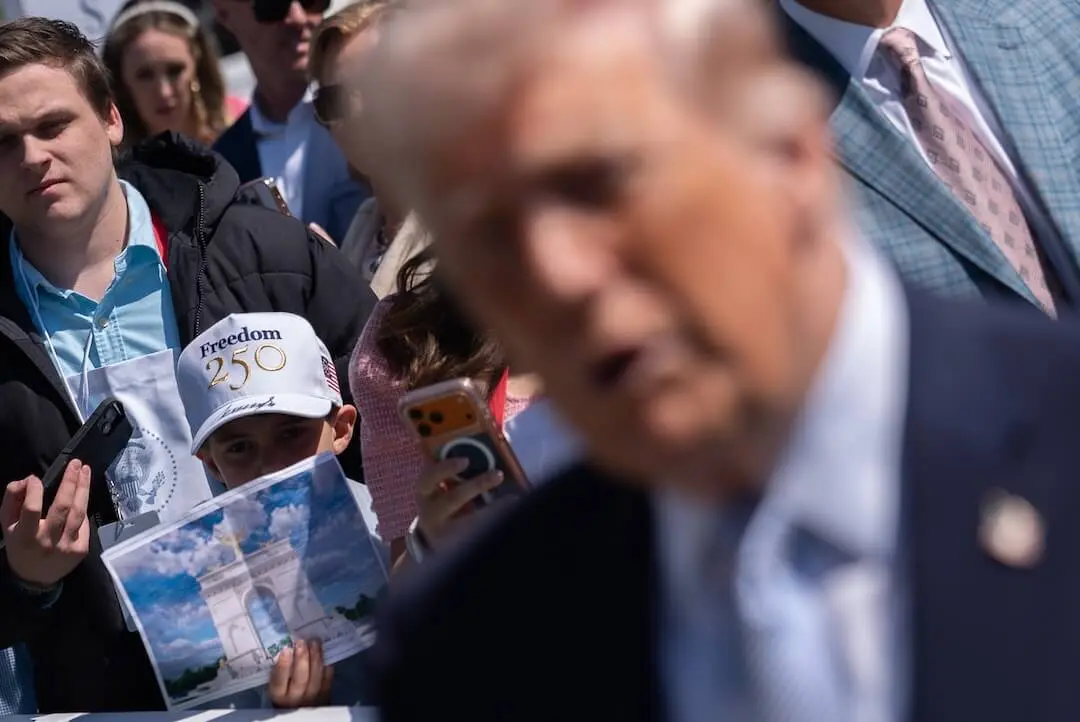
- Monumental Additions: The administration continued to push forward blueprints for a massive, 250-foot Triumphal Arch and the proposed National Garden of American Heroes.
Official Statements and Institutional Perspectives
The Administration’s Defense
Defending the administration’s aggressive timeline and financial outlays, White House spokesperson Davis Ingle emphasized the historic nature of the endeavor in an official email statement:
"No other president has done more to beautify our Nation’s interior than President Trump. From restoring our treasured landmarks, which had suffered years of abuse and vandalism, to cleaning our parks and the Reflecting Pool, President Trump’s bold vision ensured that America rang in its 250th birthday celebration with glory and pride."
Academic and Rhetorical Analysis
Political communication scholars suggest that Trump’s relentless focus on physical infrastructure offers a revealing diagnostic lens into his overarching theory of executive power.
Dr. Sam Martin, an associate professor of political communication at Boise State University, notes that the rhetoric fundamentally departs from traditional notions of presidential stewardship:
"The building and renovating reinforce a view of presidential power that I think has characterized Trump’s public rhetoric from the beginning. That effective government depends primarily on the judgment, instincts, and abilities of one exceptional individual rather than on constitutional processes or institutional collaboration."
Echoing this sentiment, Dr. Robert Rowland of the University of Kansas argues that Trump’s background as a commercial real estate developer heavily informs his governing style. By focusing on projects that "gleam," the president operates under the assumption that tangible physical changes serve as the most immediate and undeniable proof of success to the voting public.
Dr. Allison Prasch of the University of Wisconsin-Madison further observes that Trump’s developments are ultimately designed to outlast his physical tenure in office:
"The nation’s capital city was built to be seen and to display stories and symbols of what this nation has been, is, and will be. Trump wants to shape this national narrative, and do so in a way that his influence and eminence will outlast himself."
Public Opinion and the Partisan Divide
Despite the administration’s efforts to frame these projects as gifts to the American public, a July Washington Post/Ipsos poll highlights a stark disconnect between the White House and the electorate.
Overall, nearly two-thirds (approx. 66%) of Americans report feeling "dissatisfied" or "upset" regarding Trump’s ballroom, pool, and architectural initiatives. Conversely, only about one-third (33%) express satisfaction or enthusiasm.
This sentiment breaks cleanly along highly polarized political fault lines:
- Democrats: 90% express dissatisfaction or anger over the projects.
- Republicans: 68% view the initiatives favorably.
- MAGA Republicans: Support surges to 86% among self-identified movement loyalists, mirroring the broader cultural and political tribalism that defines contemporary American politics.
Future Outlook
As the legal battle over the White House ballroom heads toward a high-stakes confrontation at the Supreme Court, and as structural reviews of the National Mall continue, President Trump shows no signs of stepping back from his urban development campaign.
For the administration, these physical monuments represent a permanent architectural legacy—a tangible manifestation of executive strength designed to overshadow ongoing foreign policy pressures and domestic economic anxieties. For critics, congressional opponents, and the federal judiciary, however, the construction boom represents an alarming overreach of executive authority, characterized by inflated budgets, questionable contracting practices, and a disregard for institutional checks and balances.
As the nation moves past its semi-quincentennial celebrations, the debate over who controls the aesthetic and physical landscape of Washington, D.C., remains locked in a bitter struggle between presidential ambition and constitutional law.