When a corporate branding initiative fails, the autopsy rarely points to the final logo design stage. Instead, the breakdown almost always originates much earlier—deep within the strategy phase. Vague, overused corporate adjectives like “modern,” “trustworthy,” “premium,” “friendly,” and “disruptive” are left undefined, creating a chasm between what a brand intends to communicate and what designers are expected to produce.
To bridge this gap, creative teams must master what is known as the “pre-concept” phase. This crucial preliminary stage occurs after the initial project kickoff, but long before a designer opens Figma or sketches a single visual concept. By systematically researching brand context, uncovering hidden assumptions among stakeholders, and translating abstract strategic directions into a concrete visual foundation, organizations can eliminate guesswork. Ultimately, the pre-concept phase replaces subjective arguments about personal taste with objective, context-driven evaluations, ensuring that the first visual concepts hit the mark.
Detailed Chronology: Navigating the Pre-Concept Roadmap
A successful brand identity journey does not happen by accident; it follows a deliberate sequence of discovery, alignment, and translation. Moving from abstract business goals to tangible design parameters requires a structured, multi-stage approach.
Stage 1: Researching Brand Context and Clarifying Perception
A standard brand discovery workshop typically covers foundational topics: the core business model, overarching goals, product offerings, the competitive landscape, and the target audience. However, exceptional branding requires a deeper focus on perception.
As Marty Neumeier famously noted in The Brand Gap, "A brand is a person’s gut feeling about a product, service, or company." Because a brand ultimately lives in the minds of its audience, discovery workshops must clarify what perception the team is trying to engineer.
Consider the real-world example of a health-tech company seeking to reposition itself. Stakeholders universally agreed they wanted the brand to look "modern, trustworthy, and disruptive." Initially, "disruptive" implied a bold, unconventional aesthetic. However, deeper stakeholder discussions revealed a critical nuance: their primary clients were conservative government medical institutions. In this specific regulatory and institutional environment, visual rebellion would instantly erode credibility. Their definition of "disruptive" had to be expressed through clarity, uncompromising efficiency, and supreme confidence—not wild avant-garde styling.
To prevent such misalignments, design teams must interrogate abstract words:
What kind of "modern" are we targeting?
Trustworthy in what specific way?
Disruptive compared to whom?
How far can the brand deviate from category norms before alienating its core audience?
Words alone are rarely enough to guide a design team. To transition successfully from verbal strategy to visual direction, facilitators must employ active exercises that force stakeholders to engage with imagery, associations, and relative positioning.
As Jake Knapp emphasizes in GV’s Three-Hour Brand Sprint, "The point of these exercises is to make the abstract idea of ‘our brand’ into something concrete." Passive clients who merely receive strategy presentations often harbor hidden assumptions that derail later reviews. By making them active participants, internal disagreements surface early—long before they can compromise the design phase.
Exercise 1: Competitor Perception Mapping
Before the workshop, facilitators collect visible touchpoints of competitor brands (websites, interfaces, marketing assets). During the session, stakeholders plot these competitors onto a two-axis grid.
This exercise maps category perception rather than simple aesthetic preferences. For the health-tech firm, axes might range from Traditional to Progressive and Corporate to Human. For a fintech startup, axes might span Understated to Bold and Accessible to Exclusive. The true value of this map lies in the inevitable disagreements it sparks—revealing how different stakeholders interpret foundational traits like trust and innovation.
Exercise 2: The Visual Brand Driver
Next, the conversation turns inward using the Visual Brand Driver exercise. Stakeholders select images representing the company across unrelated categories: transport, typography, activity, furniture, mood, object, animal, architecture, and drink.
Crucially, these images must not reflect personal aesthetic preferences; they must metaphorically embody the company. If the enterprise were a vehicle, is it a quiet electric car, a high-speed bullet train, or a heavy-duty transport van? By analyzing the metaphors and accompanying adjectives, hidden contradictions and patterns emerge, providing rich raw material for the visual identity.
Stage 3: Building the Visual Foundation
With strategic assumptions unearthed, the next milestone translates shared understanding into a tangible visual foundation across three distinct, interconnected layers:
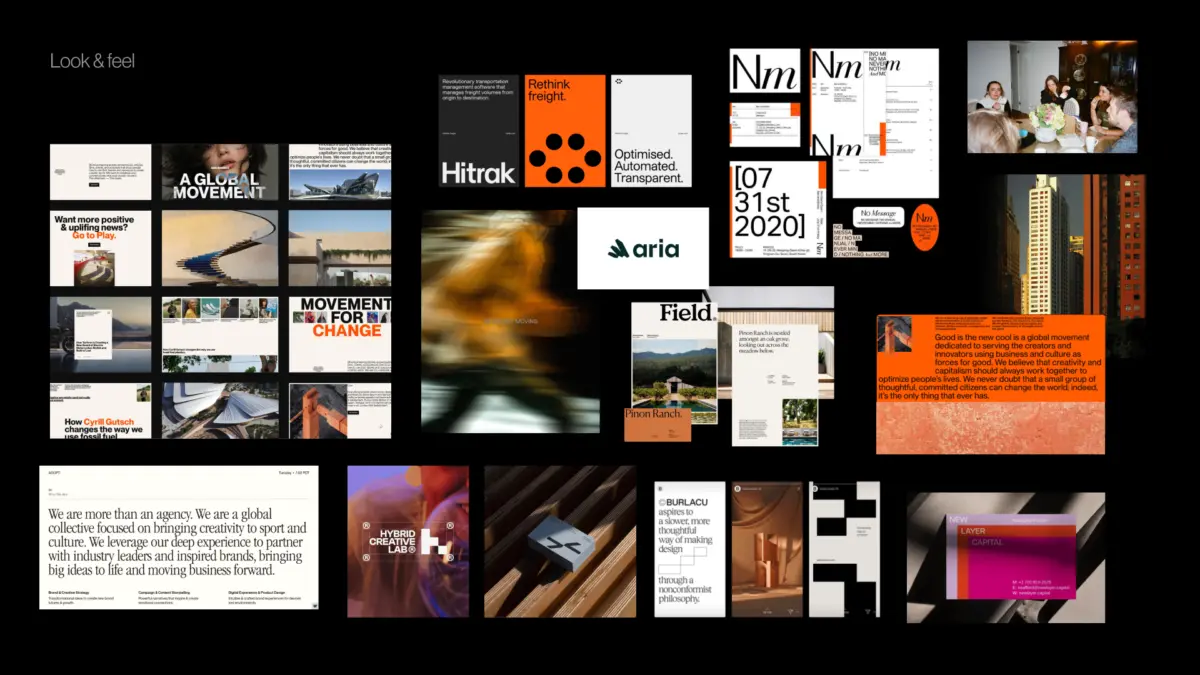
Look and Feel Boards: Curated reference boards used to discuss perception, category tension, and brand character before touching logos or color palettes.
Design Code: The translation of core brand ideas into specific visual principles. For instance, a brand promise of "research-backed support for real life" might manifest as clinical data snapshots, doctor consultations, and clean editorial layouts.
Brand Asset Direction: Early exploration of typography, color theory, photography style, and graphical language, setting clear design boundaries without predetermining the final logo.
Supporting Context & Metrics: The Cost of Skipping the Pre-Concept Phase
Industry data consistently highlights that revisions, scope creep, and stakeholder pushback are the primary drains on agency profitability and internal design team bandwidth. According to design operations benchmarks, projects that lack a formalized pre-concept or brand strategy phase experience up to 300% more revision cycles than those that invest upfront time in alignment frameworks.
Furthermore, qualitative UX research underscores the psychological impact of stakeholder participation. When executives are included in competitor mapping and visual driver exercises, their "buy-in" metrics increase exponentially. Instead of reacting defensively to creative concepts with vague statements like "I don’t like that color," trained stakeholders evaluate work against agreed-upon criteria: "Does this specific visual asset successfully communicate our commitment to institutional security?"
Official Statements and Industry Insights
Design leaders and brand strategists increasingly emphasize that technical execution tools (like Figma, Illustrator, or Blender) are secondary to the cognitive architecture established beforehand.
"The strongest visual concepts don’t start in Figma. They start with the right questions. When teams skip the pre-concept phase, they trade strategic clarity for premature execution, leading to endless revision cycles and misaligned brand perceptions."
— Leading Brand Identity Strategist
Industry veterans note that the democratization of design software has made technical polish cheap; what commands premium value is strategic clarity. By treating brand identity as a translation problem—moving from business strategy to human perception, and finally to visual code—teams can eliminate the subjective friction that plagues creative reviews.
Future Outlook: The Evolution of Brand Strategy in Digital Products
As digital products become more complex and competitive, the boundaries between product design, brand identity, and enterprise strategy are rapidly dissolving. Looking ahead over the next decade, the pre-concept phase will likely integrate deeper quantitative perception metrics and AI-driven sentiment analysis.
However, the core human element—facilitating workshops, interrogating hidden assumptions, and finding consensus among diverse stakeholder groups—will remain irreplaceable. Organizations that institutionalize the pre-concept phase will continue to build enduring, highly resilient brand identities. Those that rush straight to the canvas will continue to wonder why their visual concepts miss the mark. The future of branding belongs to teams who understand that before you can design how a brand looks, you must rigorously define what it means.