

Executive Overview
At the heart of nearly every known massive galaxy lies a supermassive black hole—a behemoth weighing millions to billions of times the mass of our Sun. These gravitational titans exert forces so extreme that they warp spacetime, bend light, and govern the structural evolution of their galactic hosts. Yet, for decades, these engines of the cosmos remained largely obscured unless active accretion illuminated their immediate surroundings.
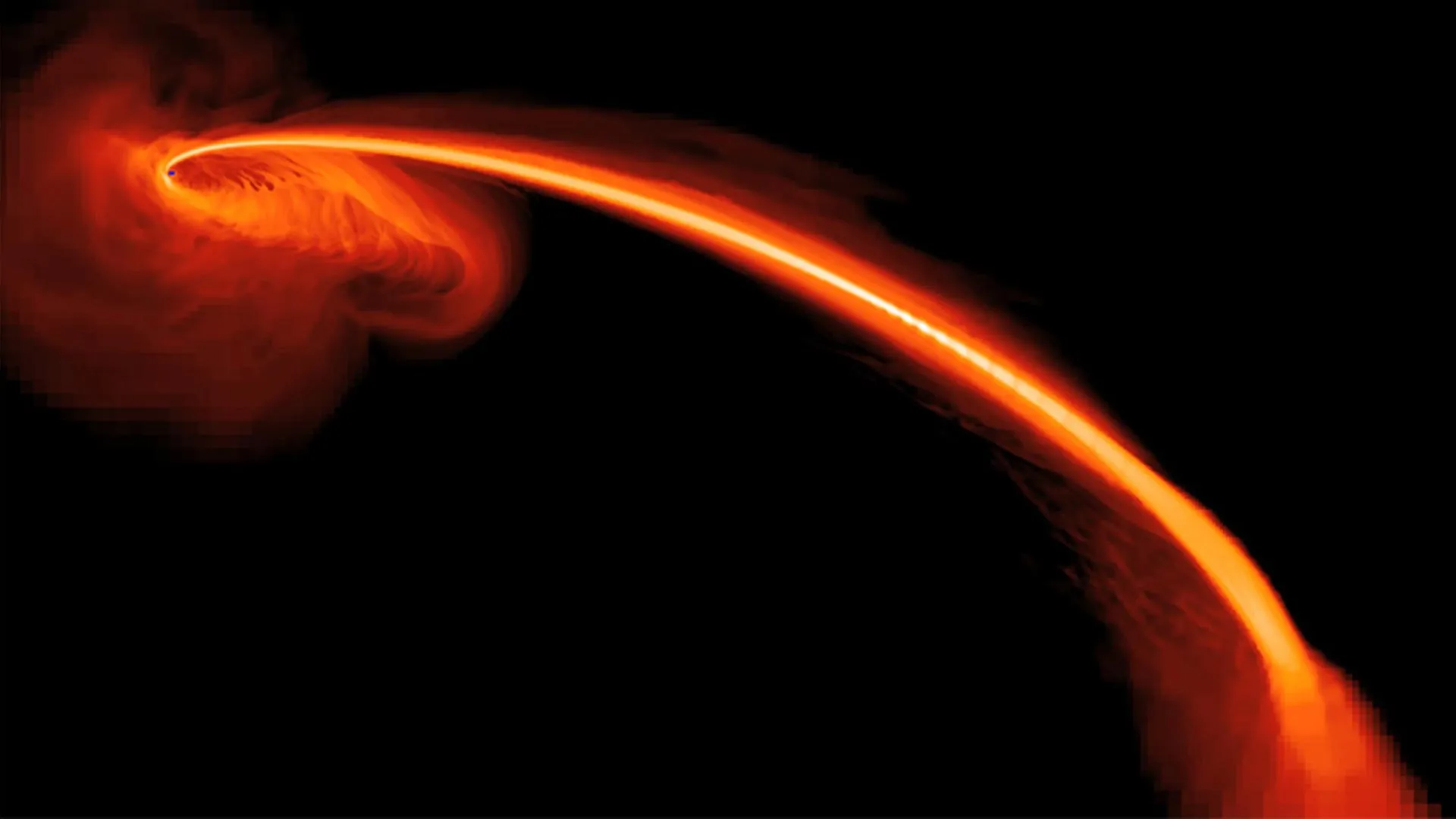
A rare observational phenomenon known as repeating partial tidal disruption events (rpTDEs) has granted astrophysicists an unprecedented window into these environments. When a wandering star passes perilously close to a supermassive black hole, it is not always immediately obliterated. In select instances, the star survives the initial gravitational onslaught, its core remaining intact as it settles into a highly eccentric orbit, returning repeatedly every few months or years to shed more of its mass. Each close approach yields a fresh flare of light, giving astronomers a dynamic, multi-stage chronicle of stellar destruction.
However, theoretical models have long collided with an observational paradox. Of the roughly ten repeating partial tidal disruption systems identified to date by wide-field time-domain surveys, four have exhibited flares that grow steadily fainter with each successive return. Standard hydrodynamical simulations repeatedly failed to replicate this diminishing brightness; even when a star lost less material on subsequent passes, the models stubbornly predicted flares of virtually identical peak luminosity.
Now, groundbreaking research spearheaded by astrophysicists at Syracuse University has resolved this two-year cosmological puzzle. Published in The Astrophysical Journal, the study reveals that a previously overlooked stellar characteristic—the star’s rotational velocity prior to its maiden encounter with the black hole—acts as the crucial missing variable. By accounting for a rapid initial spin, researchers have not only successfully simulated the observed fading flares but also tied the phenomenon to a violent galactic birth mechanism known as the Hills mechanism. This breakthrough offers profound implications for understanding exotic stellar dynamics both in distant galaxies and within our own Milky Way.
Detailed Chronology of the Discovery
The Puzzle of the Repeating Partial Disruption
The investigation began with a fundamental discrepancy between observation and theory. In a classical, full tidal disruption event (TDE), the differential gravitational pull across the diameter of a stray star—known as the tidal force—exceeds the star’s self-gravity, ripping it apart entirely. The resulting debris streams spiral inward, forming an accretion disk that releases intense radiation across the electromagnetic spectrum over weeks or months.
When an encounter is non-fatal, however, the star’s core retains its structural integrity, resulting in a partial TDE. In repeating systems (rpTDEs), this surviving core loops back for secondary, tertiary, and subsequent trimmings. Because wide-field time-domain surveys continuously scan large swaths of the sky, tracking transients whose brightness fluctuates over time, astronomers have been able to catalogue these repeating flashes with increasing precision.
Yet, theorists encountered an intractable roadblock when analyzing systems where the light curves progressively dimmed. Intuition suggested that stripping less material from the star during each successive orbit should yield weaker, dimmer flares. Hydrodynamical simulations, however, told a different story.
As the Syracuse team previously discovered, the black hole’s tidal forces do more than just strip matter; they also impart a powerful gravitational torque onto the surviving core, causing it to spin faster after each close encounter. This accelerated rotation fundamentally alters the dynamics of the stripped debris. Even though less mass is pulled away from the star, the heightened rotational velocity causes that material to return to the black hole more rapidly. This compressed fallback rate maintains a high peak accretion flow, compensating for the lower mass and resulting in flares of nearly constant peak brightness in theoretical models. For two years, this theoretical resilience baffled the research team.
The Turning Point: Pre-Encounter Stellar Rotation
The breakthrough materialized when the research team introduced a fresh physical parameter into their complex simulations: a star that was already spinning rapidly before its first gravitational rendezvous with the supermassive black hole.
Led by doctoral student Ananya Bandopadhyay, alongside postdoctoral researcher Benjamin Amend and Associate Professor Eric Coughlin of Syracuse University’s Department of Physics, the team modeled how pre-existing stellar spin interacts with the black hole’s tidal torques. Their findings indicate that a star already rotating at high speeds cannot be spun up nearly as aggressively during subsequent passages.
Without that dramatic post-encounter boost in rotational speed, the time required for the stripped debris to travel out on its elliptical trajectory and fall back toward the black hole remains relatively constant. Consequently, as the star sheds progressively less mass during each successive orbit, the peak fallback rate drops accordingly. For the first time, hydrodynamical models accurately reproduced the fading flares observed by astronomers in the cosmos.
Supporting Context & Metrics
To appreciate the scale and significance of these findings, it is helpful to examine the underlying mechanics and astrophysical metrics governing repeating partial tidal disruption events:
- Mass Discrepancies: Supermassive black holes typically range from $10^6$ to $10^9$ solar masses ($Modot$). The stars encountering them are generally Sun-like or lower-mass stars ($0.1 Modot$ to $1M_odot$).
- Structural Meringues vs. Onions: Low-mass stars possess low central concentrations—likened by Bandopadhyay to a "fluffy meringue"—making them structurally vulnerable and easily destabilized. Higher-mass stars feature dense, onion-like internal core concentrations that allow them to shed outer envelopes while preserving a resilient core.
- Observational Sample Size: Out of approximately 10 confirmed repeating partial tidal disruption event systems detected by modern time-domain surveys, a significant fraction (four systems) exhibit the anomalous, progressively dimming flare behavior that the Syracuse study successfully models.
- Timescales: The orbital periods of surviving stellar cores in rpTDE systems typically range from several months to a few years, defining the cadence of the recurring light bursts.
Official Statements and Expert Analysis
The theoretical implications of the study extend far beyond resolving a numerical discrepancy in flare brightness. They offer a unified explanation for how stars acquire the extreme orbital configurations necessary to initiate rpTDEs in the first place.
"We were puzzled by this for two years," notes lead author Ananya Bandopadhyay, reflecting on the stubborn refusal of standard simulations to yield fading light curves. The integration of pre-encounter spin transformed their theoretical framework from an observational mismatch into a predictive success.
Associate Professor Eric Coughlin emphasizes the broader puzzle of how these stellar systems are assembled in the first place: "It is also extremely difficult to ‘bind’ a star to a supermassive black hole so tightly that it orbits the black hole in a matter of months, and yet they seem to do so in rpTDEs."
To solve this orbital conundrum, the researchers turned to the Hills mechanism—a theoretical process originally proposed by astronomer Jack Hills in 1988. In this scenario, a binary star system—two stars tightly bound in mutual orbit—wanders too close to a supermassive black hole. The immense tidal field tears the binary apart. One star is ejected from the galactic center at hypervelocity speeds, while the companion star is captured into a tight, bound orbit around the black hole.
Importantly, stars within an extremely tight binary system naturally undergo tidal locking, where their rotational period matches their orbital period. Consequently, a compact binary possesses both the tight orbital separation required to produce a short-period rpTDE and the rapid pre-encounter stellar rotation demanded by Bandopadhyay’s new models.
"Ananya’s work demonstrates that each of these peculiarities can be explained by the same underlying phenomenon: the tidal destruction of a binary system and the capture of one of the stars," Coughlin states. "From a theoretical standpoint, this is a major step forward in our understanding of the physics at play in these systems."
Future Outlook and Astrophysical Implications
The ramifications of this research stretch deep into galactic dynamics, potentially illuminating phenomena much closer to home.
Coughlin points out that the Hills capture mechanism—invoked here to explain the origins of rapidly spinning stars in repeating partial tidal disruption events—may also account for many of the anomalous stars currently orbiting **Sagittarius A***, the supermassive black hole residing at the center of the Milky Way. Our galaxy’s core hosts populations of young, massive stars in close orbits that have long puzzled dynamicists, as local star formation under the intense tidal and radiative stress of a supermassive black hole is exceptionally difficult.
By establishing a clear bridge between binary tidal breakups, pre-encounter stellar rotation, and light-curve evolution, the Syracuse University team has provided observational astronomers with a powerful diagnostic tool. As next-generation astronomical facilities—such as the Vera C. Rubin Observatory’s Legacy Survey of Space and Time (LSST)—come online, they will uncover hundreds more transient disruption events.
Armed with these refined hydrodynamic models, researchers will be uniquely positioned to read the light curves of distant galactic flares like cosmic rosetta stones, using the death throes of stars to map the hidden architectures of supermassive black holes across the universe.