

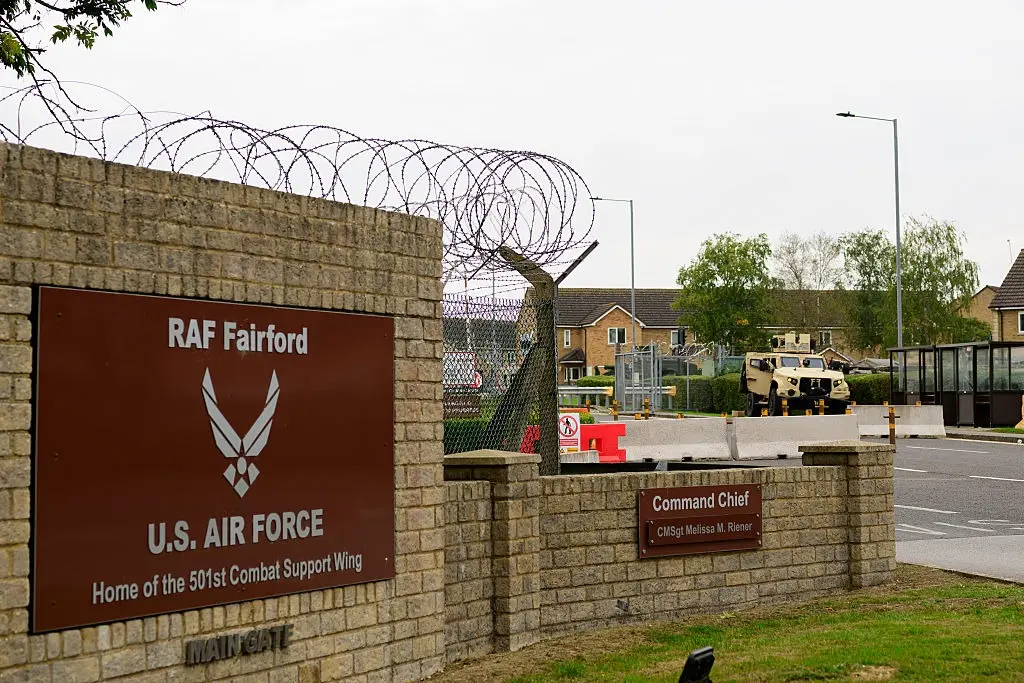
LONDON — British counterterrorism authorities, operating in close coordination with international intelligence partners, are aggressively investigating a potential Iranian connection following the high-stakes arrest of five men near a critical U.S.-utilized Royal Air Force base in Gloucestershire, England.
The security operation, which triggered a major incident response, the deployment of explosive ordnance disposal units, and the precautionary evacuation of dozens of nearby households, highlights escalating geopolitical tensions and the growing threat of state-sponsored sabotage targeting Western military infrastructure.
Executive Overview
The sweeping security operation unfolded in the dead of night following an emergency alert regarding suspicious vehicular movement in close proximity to RAF Fairford, a premier military installation in southern England heavily utilized by the United States Air Force. Armed officers intercepted three vehicles in the nearby village of Whelford, taking five suspects into custody.
Initially detained on severe explosives offenses, the suspects were subsequently re-arrested under counterterrorism legislation on suspicion of preparing acts of terrorism.
While British law enforcement and intelligence agencies have maintained a deliberate veil of discretion regarding formal attributions, sources close to the sprawling investigation indicate that a state-backed Iranian motive has emerged as the leading hypothesis. Investigators are also carefully weighing alternative scenarios, including potential Russian sabotage operations and localized extremist plotting.
The incident underscores the acute vulnerability of strategic military nodes amid broader, simmering conflicts in the Middle East. RAF Fairford has featured prominently in recent strategic deployments, serving as a staging ground for long-range American bombers executing critical operations. As investigators scour digital footprints, communications arrays, and material evidence recovered from the intercepted vehicles, the case has already ignited high-level diplomatic and political exchanges across the Atlantic.
Detailed Chronology of the Incident
The sequence of events that culminated in the declaration of a major incident began shortly after midnight on a Sunday, transforming a quiet rural enclave in Gloucestershire into the epicenter of a national security emergency.
The Midnight Interception
At approximately 12:15 AM, local police forces received a frantic civilian report concerning three suspicious vehicles traveling with unusual urgency along rural routes leading directly toward the perimeter of RAF Fairford. Given the heightened global threat matrix and the base’s high-value strategic profile, local authorities immediately escalated the alert level.
Armed response vehicles, dispatched under the coordination of regional command structures, intercepted the convoy in the nearby village of Whelford, situated just miles from the airfield.
Tactical Detainment and Explosives Act Arrests
Upon halting the vehicles, armed officers secured the perimeter and detained five adult males without immediate exchange of gunfire. A preliminary search of the vehicles yielded materials and devices that prompted the immediate deployment of specialist bomb disposal units.
The suspects were initially booked on suspicion of severe offenses under the Explosives Act, a legislative tool frequently utilized when chemical precursors, detonators, or suspicious mechanisms are recovered outside of authorized industrial or military contexts.
Escalation to Counterterrorism Powers
As forensic teams began the painstaking process of analyzing the contents of the intercepted vehicles, the investigation was swiftly escalated to Counter Terrorism Policing (CTP). Recognizing the systemic nature of the threat, detectives formally re-arrested all five suspects on suspicion of the commission, preparation, or instigation of acts of terrorism under Section 5 of the UK Terrorism Act 2006.
The Security Lockdown and Evacuations
To ensure public safety during the examination of the suspicious vehicles, law enforcement established a stringent 400-meter exclusion zone around the intercept site. Recognizing the potential lethality of the materials onboard, local authorities advised approximately 85 nearby households to evacuate their properties temporarily.
Emergency shelters were established in community centers, and local transport networks experienced rolling closures as bomb disposal technicians utilized specialized robotic equipment to inspect, render safe, and recover potential ordnance. By Sunday evening, police confirmed that the immediate physical threat had been contained, though forensic examination of the cordoned area and the seized vehicles stretched well into the following week.
Supporting Context & Metrics
To fully comprehend the gravity of the events at RAF Fairford, analysts must examine the geopolitical crossroads where local law enforcement intersects with international great-power competition.
Strategic Importance of RAF Fairford
RAF Fairford is not a standard Royal Air Force station; it is one of a select few European installations capable of hosting the United States Air Force’s heavy bomber fleet. Boasting an exceptionally long runway and specialized maintenance and command infrastructure, the base has routinely hosted B-1B Lancer and B-52H Stratofortress strategic bombers.
In recent months, as hostilities between Western powers, regional proxies, and Iran have intensified, Fairford has served as a critical operational hub. The base has facilitated deployments associated with long-range strike capabilities, including missions designed to deter Iranian aggression and degrade advanced missile infrastructure across the Middle East.
The Iranian Threat Matrix
The targeting—or perceived planning against—Western military assets by hostile nation-states represents a fundamental shift in modern security paradigms. State-sponsored sabotage often bypasses traditional asymmetric terror cells in favor of proxy networks, criminal sub-contractors, or specialized operatives tasked with reconnaissance, surveillance, and localized disruption.
In July, rhetoric surrounding the base reached a boiling point. Iran’s Islamic Revolutionary Guard Corps (IRGC) issued a thinly veiled and direct warning to the United Kingdom, explicitly condemning London for permitting U.S. bombers to operate from British soil. Tehran’s military leadership stated unequivocally that any foreign installations utilized to launch or support attacks against Iranian territory would be considered "legitimate targets" for retaliatory action.
Intelligence analysts note that Iran’s external operations wing—specifically the Quds Force—has historically utilized a mix of state intelligence officers, criminal syndicates, and radicalized proxies to scout, plan, and execute kinetic operations against Western targets abroad.
Multi-Vector Investigative Angles
While an Iran-linked motive is currently tracking as the primary investigative lead among intelligence officials, counterterrorism investigators are bound by professional protocol to maintain a holistic overview. The parallel avenues of inquiry include:
- Russian State Sabotage: Amid an ongoing hybrid war across Europe—marked by arson, cyberattacks on critical infrastructure, and covert reconnaissance targeting military logistics hubs—Russian intelligence services remain prime suspects in any unexplained security breach near NATO-aligned facilities.
- Islamist Extremism: Traditional domestic and international jihadist networks continue to pose persistent threats to Western military installations, prompting investigators to thoroughly check the digital footprints and travel histories of the five suspects for ties to known extremist organizations.
Official Statements and International Reactions
The high-profile nature of the arrests prompted immediate commentary from senior law enforcement figures and international political leaders, underscoring the trans-Atlantic dimensions of modern national security cooperation.
British Counterterrorism Leadership
Addressing the media during a press briefing at Scotland Yard, Deputy Assistant Commissioner Vicki Evans, the senior national coordinator for Counter Terrorism Policing, urged calm while emphasizing the seriousness of the ongoing inquiries.
"We are in the very early stages of a complex and fast-moving investigation," Evans stated. "Five men remain in police custody, and our teams are working around the clock to establish the full timeline, intent, and connections of those involved. I want to reassure the public that the immediate incident has been safely contained, but our presence in Gloucestershire and across supporting regions will remain elevated as we follow every available lead."
Evans declined to comment directly on specific foreign state involvements, adhering to standard British investigative protocol which avoids public speculation regarding active state actors while judicial processes are underway.
International Political Interventions
The case gained an unexpected diplomatic layer when former U.S. President Donald Trump publicly addressed the incident during a press appearance on Sunday. Trump asserted that U.S. and British intelligence agencies had maintained active surveillance on the suspects prior to their interception, claiming the operation successfully neutralized a high-impact plot.
"We had them under investigation," Trump told reporters. "They were looking to do big damage to our fort."
Trump’s remarks pointed to a high degree of intelligence sharing between Washington and London, highlighting how joint oversight often tracks transnational threats long before tactical interdiction occurs. However, British authorities pointedly declined to formally confirm or deny Trump’s characterization of the surveillance timeline, maintaining a strict firewall between political commentary and active investigative disclosures.
Local officials in Gloucestershire expressed gratitude to the emergency services and bomb disposal squads, emphasizing the resilience of the local community in the face of sudden disruptions and evacuations.
Future Outlook and Strategic Implications
As the investigation enters its next critical phase, the fallout from the RAF Fairford arrests is expected to reverberate across European defense and intelligence communities for months to come.
Legal and Judicial Proceedings
The five suspects, whose identities have been withheld pending formal charging decisions, face interrogation by specialized counterterrorism detectives. Under British counterterrorism law, police can hold suspects for extended periods before formally charging them or applying for judicial extensions. Prosecutors are currently reviewing forensic evidence recovered from the seized vehicles, including encrypted communications devices, mapping software, and chemical traces.
Reinforcement of Base Security
In the wake of the incident, the Ministry of Defence, in close consultation with U.S. Air Forces in Europe (USAFE), has ordered an immediate review of security postures across all military installations hosting allied assets on British soil. Enhanced patrols, upgraded perimeter surveillance, and tightened access-control protocols are expected to remain in place indefinitely.
The incident serves as a stark reminder that the theater of modern geopolitical conflict is no longer confined to distant battlefields. As state adversaries increasingly resort to gray-zone tactics, sabotage, and covert operations within Western borders, the vigilance of local law enforcement and the seamless integration of international intelligence networks remain the ultimate bulwark against catastrophic security failures.