

Executive Overview
In a groundbreaking leap forward for clean energy technology, an interdisciplinary research team has uncovered a fundamental mechanism of solid oxide cells that challenges decades of conventional electrochemical engineering assumptions. For the first time, scientists have demonstrated that a single silver ($textAg$) nanocatalyst can dynamically alter its primary active reaction sites depending on the operational mode of the device—switching entirely between generating electricity and producing green hydrogen.
Led by Professors WooChul Jung and Jeong Woo Han of the Department of Materials Science and Engineering at Seoul National University (SNU), alongside Professor Sang Ouk Kim’s team at the Korea Advanced Institute of Science and Technology (KAIST) and Dr. Beomgyun Jeong’s research group at the Korea Basic Science Institute (KBSI), the study sheds critical light on the complex behavior of metal nanocatalysts. Their findings resolve a long-standing mystery in electrochemistry: whether catalytic activity predominantly occurs directly on the surface of the nanoparticle or at the triple-phase boundary where the catalyst, electrode, and gas phase meet.
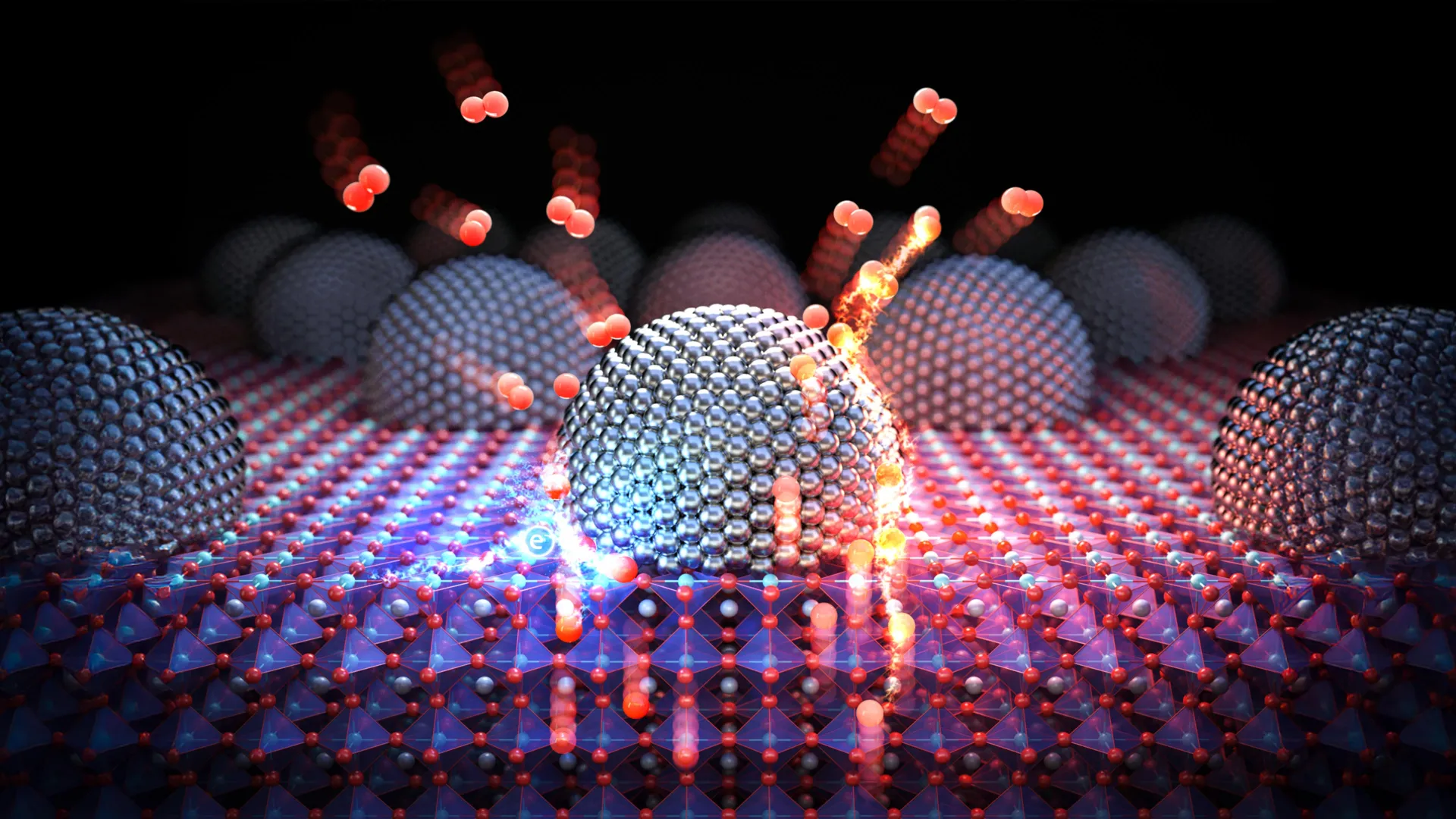
The answer, as the team discovered, is both—depending on which direction the energy flows. When a solid oxide cell operates in fuel-cell mode to generate electricity, the primary electrochemical reactions concentrate heavily along the boundary interface between the silver nanoparticles and the underlying perovskite oxide electrode. Conversely, when the system reverses to operate in electrolysis mode—splitting water molecules to yield clean hydrogen—the active reaction zone migrates entirely to the exposed outer surface of the silver nanoparticles themselves.
This behavioral duality shifts the paradigm for next-generation energy storage and conversion devices. Published in the prestigious journal Energy & Environmental Science and featured prominently as an Outside Back Cover article, the research provides a new architectural framework for designing high-performance solid oxide cells (SOCs). By recognizing that active sites and reaction mechanisms are environmentally fluid rather than static, materials scientists can now independently engineer the catalyst-electrode interface and the catalyst surface. This targeted approach promises to drastically enhance the efficiency of distributed combined heat and power (CHP) systems in urban architectures and lower the electrical energy penalties traditionally associated with renewable-driven green hydrogen production.
Detailed Chronology of the Breakthrough
Unraveling the Complexity of Solid Oxide Interfaces
For years, the development of solid oxide cells has been hampered by a fundamental knowledge gap regarding air electrode dynamics. While metal nanocatalysts were widely known to improve cell performance and reaction kinetics, researchers struggled to pinpoint their exact operational mechanics. Real-world electrodes possess highly tortuous, complex microscopic architectures, making it nearly impossible to isolate where and how nanocatalysts participate in oxygen reduction (electricity generation) versus oxygen evolution (hydrogen production).
To overcome this analytical bottleneck, the collaborative research team abandoned traditional, structurally chaotic electrodes in favor of a meticulously engineered model system. Instead of relying on random distributions, the scientists fabricated model electrodes featuring uniform metal nanoparticles arranged in precise, highly ordered spatial patterns with controlled sizes and distinct spacings. This custom platform allowed the team to systematically evaluate several high-potential metal nanocatalysts—including silver, cobalt, palladium, and platinum—deposited onto thin-film perovskite oxide substrates.
Pinpointing the Catalyst: The Superiority of Silver
Through rigorous electrochemical testing under controlled gas and thermal conditions, the team evaluated each metal’s ability to accelerate oxygen-related reactions. Among all the candidates tested, silver ($textAg$) emerged as the clear frontrunner, demonstrating the most dramatic catalytic enhancement for oxygen exchange kinetics.
With silver chosen as the primary subject of investigation, the researchers manipulated the size, distribution, and geometric spacing of the nanoparticles. By systematically altering these structural parameters while monitoring electrochemical output, the team unlocked the core secret of the silver nanocatalyst: its ability to completely relocate its active operational zones based on the electrochemical task at hand.
Mapping the Dual-Site Mechanism
The team’s controlled experiments revealed two distinct operational regimes:
- The Electricity Generation Phase (Oxygen Reduction Reaction – ORR): When the solid oxide cell was driven to produce electricity, the electrochemical reaction rates scaled directly with the total length of the boundary line where the silver nanoparticles met the underlying oxide electrode. This confirmed that the peripheral interface acts as the primary catalytic workspace during power generation.
- The Hydrogen Production Phase (Oxygen Evolution Reaction – OER): When the operating voltage was reversed to split water and generate hydrogen, the reaction kinetics shifted dramatically. Reaction rates no longer correlated with the perimeter length, but instead scaled directly with the total surface area of the silver nanoparticles. This proved that the exposed outer facets of the silver particles take over as the principal reaction sites during hydrogen evolution.
To confirm these physical observations at the atomic scale, the team deployed advanced synchrotron-based ambient-pressure X-ray photoelectron spectroscopy (AP-XPS) at the Pohang Accelerator Laboratory (PAL). Coupled with rigorous density functional theory (DFT) atomic-scale calculations, the analysis revealed that the silver nanoparticles actively modify the electronic structure of the underlying electrode surface during oxygen reduction to facilitate electron transfer. During oxygen evolution, however, the silver atoms reconfigure their local electronic landscape to drastically lower the energy barrier required for oxygen atoms to recombine into diatomic $textO_2$ molecules and release into the gas phase.
Supporting Context & Metrics
The Versatility and Promise of Solid Oxide Cells
Solid oxide cells represent a critical pillar in the global transition toward sustainable energy infrastructure. Unlike low-temperature fuel cells, operating at elevated temperatures (typically between 500°C and 800°C) allows SOCs to achieve exceptionally high thermodynamic efficiencies and utilize non-precious catalysts for various reactions.
The technology’s true strength lies in its reversibility:
- Power Generation Mode (Solid Oxide Fuel Cell – SOFC): By feeding hydrogen, natural gas, or biofuels alongside oxygen, the device generates clean electricity while outputting high-grade waste heat. This thermal byproduct can be captured for industrial processes or district heating in distributed combined heat and power (CHP) systems, pushing total system efficiencies past 80%.
- Hydrogen Generation Mode (Solid Oxide Electrolysis Cell – SOEC): By applying electrical energy derived from renewable sources (such as wind or solar) alongside steam, the cell splits water molecules into green hydrogen and oxygen. Because the process occurs at high temperatures, it requires significantly less electrical input than conventional room-temperature liquid water electrolysis, making it one of the most cost-effective pathways for large-scale green hydrogen generation.
Methodological Innovation: The Ordered Nanoparticle Platform
The success of this research hinged on the creation of a sophisticated model electrode platform. By decoupling nanoparticle size from inter-particle spacing, the team neutralized the confounding variables that typically plague electrochemical analysis in porous, disordered electrodes. This standardized methodology not only validated the dual-site behavior of silver but also established a universal testing paradigm that can be adapted to evaluate other catalytic materials. The platform holds immediate promise for studying electrochemical conversion devices, advanced sensors, and solid-state oxygen separation membranes.
Official Statements from Research Leadership
The collaborative nature of this breakthrough brought together top-tier materials scientists from South Korea’s leading academic and research institutions.
Dr. Jinwook Kim, the lead researcher on the study—who completed the work as a postdoctoral researcher and is transitioning to an assistant professorship in the Department of Materials Science and Engineering at the University of Seoul—emphasized the broader implications for energy device manufacturing:
"Our findings prove that nanocatalysts are not passive accelerators that perform uniformly across all operational phases. Their active zones and underlying mechanisms are fluid, adapting directly to the systemic flow of energy. Recognizing this duality is essential if we are to push the boundaries of solid-state electrochemistry."
Reflecting on the overarching significance of the study, Professor WooChul Jung of Seoul National University stated:
"This research is fundamentally significant because it moves beyond qualitative observation to quantitatively evaluate the performance of nanocatalysts while mapping their exact, shifting reaction sites and atomic-scale operating mechanisms. We plan to establish this dynamic framework as a universal design principle applicable to a wide array of advanced energy conversion materials."
Future Outlook and Commercial Implications
A New Architectural Paradigm for Energy Devices
The revelation that silver nanocatalysts alter their reaction sites based on operational mode calls for a total overhaul of how air electrodes in solid oxide cells are designed. Historically, engineers attempted to optimize electrodes using a "one-size-fits-all" approach, balancing porosity and composition to suit both fuel-cell and electrolysis modes simultaneously.
Armed with this new insight, materials engineers can now pursue independent dual-optimization strategies:
- Optimizing the Interface: To boost electricity generation efficiency, manufacturing techniques can be refined to maximize the perimeter length of the catalyst-electrode boundary, enhancing electron-transfer kinetics during the oxygen reduction reaction.
- Optimizing the Surface: To maximize green hydrogen production rates in electrolysis mode, fabrication processes can focus on tailoring the exposed surface area, morphology, and crystal facets of the silver nanoparticles to expedite oxygen recombination and release.
Impact on Reversible Energy Systems and the Hydrogen Economy
These design strategies are particularly transformative for Reversible Solid Oxide Cells (R-SOCs). R-SOCs are capable of seamlessly transitioning between power generation and hydrogen production within a single unified unit. By utilizing catalysts engineered to excel at both the interfacial boundary and the particle surface, future R-SOC systems can operate with minimal efficiency degradation over thousands of charge-discharge cycles.
For residential and commercial real estate, optimized distributed energy systems featuring advanced solid oxide architecture could provide localized, reliable heat and power while storing excess renewable energy as green hydrogen during peak generation hours. In industrial sectors—such as steel manufacturing, ammonia synthesis, and chemical refining—the reduction in electrical energy required for high-temperature steam electrolysis will lower the levelized cost of green hydrogen, accelerating the global decommissioning of fossil-fuel-reliant processes.
As research teams worldwide begin adopting the ordered nanoparticle model platform to study alternative catalytic metals (such as palladium, cobalt, and platinum alloys), the transition toward highly efficient, durable, and economically viable solid oxide energy systems draws substantially closer to reality.
Funding and Acknowledgments
This research was generously supported by the Ministry of Science and ICT and the National Research Foundation of Korea (Grant Nos. RS-2024-00452853 and RS-2025-00521316). Synchrotron-based ambient-pressure X-ray photoelectron spectroscopy (AP-XPS) analyses conducted at the KBSI-PAL 8A2 AP-XPS beamline were made possible through the collaborative support of the Pohang Accelerator Laboratory (PAL), POSTECH, and the Korea Basic Science Institute (KBSI).