

Executive Overview
In the rapidly accelerating landscape of artificial intelligence and digital content creation, few brand revivals are as fascinating—or as unexpected—as the modern incarnation of LimeWire. Once universally recognized in the mid-2000s as a notorious peer-to-peer file-sharing client that inadvertently shaped the early days of digital media distribution, the brand has undergone a profound structural metamorphosis. Today, LimeWire has re-emerged as a cutting-edge generative AI content publishing platform, studio, and decentralized marketplace.
By marrying state-of-the-art machine learning models with blockchain technology, LimeWire has positioned itself at the intersection of creative empowerment and Web3 monetization. The platform allows users of all technical backgrounds to generate high-fidelity digital art, photographs, and media using leading foundational models, while seamlessly transforming these creations into ownable, tradable Non-Fungible Tokens (NFTs). Furthermore, the platform dismantles traditional creator-economy paradigms by offering aggressive ad-revenue-sharing models and a proprietary utility token, LMWR.
This comprehensive report examines LimeWire’s technological architecture, its evolving suite of generative AI tools, its intricate monetization and royalty structures, and the broader implications of its entry into the creator economy.
Detailed Chronology: The Transformation of LimeWire
To understand LimeWire’s current positioning in the generative AI ecosystem, it is vital to contextualize its journey across two distinct technological epochs.
Era 1: The P2P File-Sharing Phenomenon (2000–2010)
Founded in 2000 by Mark Gorton, LimeWire originally operated as a Java-based file-sharing client utilizing the Gnutella network. During the peak of the MP3 revolution, it became a cultural touchstone, rivaling (and eventually succeeding) Napster as the go-to utility for downloading music, movies, and software. However, the platform’s decentralized architecture and widespread copyright infringement led to catastrophic legal battles with the Recording Industry Association of America (RIAA). In October 2010, a federal judge ordered a permanent injunction halting the distribution and operation of the original LimeWire software, effectively ending its first life.
Era 2: The Web3 and AI Renaissance (2022–Present)
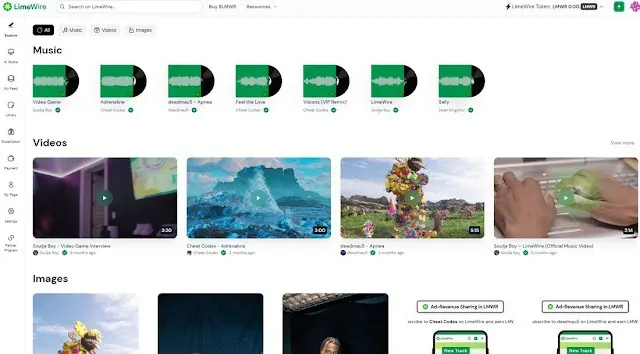
Following a decade of dormancy, the LimeWire brand was acquired by new ownership (led by brothers Julian and Paul Zehetmayr) with the intent of pivoting the historic name into the legal, regulated digital assets space. Initially launched as a digital collectibles marketplace for music and art—attracting major cultural figures such as Deadmau5, Soulja Boy, and Sean Kingston—the platform quickly recognized the transformative wave of generative artificial intelligence.
By late 2022 and into 2023, LimeWire transitioned into an AI-first content studio. It integrated advanced image generation models, launched its native utility token ($LMWR) via public sales and exchange listings, and instituted a robust infrastructure designed to automate the minting, sharing, and monetization of synthetic media. Today, the platform operates not merely as a tool for creating art, but as an integrated ecosystem where AI generation meets decentralized finance and creator monetization.
Supporting Context & Metrics: Inside the LimeWire AI Studio
LimeWire Studio functions as an all-in-one creative workspace. Rather than requiring users to piece together disparate software packages for image generation, upscaling, minting, and publishing, LimeWire integrates these functions into a unified browser-based dashboard.
The Technological Stack: Generative AI Models
At the core of LimeWire’s content generation capabilities is its multi-model architecture. The platform supports several industry-standard and cutting-edge generative models, ensuring that users can achieve diverse aesthetic outcomes:
- Stable Diffusion (2.1 & XL): Provides robust open-source image generation capabilities, allowing for high-detail, prompt-accurate renderings across photorealistic, illustrative, and abstract styles.
- DALL-E 2: Integrated to offer OpenAI’s advanced contextual understanding and surrealist design capabilities.
- Proprietary AI Models: In addition to third-party integrations, LimeWire is actively developing its own proprietary AI models to ensure exclusive features, faster rendering times, and customized design styles for its user base.
Aesthetic Versatility and Customization
The platform is engineered to accommodate creators of varying skill levels—from absolute novices utilizing simple text prompts to digital artists employing complex negative prompts, samplers, and seed adjustments. Users can effortlessly toggle between distinct visual genres, including:
- Cinematic and photorealistic renderings
- Digital painting and concept art
- Pixel art and retro aesthetics
- Anime and stylized illustration
- Analog film simulations and vintage photography
Automated Blockchain Minting
Once a user generates an image, graphic, or multimedia asset, LimeWire removes the technical friction traditionally associated with Web3. With a single click to publish, the platform automatically mints the creation as an NFT on either the Polygon or Algorand blockchains. This automated process permanently stamps the digital asset with a unique cryptographic signature, establishing provenance, authenticity, and verifiable ownership.
Official Economic Architecture & Revenue Models
Perhaps LimeWire’s most disruptive feature is its approach to the creator economy. Traditional social media and content platforms often capture the vast majority of ad revenue while offering creators negligible compensation. LimeWire addresses this imbalance through a multi-tiered economic framework.
1. Ad-Revenue Sharing
When creators publish their AI-generated images, music, or videos publicly on LimeWire, their content becomes discoverable to the wider community. As other users view, interact with, and engage with these creations, ad revenue is generated. LimeWire distributes up to 70% of all generated ad revenue directly back to the content creator. This creates a passive income stream for designers and digital artists who experiment with AI tools.
2. The LMWR Token Economy
All earnings distributed by LimeWire are paid out in LMWR tokens, the platform’s native cryptocurrency.
- Liquidity and Exchange Access: Creators can withdraw their monthly LMWR earnings and trade them on major global cryptocurrency exchanges, including Kraken, ByBit, and Uniswap.
- Platform Utility: Beyond cash-out options, LMWR tokens serve as internal fuel. Users can utilize their tokens to purchase additional generation credits, pay for advanced prompt features, and access specialized platform services.
3. Creator Subscriptions and Secondary Royalties
LimeWire grants creators absolute control over how their work is distributed:
- Public Access: Maximizes reach, ad impressions, and community trading of minted NFTs.
- Subscriber-Only Exclusivity: Allows creators to gate premium content behind a paywall, offering an intimate, exclusive feed for dedicated superfans.
- Secondary Market Royalties: Whenever a creator’s minted NFT is traded on the secondary market within the LimeWire community, the original creator automatically earns a 2.5% royalty fee, ensuring ongoing passive benefits from successful digital assets.
4. Subscription Pricing Tiers and Credit Structures
To accommodate casual hobbyists alongside professional enterprise creators, LimeWire operates a tiered subscription model that scales generation limits, rendering speeds, and revenue shares:
- Free Tier:
- Cost: $0 / month
- Credits: 10 free credits (permitting up to 20 AI image generations per day)
- Ad Revenue Share: 50%
- Basic Tier:
- Cost: $9.99 / month
- Credits: 1,000 credits/month (up to 2,000 image generations)
- Perks: Early access to new AI models, 50% ad revenue share, Pro profile badge, faster generation, and ad-free experience.
- Plus Tier:
- Cost: $29 / month
- Credits: 3,750 credits/month (up to 7,500 image generations)
- Perks: Early access to models, 60% ad revenue share, Pro profile badge, and priority rendering.
- Pro Tier:
- Cost: $49 / month
- Credits: 5,000 credits/month (up to 10,000 image generations)
- Perks: Early access to models, 70% ad revenue share, Pro profile badge, and full creation history.
- Advanced / Ultimate Tier:
- Cost: $99 / month
- Credits: 11,250 credits/month (up to 22,500 image generations)
- Perks: Maximum priority rendering, early model access, 70% ad revenue share, and full enterprise-level profile features.
Future Outlook
As the generative AI market matures, platforms that merely offer image-generation interfaces risk commoditization. LimeWire’s strategic roadmap indicates a clear understanding of this challenge.
Expansion into Music and Video Generation
While the platform currently anchors its utility in AI image generation, executive disclosures point toward an aggressive expansion into AI music and video generation tools. Given the brand’s historic roots in the music industry—and its early adoption by notable musicians like Deadmau5 and Soulja Boy—the introduction of generative audio and video suites could position LimeWire as a formidable competitor in multimedia synthetic content creation.
Democratizing Digital Art and Web3
By abstracting away the complex technical hurdles of blockchain deployment (such as manual gas fees, smart contract deployment, and decentralized wallet management), LimeWire acts as a vital bridge between Web2 users and Web3 economies. It transforms passive consumers of artificial intelligence into active digital entrepreneurs.
Conclusion
LimeWire’s evolution from a controversial 2000s peer-to-peer file-sharing client to a sophisticated, AI-driven creative studio is one of the most compelling narratives in modern tech history. By successfully synthesizing advanced generative models, automated NFT minting, generous ad-revenue-sharing agreements, and a functional token economy, LimeWire has carved out a unique and resilient niche. As the platform prepares to roll out advanced audio and video capabilities, it stands ready to play a defining role in shaping the future of digital content creation, ownership, and monetization.