For thousands of aspiring copywriters and digital content creators, the journey into the gig economy begins with a familiar ritual: staring at a blinking cursor, drafting a handful of cold outreach emails, pressing "send," and waiting for the floodgates of opportunity to open. Predictably, what follows is an echoing silence.
Most freelancers operate under the dangerous assumption that a single, well-crafted introductory email is enough to secure a lucrative contract. When prospects fail to reply within 24 hours, these writers throw their hands up in frustration, blaming market saturation, low-ball budgets, or bad timing.
According to sales intelligence and industry veteran Sean Ogle, founder of Location Rebel, this premature surrender is the single biggest mistake holding freelance writers back from hitting their first major financial milestones—such as scaling past the $1,000-per-month threshold. The hidden differentiator between starving creators and six-figure independent contractors isn’t necessarily superior writing talent; it is tenacity, systematic follow-up cadences, and hyper-personalized outreach. In a digital landscape drowning in AI-generated spam and generic pitches, mastering the art of the persistent, respectful check-in is no longer just a nice-to-have skill—it is the ultimate catalyst for business survival and growth.
Detailed Chronology: The Evolution of Cold Outreach and the Follow-Up Imperative
To understand why follow-ups dictate long-term success in freelance writing, one must analyze the typical lifecycle of a cold outreach campaign.
Phase One: The Initial Outreach and the Myth of the "One-Shot" Win
When freelancers begin pitching prospective clients—whether through Letters of Introduction (LOIs) or targeted service pitches—they generally experience a steep psychological learning curve. Crafting an effective initial email requires researching a brand, identifying a content gap or operational bottleneck, and presenting a concise value proposition.
Understandably, after investing 20 to 30 minutes crafting a single tailored email, the writer expects a prompt acknowledgment. Yet, industry metrics confirm that the initial conversion rate for a first-touch cold email is exceptionally low. Prospects are inundated with hundreds of messages daily, ranging from software sales pitches to administrative demands. A first email rarely sparks an immediate transaction because the timing rarely aligns precisely with an active, urgent hiring need.
Phase Two: The Silence and the Drop-Off Point
Historically, over 70% of freelancers abandon their outreach efforts entirely after the first unanswered email. Convinced that silence equals rejection, they scrub the prospect from their radar and pivot to fresh leads. This phenomenon represents a massive systemic leak in the freelance pipeline.
Ogle emphasizes that silence rarely means "no." More often, it means "not right now." A marketing director might love your portfolio samples on a Tuesday morning, only to be pulled into an emergency product launch by Tuesday afternoon, burying your email beneath a mountain of operational priorities.
Phase Three: The Pivot to Structured Cadences
Freelancers who achieve breakthrough success transition away from erratic, one-off emailing and embrace structured follow-up cadences. By staggering communication across predictable intervals—typically spacing the second email 2 to 5 days after the first, followed by quarterly or seasonal check-ins—writers transform from transient annoyances into reliable, persistent fixtures in a client’s inbox.
This chronology proves that landing a client is rarely a sprint; it is an endurance race governed by timing, visibility, and strategic positioning.
Supporting Context & Metrics: The Data Behind Persistence
In the world of B2B sales and freelance client acquisition, data consistently disproves the fear that following up is an inherently annoying practice. In fact, empirical sales metrics reveal that the vast majority of profitable business agreements happen well after the initial point of contact.
The Sales Statistics Breakdown
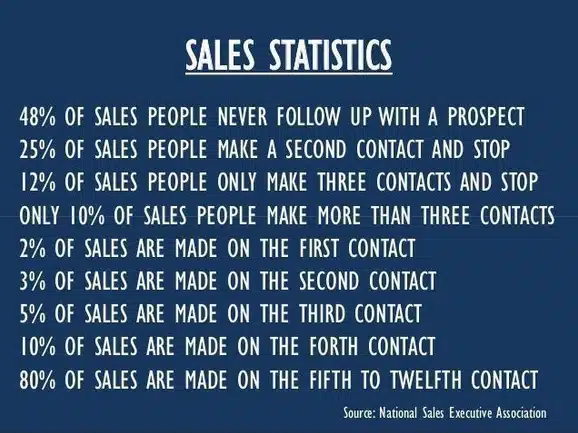
Industry data regarding sales touchpoints reveals a striking reality about human responsiveness:
2% of sales are made on the first contact.
3% of sales are made on the second contact.
5% of sales are made on the third contact.
10% of sales are made on the fourth contact.
80% of sales are made between the fifth and twelfth contact.
When evaluated against these metrics, a freelancer who stops after one or two emails is deliberately abandoning up to 90% of their potential revenue. The numbers do not lie: persistence pays exponential dividends.
The Psychology of "Right Place, Right Time"
Why do follow-ups work so effectively months down the road? The answer lies in the volatile nature of corporate marketing budgets and agency workloads.
At the exact moment a freelancer sends an initial cold email, the target client may have a fully staffed internal team or an existing roster of reliable writers. However, the corporate landscape shifts rapidly:
Existing writers burn out, miss deadlines, or raise their rates.
Companies secure new funding rounds and suddenly expand their content output.
Marketing managers launch unexpected Q3 or Q4 campaigns that overwhelm current resources.
If a freelancer has maintained a disciplined follow-up schedule—checking in quarterly or aligning messages with seasonal business shifts (such as year-end wrap-ups or New Year planning)—they occupy prime real estate in the client’s mental ecosystem. When a sudden writing vacancy opens up, the client does not need to post a job listing on a saturated public board; they simply look at the most recent, polite, and professional email sitting at the top of their inbox.
Official Insights & Methodologies from Industry Leaders
Sean Ogle, drawing on more than a dozen years of
operational experience building online businesses through Location Rebel, breaks down the tactical mechanics of how to execute follow-ups without crossing the line into digital harassment.
The Fine Line Between Helping and Spamming
A primary hesitation among new freelancers is the fear of being perceived as a nuisance. Ogle addresses this concern directly by defining the difference between value-driven outreach and indiscriminate spam.
"Offering to help is not annoying; spamming is. And if they tell you to stop emailing them, take their email off your follow-up list."
Spam is characterized by generic, unpersonalized copy sent en masse with no regard for the recipient’s business model. Conversely, a thoughtful follow-up acts as a professional reminder. Ogle suggests leveraging calendar-based talking points to anchor these check-ins naturally. For instance:
Q4 / Late Autumn: Offering assistance with end-of-year content backlogs, holiday campaigns, or last-minute writing requests before budgets reset.
Mid-January: Wishing the team a Happy New Year and inquiring about new content initiatives for the upcoming fiscal quarters.
Spring and Summer: Checking in during transitional operational periods when companies re-evaluate their editorial calendars.
The Dangers of Generic AI Outreach
The proliferation of generative artificial intelligence tools has introduced a new hurdle for legitimate freelancers. Inboxes are flooded with low-effort, AI-generated pitches that lack human nuance, often accompanied by automated daily follow-ups that sound robotic and insincere.
Ogle warns that this flood of low-quality automation damages the reputation of all independent creators. To rise above the noise, freelancers must inject authentic personalization into their outreach.
Fortunately, hyper-personalization does not require hours of exhaustive research per lead. According to Ogle, customizing just the opening sentence—referencing a recent company milestone, a specific blog post published by the client, or an insightful podcast appearance—instantly separates a professional writer from the automated masses.
The Power of the "Easy Out"
One of Ogle’s signature conversion strategies is concluding outreach messages with what he terms the "easy out." By giving the prospect a graceful, low-pressure way to decline or defer the conversation (e.g., "If you’re fully staffed right now, no worries at all—just let me know and I’ll check back in later this year"), the writer removes psychological friction. This non-intrusive approach keeps communication channels wide open and preserves professional dignity.
Future Outlook: Systems, Tools, and Scaling Your Freelance Pipeline
Managing a multi-stage follow-up cadence for dozens—or even hundreds—of prospective clients can quickly become overwhelming if managed strictly through memory or disorganized sticky notes. To build a sustainable, scalable freelance writing business, professionals must implement robust tracking systems.
Modern CRM Integration vs. Manual Tracking
While a traditional spreadsheet can suffice during the nascent stages of freelance outreach, modern creators are increasingly adopting specialized technology to automate administrative friction.
Streak for Gmail: For freelancers living inside Google Workspace, tools like Streak transform a standard Gmail inbox into a lightweight, free Customer Relationship Management (CRM) platform. Users can monitor when emails are opened, attach detailed notes to specific contacts, and schedule automated reminders for the next designated follow-up interval in their cadence.
AI-Assisted Outreach Management: Beyond simple spreadsheet tracking, sophisticated freelancers are utilizing advanced large language models (such as Claude or ChatGPT) to manage their pipeline. By updating an AI instance with outreach logs, dates, and prospect details, writers can query the system for automated periodic summaries—tracking metrics such as total cold emails sent, discovery calls booked, and conversion rates achieved. As Ogle notes, this functions essentially as having an unfailingly dedicated marketing assistant on your payroll.
The Path to Your First $1,000 and Beyond
Ultimately, breaking through the income glass ceiling in freelance writing is an exercise in operational discipline. The hardest components—building a portfolio, writing samples, and mastering baseline grammar—are only half the battle.
The remaining 50% of success belongs to the mechanics of distribution, tracking, and relentless, respectful follow-up. By treating outreach as a structured, metric-driven system rather than a series of emotional lottery tickets, freelance writers can reliably fill their pipelines, build enduring B2B relationships, and secure the financial freedom they set out to achieve.