

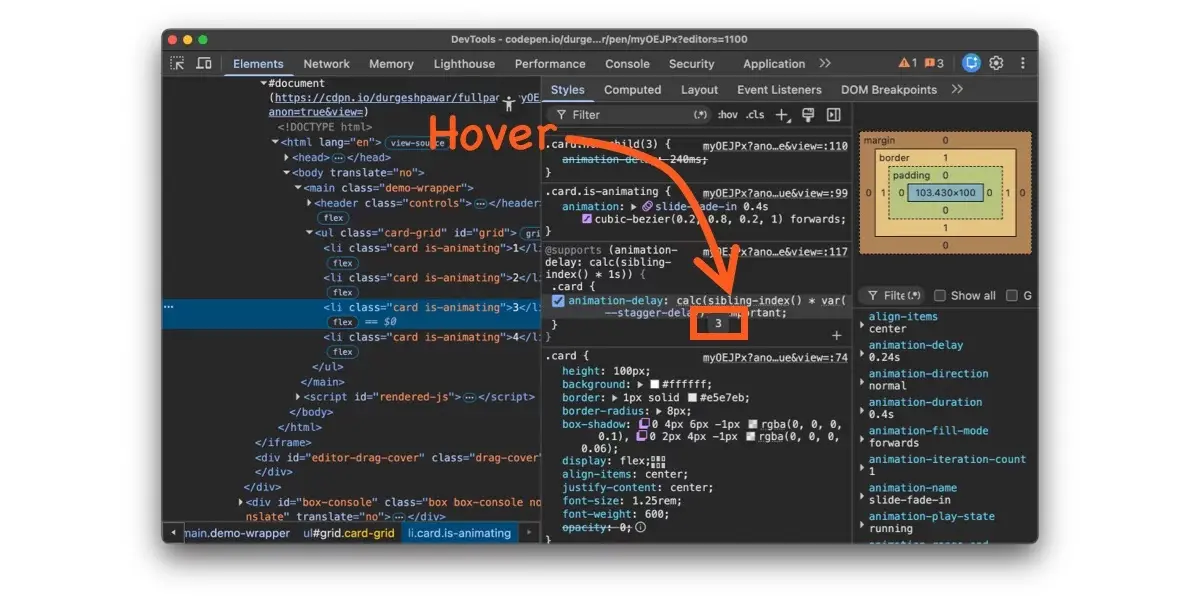
For as long as modern web development has relied on responsive grids and component-driven architectures, front-end engineers have harbored a quiet, collective frustration.
Consider a ubiquitous user interface pattern: a dynamic grid of cards that fade into view sequentially, creating a smooth, staggered cascade effect. Visually, it is effortless, polished, and contemporary. Yet, the architectural reality of producing that effect has long forced developers to compromise. Historically, implementing a staggered animation across a list of items required one of two flawed approaches: generating dozens of brittle, hardcoded :nth-child() rules via preprocessors like Sass, or leaking layout concerns into JavaScript by injecting inline styles directly into the DOM.
Both methods share a fundamental architectural sin: they force the developer to manually inform the rendering engine of information the browser already inherently possesses. The browser parses the document, builds the DOM tree, and inherently knows that a given node is the third child of its parent. The data has always been present; CSS simply lacked the vocabulary to access it.
That missing vocabulary has finally arrived.
Part of the CSS Values and Units Module Level 5 specification, the introduction of native tree-counting functions—namely sibling-index() and sibling-count()—represents a watershed moment for stylesheet architecture. These utilities eliminate the need for preprocessor loops, JavaScript workarounds, and maintenance-heavy inline styles, allowing developers to orchestrate complex mathematical layouts, staggering, and color distributions natively, dynamically, and with zero runtime overhead.
Executive Overview: The Death of the Hardcoded Index
To understand the paradigm shift introduced by sibling-index() and sibling-count(), one must examine the limitations of the tooling they replace.
In previous web development eras, scaling a simple stagger effect across an arbitrary number of items meant anticipating the maximum capacity of a component. If a list contained ten items, engineers authored ten individual rules:
li:nth-child(1)  --idx: 1;
li:nth-child(2)  --idx: 2;
/* ... eight more rules ... */
li:nth-child(10)  --idx: 10;

li
  animation-delay: calc(var(--idx) * 100ms);
If a content update expanded that list to fifty items, the CSS broke, forcing teams to lean on build-time Sass loops to brute-force hundreds of generated selectors. Ingenious workarounds emerged—such as Roman Komarov’s $O(sqrtN)$ counting strategies—yet they still required dozens of compiled rules to cover basic document fragments. Alternatively, teams turned to JavaScript, iterating through elements to apply style="--index: 3" directly. While functionally sound, this pattern quietly undermines component encapsulation, coupling presentation logic to runtime scripts that inevitably break during refactoring.
The advent of sibling-index() completely bypasses these workarounds:
li
  animation-delay: calc(sibling-index() * 100ms);
Resolving directly to an integer rather than a string, these functions integrate seamlessly into standard CSS mathematical expressions (calc(), min(), max(), round()) and trigonometric operators (sin(), cos()). Whether rendering five items or five thousand, the browser computes the exact positional state on the fly during the style cascade phase.
Detailed Chronology: From CSSWG Draft #4559 to Baseline Release
The journey from conceptual frustration to standardized CSS specification spans years of meticulous debate within the World Wide Web Consortium (W3C) Cascading Style Sheets Working Group (CSSWG).
Genesis and Specification Proposals
The discussion originated under CSSWG Issue #4559, where engineers formally requested native mechanisms to expose tree structural data to the style engine. For decades, selectors like :nth-child() were pigeonholed into roles they were never designed to fulfill. While :nth-child() acts strictly as a selector pattern-matching tool to filter elements, developers desperately needed a way to extract values from positional hierarchy.
As the proposal matured into the CSS Values and Units Module Level 5 working draft (specifically under Section 9: Tree Counting), the specification defined two zero-argument functions:
sibling-index(): Returns the 1-based integer index of an element relative to its element siblings.sibling-count(): Returns the total number of element siblings sharing the same parent container.
Standardization and Browser Engine Implementation
Following extensive scrutiny regarding performance, security boundaries, and Shadow DOM encapsulation, the CSS Working Group approved the specification for implementation.
Browser vendors rapidly prioritized the feature. Chrome and Edge 138 rolled out native support in stable releases, quickly followed by Safari 26.2 via WebKit. While Firefox implementation remains in active development under Bugzilla tracking, Mozilla’s positive standards position signals a unified cross-browser consensus. This trajectory positions tree-counting functions as one of the most rapidly adopted quality-of-life enhancements in modern CSS history.
Supporting Context, Architectural Patterns, and Metrics
Liberated from the constraints of static selectors, developers can now deploy dynamic, mathematically driven layout patterns entirely within stylesheets.
Advanced CSS Design Patterns Worth Stealing
1. Reverse Stagger Animations
By combining both functions, developers can orchestrate complex choreography—such as ensuring the final item in a list animates instantaneously while earlier items cascade backward:
.card
  animation: fade-in 0.4s ease both;
  animation-delay: calc((sibling-count() - sibling-index()) * 80ms);
2. Automatic Proportional Sizing
Manually writing media queries or calculating percentage widths for dynamic tab bars or button groups is obsolete:
.tab
  width: calc(100% / sibling-count());
Whether the container holds three tabs or nine, widths adjust instantly with zero layout shift or JavaScript observers.
3. Algorithmic Color Swatch Distribution
Generating color palettes that adapt dynamically to DOM composition previously required third-party JavaScript libraries. Now, dynamic HSL distribution occurs natively:
.swatch
  background-color: hsl(
    calc((360deg / sibling-count()) * sibling-index()) 70% 50%
  );
4. Native Radial Layouts
By pairing tree-counting functions with native CSS trigonometric operators (sin() and cos()), circular and radial interfaces can be constructed entirely without layout scripts:
.radial-item
  --angle: calc((360deg / sibling-count()) * sibling-index());
  --radius: 120px;

  position: absolute;
  left: calc(50% + var(--radius) * cos(var(--angle)));
  top: calc(50% + var(--radius) * sin(var(--angle)));
  transform: rotate(calc(var(--angle) * -1));
Critical Edge Cases and Gotchas
Despite their elegance, sibling-index() and sibling-count() introduce subtle architectural nuances that require careful implementation.

The Shadow DOM Boundary
Tree-counting functions evaluate against the explicit DOM tree rather than the flattened visual tree. Within Web Components and Shadow DOM architectures, styles applied to internal structural nodes ignore projected Light DOM content. Furthermore, security boundaries deliberately prevent external stylesheets utilizing ::part() from querying internal component structures; attempting to do so returns a flat 0.
The display: none Pitfall
A critical distinction lies between the layout tree and the DOM tree. Hidden elements possessing display: none vanish from visual rendering and layout calculations, yet they remain active nodes within the DOM.
Consequently, a hidden element still consumes an integer slot in sibling-index() sequencing. Developers building search filters or dynamic filtering systems that rely on continuous, uninterrupted indices (such as radial menus or proportional grids) must physically remove filtered nodes from the DOM rather than merely hiding them visually, or else implement appropriate fallbacks.
Immediate Custom Property Evaluation
Attempting to centralize index resolution by defining a custom property on a parent element—such as --idx: sibling-index(); on a container—fails because the property resolves immediately to the parent’s own positional index, passing a static, uniform value to all children. Tree-counting custom properties must be declared directly on the target child elements.
Official Statements and Industry Reception
Industry response from design systems architects and specification authors has been overwhelmingly positive.
"We spent years treating CSS like a static document language while demanding dynamic application behavior," notes a core contributor to the CSSWG specifications. "By exposing structural tree data directly to the calculation engine, we bridge the gap between markup architecture and visual presentation without polluting the DOM with brittle instrumentation."
Engineers have widely praised the reduction in build-step complexity. By stripping out thousands of lines of preprocessor-generated :nth-child() rules, production stylesheets achieve leaner file sizes, improved caching efficiencies, and significantly simplified component trees.
Future Outlook: What Lies Beyond Level 5
The introduction of tree-counting functions in CSS Values and Units Level 5 is merely the foundation of a broader movement toward algorithmic stylesheet styling. The CSS Working Group has already documented several high-priority extensions and proposals currently navigating the standardization pipeline:
- The
of <selector>Parameter (Issue #9572): Future iterations aim to introduce filtering capabilities directly into tree functions (e.g.,sibling-index(of .active)), allowing developers to evaluate indices exclusively among siblings matching specific class criteria or states. - Parent-Centric Counting (Issue #11068 & #11069): Proposed functions like
children-count()anddescendant-count()will provide a vertical perspective to complement horizontal sibling metrics, exposing structural depth directly to container elements.
Progressive Enhancement in Production Today
Because Firefox support is actively progressing under Bugzilla tracking, production teams must implement safe progressive enhancement strategies using @supports queries:
/* Bulletproof baseline for legacy environments */
.item
  width: 25%;
  animation-delay: 0ms;


/* Progressive enhancement for modern baseline engines */
@supports (z-index: sibling-index())
  .item
    width: calc(100% / sibling-count());
    animation-delay: calc(sibling-index() * 80ms);
Conclusion
The persistent friction that generations of web developers felt when writing repetitive, hardcoded animation delays was never a failure of imagination—it was a limitation of the platform. With the arrival of native tree-counting, CSS finally acknowledges what the browser has known all along. As modern browser engines solidify support for sibling-index() and sibling-count(), stylesheets transition from static design documents into intelligent, self-calculating layout engines, forever changing how we build the modern web.