

Executive Overview
In the polarized landscape of contemporary American politics, few figures evoke as sharp a polarization as Defense Secretary Pete Hegseth. While polling analysis from major networks places his national approval ratings deep in the basement—trailed even by President Donald Trump and Vice President JD Vance—a very different narrative is quietly taking shape within the engine room of the modern Republican Party. Hegseth’s recent, high-profile appearance at the Iowa State Fair—widely interpreted as the soft launch of a prospective 2028 presidential campaign—was initially met with derision by political establishment insiders. Pundits and critics laughed off the notion that a twice-married television host with a history of controversial rhetoric could capture the GOP nomination.
Yet, this external ridicule fundamentally misjudges the current ideological trajectory of the American right. Beneath the national polling numbers lies a vital political reality: Hegseth enjoys a profound, symbiotic alignment with white evangelical voters, who continue to command a decisive majority in Republican primary electorates. Rather than being deterred by his combative persona, controversial personal history, and deep-seated ties to extremist religious figures, the party’s most loyal voting bloc increasingly equates such unvarnished aggression with authenticity. As the GOP continues its sharp ideological migration toward Christian nationalism, Hegseth’s hyper-masculine, uncompromisingly exclusionary brand of politics may position him as a formidable contender for the 2028 presidential cycle.
Detailed Chronology: From Cable News to the Pentagon and the 2028 Trail
The evolution of Pete Hegseth from a weekend television host to one of the most polarizing cabinet secretaries in modern American history follows a distinct trajectory of escalating provocation and political positioning.
- Pre-2025: Hegseth builds a prominent public profile as a co-host on Fox News, championing a fervent, populist brand of military nationalism and traditionalist gender roles, while cultivating deep connections within conservative religious and political circles.
- Early 2025 to Mid-2026: Ascending to the helm of the Department of Defense under the Trump administration, Hegseth immediately initiates sweeping structural and cultural overhauls. His tenure is marked by systematic efforts to purge the military leadership of diversity initiatives, sidelining Black and female service members and dismantling institutional frameworks designed to promote inclusion. Concurrently, internal Pentagon policies witness an aggressive narrowing of religious diversity, initially seeking to slash recognized faiths from 211 down to 31, heavily favoring Christian denominations.
- March to July 2026: Policy shifts at the Pentagon draw intense national scrutiny. The department oversees the ejection of up to 1,000 transgender service members under sweeping new directives. Simultaneously, reports emerge that the Navy is considering stripping the name of Doris Miller—a celebrated Black World War II hero of Pearl Harbor—from an upcoming aircraft carrier to potentially rename it after Donald Trump.
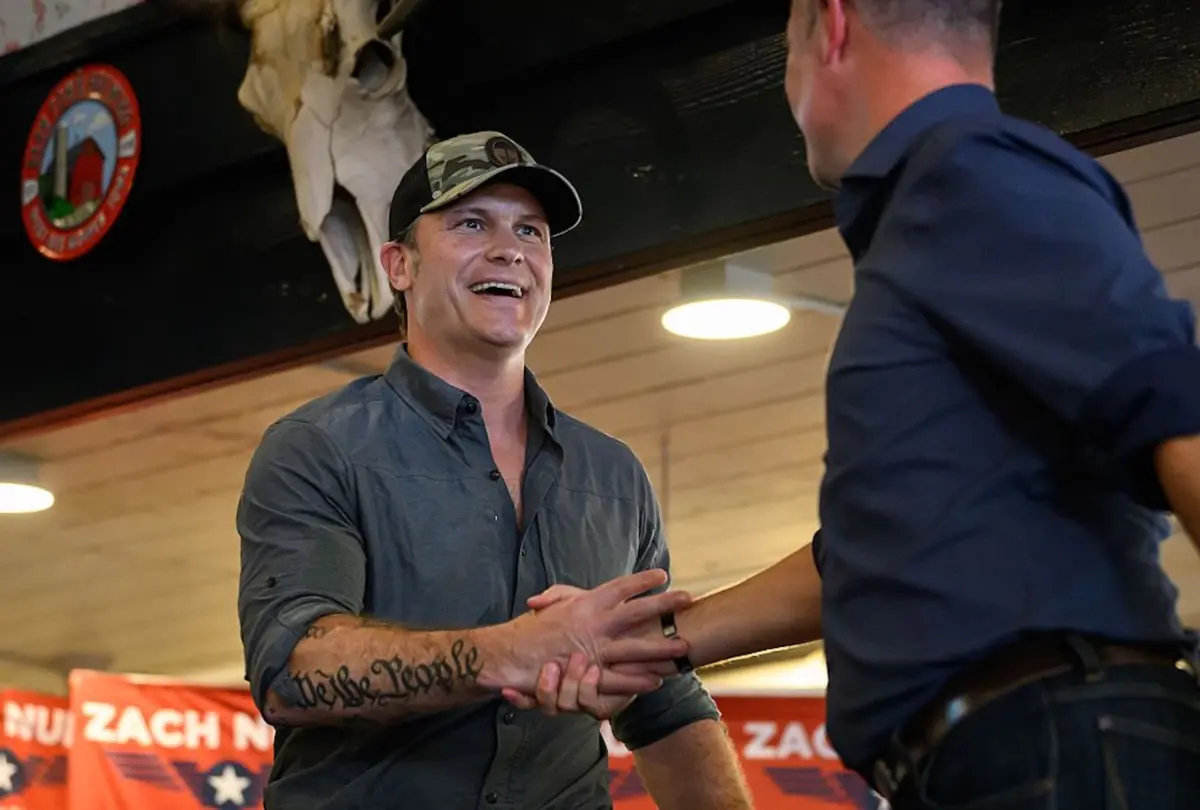
- August 17, 2026: Hegseth takes the stage at the Iowa State Fair during a campaign event for Representative Zach Nunn (R-IA). Rolling up his sleeves to display a prominent cross tattoo, Hegseth delivers a fiery, headline-grabbing speech characterized by aggressive anti-transgender rhetoric and an assertive declaration regarding the cultural identity of the armed forces.
- August 24, 2026: Political analysts highlight a widening chasm between Hegseth’s dismal national approval ratings and his exceptionally high standing among registered Republicans, solidifying his status as a polarizing vanguard for the party’s religious right wing as the conversation surrounding the 2028 presidential nomination accelerates.
Supporting Context & Metrics: The Demographic and Ideological Shift
To understand why Hegseth’s incendiary style plays well with core conservative constituencies, one must examine the shifting demographic and theological contours of white evangelicalism in the United States. According to comprehensive data from organizations like Public Religion Research Institute (PRRI) and the Brookings Institution, white Christians—once the dominant cultural baseline of the country—now find themselves as a shrinking percentage of the broader American populace. However, within the Republican primary ecosystem, white evangelicals remain the undisputed kingmakers.
This demographic contraction has not led to moderation; rather, it has catalyzed a profound insularity and ideological radicalization. Key data points illuminate this transformation:
- Christian Nationalism: Recent PRRI research indicates that nearly 70% of white evangelicals now embrace tenets of Christian nationalism—the belief that America is fundamentally a Christian nation and that divergent cultural or religious identities should be marginalized.
- Partisan Disparity in Approval: While a Quinnipiac University poll reveals that Hegseth’s national approval sits at an abysmal 34% among the general public, his support among registered Republicans skyrockets to an overwhelming 79%.
- The Theological Pipeline: Scholars of religion and politics, such as Calvin University historian Kristin Kobes Du Mez (author of Jesus and John Wayne), note that modern white evangelicalism has systematically discarded traditional models of gentle Christian meekness in favor of a hyper-masculine, militant ethos. This subculture frequently frames cruelty and intolerance not as moral failings, but as necessary acts of spiritual warfare.
Hegseth’s institutional affiliations further contextualize his worldview. His association with extremist-leaning ecclesiastical leaders—such as pastors who openly question women’s suffrage and romanticize historical patriarchal hierarchies—complements an online ecosystem where social media influencers frequently eclipse traditional clergy in moral authority. In this digital marketplace, extreme rhetoric and the rejection of empathy are heavily rewarded, creating a feedback loop that normalizes exclusion and systemic bigotry.
Official Statements and Expert Analysis
The cultural and political implications of Hegseth’s rise have drawn sharp commentary from historians, political scientists, and cultural critics attempting to decode the shifting alliance between secular nationalism and religious fundamentalism.
Dr. Kristin Kobes Du Mez, analyzing the rhetorical strategies of the contemporary religious right, points out that the embrace of aggressive language is entirely intentional within certain evangelical subcultures.
"Most evangelicals would not go this far in terms of the explicit language they use," Du Mez explains, addressing the inflammatory slurs and hyper-masculine posturing favored by figures like Hegseth. "However, they deeply resonate with the core idea that tolerating or normalizing sinful behavior is a threat to the nation. In this way, hostility is reframed as ‘biblical’ conviction, and cruelty is packaged as an act of moral clarity."
Political commentators tracking the preliminary moves toward the 2028 election have similarly emphasized that dismissing figures like Hegseth as mere political novelties overlooks the deep institutional shifts within the conservative coalition. While establishment figures within the party may favor more traditional, technocratic conservative profiles—such as Senator Marco Rubio or Vice President JD Vance—none command the same raw, visceral enthusiasm from the evangelical base as a cabinet secretary who aggressively projects a "warrior" persona.
During his address at the Iowa State Fair, Hegseth made his administrative philosophy explicitly clear to the assembled faithful, declaring:
"At the Department of War, we do training, not identity politics."
This rhetorical framing—deliberately substituting "Department of Defense" with "Department of War"—serves as a direct dog whistle to a base that hungers for institutional disruption and a rollback of pluralistic military policies.
Future Outlook: Implications for the 2028 GOP Primary Landscape
As the political horizon clears toward the 2028 presidential cycle, the trajectory of Pete Hegseth offers a stark window into the future of the American conservative movement. The traditional gatekeepers of the Republican Party are finding their influence steadily eclipsed by an increasingly radicalized primary electorate that prioritizes cultural combat, performative machismo, and explicit Christian nationalism over conventional political polish.
Several key dynamics will dictate whether Hegseth’s brand of politics can successfully transition from a cabinet-level platform to a viable national presidential campaign:
- The Endurance of the Populist Base: Trump’s unmistakable preference for hardline loyalists over cautious moderates—highlighted by internal security choices during international crises—signals to ambitious figures within the administration that ideological purity and aggressive loyalty are the ultimate currencies of power.
- Institutional Polarization: As the Pentagon continues to divest itself of historical diversity initiatives, rename military assets to honor political allies, and enforce narrow religious definitions, the administrative footprint left behind will cement Hegseth’s reputation as a transformative figure among the conservative base, regardless of the backlash from the broader American public.
- The Evolution of Evangelical Politics: With mainstream religious moderation continuing to contract as disillusioned members leave organized religion, the remaining core of white evangelical voters is likely to double down on candidates who reflect their grievances. Hegseth’s ability to seamlessly fuse military authority with religious fundamentalism provides a powerful blueprint for future campaigns.
Ultimately, whether Pete Hegseth ultimately captures the Republican nomination or remains a cautionary symbol of a shifting political paradigm, the broader reality remains unchanged. His political viability demonstrates that the intersection of hyper-masculine aggression and religious nationalism is no longer a fringe phenomenon within the GOP—it is an increasingly dominant force shaping the future of American governance.