

Executive Overview
In an era dominated by the hyper-homogenized, brightly waxed monocultures of the modern supermarket—where varieties like the Red Delicious and the Gala reign supreme through sheer industrial persistence—a quiet counter-revolution is taking root. The discerning consumer and the adventurous palate are increasingly turning their attention toward heritage, wild, and specialty apple varieties. This movement seeks to reclaim the vast, sprawling biodiversity of the malus genus, celebrating fruits that do not merely taste sweet, but tell complex stories of geography, colonial history, botanical happenstance, and accidental fermentation.
This investigative report chronicles a comprehensive, sensory-driven evaluation of a secondary batch of specialty apples, building upon previous foundational pomological surveys. Through rigorous tactile, olfactory, and gustatory analysis, this review examines seven distinct cultivars: the Kickapoo Spice, St Edmunds Pippin, Sops of Wine, Fenceline Surprise, Americus Crab, Campfield (False), and the Graham.
Far from being a passive snack review, this audit serves as a deeply contextualized cultural and agricultural snapshot. It explores how storage duration dictates flavor trajectory, how industrial cider varieties differ drastically from fresh-eating table apples, and how historical horticulture connects modern consumers to seventeenth-century Puritan settlements. With scores ranging from a dismal, sand-textured 1.0 to a robust, glacier-calving 8.3 out of 10, the findings underscore a fundamental truth of pomology: beauty, flavor, and texture are rarely found in the middle of the road. They live in the eccentricities.
Detailed Chronology and Sensory Methodology
The evaluation of this batch followed a strict, standardized sensory protocol designed to assess the complete lifecycle of each fruit from the moment of physical inspection to the final lingering aftertaste. Apples are deceptively complex biological systems; they are living tissues continuing to respire long after harvest, making the timing of consumption a critical variable in any accurate pomological assessment.

The Testing Phase: Seven Cultivars Under the Microscope
The tasting protocol evaluated each specimen across five core metrics: skin integrity and tactile response upon gripping; acoustic and mechanical feedback during the initial bite ("the crunch"); internal flesh coloration and moisture distribution; flavor profile complexity (including acid-sugar balance and secondary flavor notes such as spice, herb, or synthetic analogs); and the terminal finish or aftertaste.
-
Kickapoo Spice
- Tactile & Visual: A dense, heavy-set fruit with an imposing physical presence.
- Flavor Profile: Dominated by a heavy spice component, specifically forward notes of nutmeg, supported by secondary layers of cinnamon and clove. It lacked perceived juiciness, exhibiting a dry, vegetative aftertaste reminiscent of freshly cut grass.
- Pomological Assessment: The fruit demonstrated symptoms of improper storage tenure, suggesting it was pulled from its optimal developmental window. Despite this, its distinct character earned it a respectable 6.9 out of 10.
-
St Edmunds Pippin
- Tactile & Visual: Exhibited a characteristically rough exterior skin texture, described tactilely as "like licking a shark backward."
- Flavor Profile: Delivered an explosive acoustic and mechanical pop upon entry. The internal flesh was exceptionally juicy, sharp-breaking, and vibrant, carrying unexpected herbal undertones reminiscent of fennel pollen balanced smoothly against a natural sweetness.
- Pomological Assessment: Serving as an exemplary specimen of a well-balanced, slightly eccentric heritage apple, it secured an elite score of 8.3 out of 10.
-
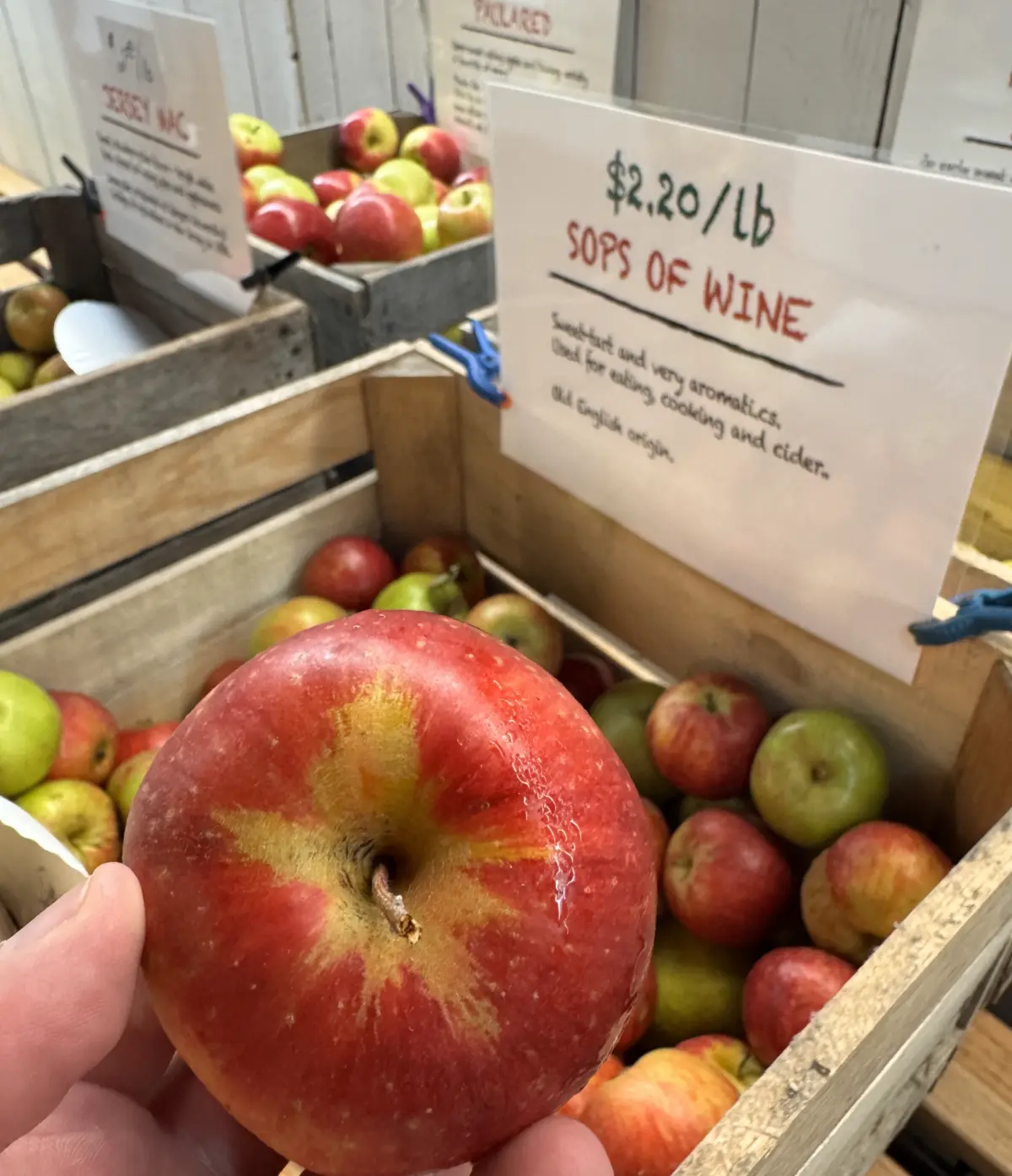
Sops of Wine

- Tactile & Visual: Standard exterior presentation, though carrying a deceptive nomenclature that historically hints at red-stained interior flesh. This specific specimen maintained standard white-fleshed attributes.
- Flavor Profile: Exhibited a pleasant flavor profile characterized by subacid sweetness (leaning sweet rather than tart) alongside subtle vanilla and spice infusions. However, structural integrity had degraded significantly, resulting in a mealy and gritty mouthfeel.
- Pomological Assessment: Due to post-harvest degradation and textural failure, the specimen was docked to 3.5 out of 10.
-
Fenceline Surprise
- Tactile & Visual: A visually appealing specimen that belied its internal reality. Marketed signage noted it as a "firm apple."
- Flavor Profile: Displayed a severely compromised texture characterized as "bland mush." A fleeting, delicate top-note resembling misted pear juice vanished instantly, leaving behind a persistent, unpalatable mouthfeel compared to beach sand.
- Pomological Assessment: A catastrophic failure of post-harvest storage or inherent cultivar weakness, resulting in a nadir score of 1.0 out of 10.
-
Americus Crab
- Tactile & Visual: A classic crabapple variant possessing a tough, resilient exterior structure.
- Flavor Profile: Highly unconventional for direct human consumption. Savory, intensely tart, physically tough, and exceptionally high in natural tannins.
- Pomological Assessment: Not engineered for casual out-of-hand snacking, but valued for its botanical curiosity. Rated 2.5 out of 10 for direct consumption.
-
Campfield (False)
- Tactile & Visual: Labeled with the enigmatic "(false)" designator, indicating genetic ambiguity or historical misattribution.
- Flavor Profile: Possessed a chewy, callused tactile consistency. The flavor profile leaned heavily toward excessive sweetness undercut by a massive surge of tannins, creating an astringent sensation where the fruit seemingly consumed the consumer.
- Pomological Assessment: Recognized fundamentally as an industrial cider apple rather than a table fruit, earning a 4.1 out of 10 for raw consumption.
-
Graham

- Tactile & Visual: An extraordinarily dense and physically armored fruit, possessing structural hardness capable of resisting standard human mastication.
- Flavor Profile: Upon mechanical penetration—likened physically to a calving glacier—the fruit yielded an astonishing, unreserved flavor profile directly mirroring commercial Juicy Fruit chewing gum.
- Pomological Assessment: Despite imposing significant mechanical strain on the human jaw, its flavor payoff propelled it to an 8.0 out of 10.
Supporting Context & Metrics: The Historical Weight of Orchards
To fully understand the spectrum of flavors found in modern specialty apples, one must examine the socio-historical framework of American pomology. Apples are not native in their current cultivated forms to North America (with the exception of native crabapples); they were brought over as seed stock and scion wood by European colonists who viewed fermented cider as a foundational dietary staple and a safer liquid alternative to contaminated water sources.
The historical lineage of cultivars such as the Campfield highlights the deep, institutional roots of orchard cultivation in early America. Archival records trace the lineage of the Campfield apple back to Matthew Canfield (alternately spelled Campfield), an anti-royalist Puritan migrant who arrived from Harleston, England, during the Great Migration of 1637. As a founding father of New Haven Colony, Norwalk, Connecticut, and Newark, New Jersey, Canfield’s civic duties were intimately tied to pomological production.
Town records from the era mandated that "freeholders"—those legally permitted to vote—were required to actively cultivate a minimum of four acres of land, a regulation that directly catalyzed the mass planting of colonial orchards. Canfield’s municipal footprint included requirements to finance corn mills, plant winter fruit trees, and pay municipal debts utilizing barrels of high-grade hard winter-fruit cider. The survival of these historical cultivar names through centuries of agricultural consolidation represents a vital living archive of colonial infrastructure.
[Historical Import: 1637 Great Migration]
       │
       ▼
[Colonial Mandate: 4-Acre Freeholder Orchard Laws]
       │
       ▼
[Industrial Fermentation: Winter-Fruit Hard Cider Production]
       │
       ▼
[Modern Pomological Audit: Evaluating Heritage Cultivars Today]
Furthermore, the audit highlights the precarious nature of the apple supply chain. Apples are biologically dynamic; factors such as cold-storage duration, ethylene exposure, and harvest timing dictate whether a fruit matures gracefully or degrades into what pomologists colloquially term "crap-town." The stark contrast between the vibrant, crisp structural integrity of the St Edmunds Pippin (8.3) and the degraded, mealy collapse of the Fenceline Surprise (1.0) emphasizes that agricultural output is heavily dependent on the precise intersection of genetics, climate, and supply-chain logistics.

Official Statements and Horticultural Perspectives
While commercial growers prioritize traits that favor mechanized harvesting, prolonged shelf life, and unblemished cosmetic uniformity—often at the direct expense of aromatic complexity and acid-sugar balance—independent pomologists and heritage orchardists advocate for a return to sensory diversity.
Horticultural experts note that many heritage apples, particularly those bred in the 18th and 19th centuries, were never intended for immediate, raw consumption out of hand. Varieties like the Campfield and the Americus Crab were engineered specifically for the tannin-heavy requirements of traditional cider-making, where astringency and structural bitterness are converted during fermentation into crisp, dry, highly complex potable alcohols.
"When consumers evaluate a cider apple using the exact same metrics they apply to a supermarket Honeycrisp, they are bound to be disappointed," notes an independent orchard historian specializing in colonial New England pomology. "Apples like the Campfield are botanical instruments. They require the alchemy of yeast and time—what we jokingly refer to as the intervention of fermentation goblins—to unlock their true potential."
Conversely, table apples such as the St Edmunds Pippin and the Graham demonstrate that genetic diversity can yield extraordinary sensory surprises. The sudden, unprompted emergence of a distinct synthetic fruit flavor—such as the uncanny Juicy Fruit gum profile discovered within the densely armored Graham—illustrates the vast, largely uncharted chemical pathways hidden within heirloom malus DNA. These accidental flavor synergies provide a compelling argument for the preservation of rare orchards against the encroachment of suburban development and industrial monoculture.

Future Outlook
As the culinary world increasingly embraces farm-to-table authenticity, terroir-driven dining, and historical foodways, the market for heritage and specialty apples is poised for a significant cultural renaissance.
The upcoming pomological expedition—scheduled to sweep through the orchards and farm stands of New York, New England, and the Canadian borderlands—promises to uncover further iterations of rare, forgotten, and eccentric cultivars. As regional orchards open their gates to consumers seeking alternatives to uniform grocery store offerings, the demand for botanical education regarding fruit storage, cider varieties, and culinary application will continue to expand.
Ultimately, the great apple audit serves as a reminder that food can and should be an adventure. Whether navigating the high-spice notes of a dense Kickapoo, dodging the jaw-shattering defenses of a gym-toned Graham, or pondering the historical weight of seventeenth-century Puritan ordinances while tasting an industrial cider apple, the consumer engages in a sensory dialogue that spans centuries. The future of pomology lies not in the erasure of imperfections, but in the celebration of every weird, wild, and challenging bite.