Rob Gronkowski occupies a singular, surreal quadrant of contemporary American pop culture. Standing in a locker room at Los Angeles’s Sierra Canyon School as the golden hour fades into Friday-night lights, the future Hall of Fame tight end cuts a familiar, imposing figure. At 37 years old—just five months older than Kansas City Chiefs star Travis Kelce—Gronk remains carved from granite, looking every bit the dominant force who hauled in passes from Tom Brady and steamrolled through linebackers en route to four Super Bowl rings.
Yet, Gronk has long since traded the gridiron for an even more relentless arena: the multi-million-dollar machine of modern media, commerce, and relentless brand monetization.
To the casual observer, Gronkowski’s public persona is that of a lovable, muscle-bound cartoon character—a modern caveman prone to "69" jokes, frantic dance moves, and high-octane celebrations. But behind the frat-boy veneer lies a fiercely disciplined, hyper-ambitious entrepreneur who understands the mechanics of modern fame better than almost anyone else in sports entertainment. This is an in-depth look inside the Gronk Industrial Complex: a seamless fusion of elite sports pedigree, unapologetic product placement, and a masterclass in leveraging celebrity underestimation.
Detailed Chronology: A Weekend Inside the Gronk Machine
To understand how Rob Gronkowski operates in his post-playing career, one must follow the frantic trajectory of a typical weekend. It is a relentless blur of private transport, green rooms, product pitches, live television broadcasts, and podcast recordings that would exhaust an Olympic decathlete.
Friday Night: High School Lights and Red-Light Therapy
The weekend begins on the campus of Sierra Canyon School, an elite private institution famous for its celebrity alumni, including the Kardashian-Jenner clan and LeBron James’s sons. Gronkowski stands before a rapt room of high school players, delivering a classic pregame pep talk. He hits all the expected marks: accountability, teamwork, and seizing the moment.
"You’re going to remember Friday-night football games for the rest of your lives," Gronk tells the teenagers.
Then, the speech takes a uniquely "Gronk" pivot. Transitioning from traditional gridiron wisdom to physical longevity, he issues a stark warning about injuries: "If you’re injured, you can’t participate. You’re worthless to the team. You gotta take care of your body."
Without missing a beat, he introduces his audience to his latest commercial venture: the DNA Vibe Jazz Band, a wearable recovery device utilizing red-light therapy and vibrational frequencies. To Gronk, corporate sponsorship and personal mentorship are completely interchangeable.
Saturday: The Beverly Hills Waldorf Astoria and the Pitchmen
The following afternoon at the Waldorf Astoria in Beverly Hills, the machinery of commerce is laid bare. Gronkowski sits down for an interview, his massive forearms covered in matching medical bandages.
"I get really dehydrated when I travel, so I get an IV," Gronk explains casually. "I also got ozone therapy, where it takes out the blood and then you put ozone in it."
Before the conversation can pivot to his prominent role on Fox NFL Sunday, he is interrupted by serial entrepreneur Lance Collins. Collins, who co-founded the sports drink company BodyArmor—subsequently acquired by Coca-Cola for $5.6 billion—is here with Gronk to push their latest venture: Recover 180, an organic, electrolyte-infused sports drink, alongside a burgeoning tequila line.
Unlike many athletes who maintain a strict firewall between journalism and commercial hawking, Gronk tears the wall down completely. "Put it in the story," he urges. "Come on, let’s put it in the story." Collins proceeds to pitch advertisements directly to the journalist, underscoring the reality that for Gronkowski, every waking minute is an opportunity for monetization.
Sunday: The Fox NFL Sunday Marathon
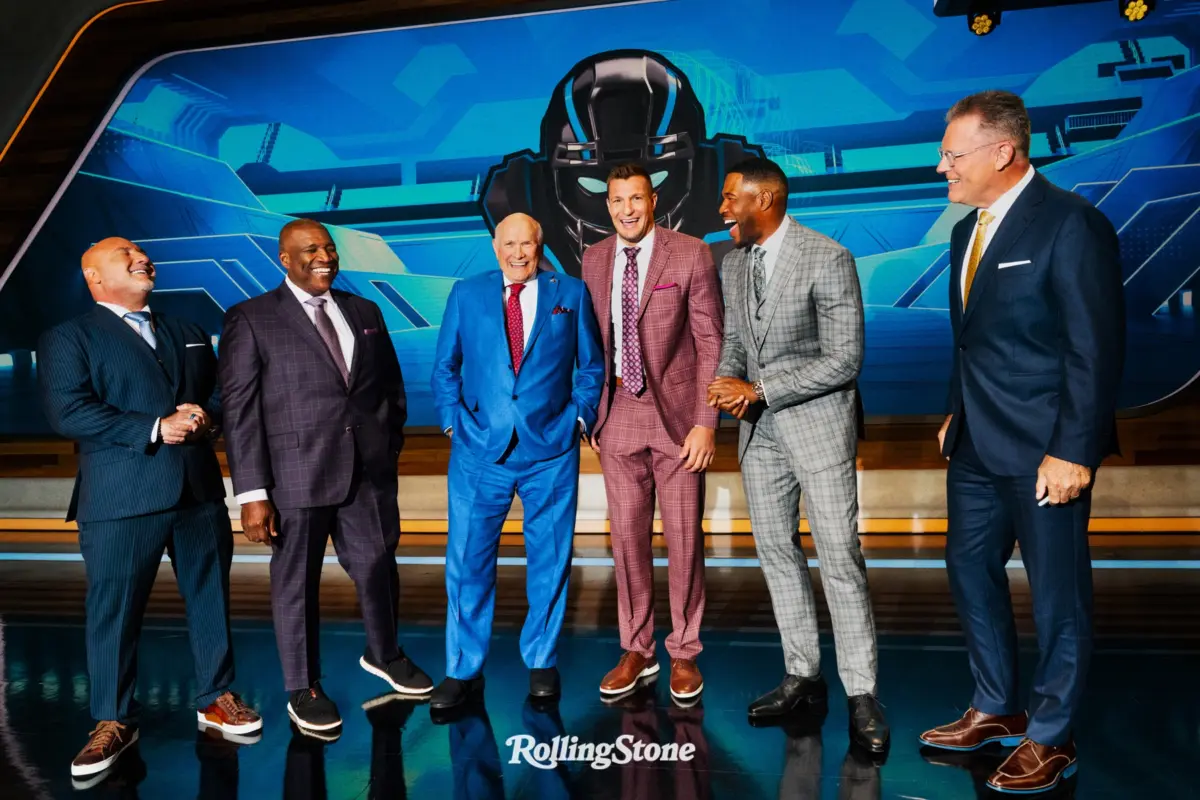
By 6:00 a.m. on Sunday, Gronkowski is already at the Fox NFL Sunday studio. At 37, he is the "kid" on a veteran panel featuring Michael Strahan, Howie Long, and Terry Bradshaw—legends decades his senior. Despite his youth relative to the panel, Gronk often cuts a fatigued figure early in the morning, weighed down by a crimson-checked suit from the Michael Strahan JCPenney collection.
The pre-airtime atmosphere resembles a surreal greenroom at a retirement community talent show. Bradshaw sings classic 1950s country-western tunes while attempting to knock cue cards out of Gronk’s meaty hands.
"I love messing with him," Bradshaw admits later. "He’s so dialed in. I try to un-dial him."
Television did not come naturally to Gronkowski. Early on, he memorized entire paragraphs word-for-word, resulting in stiff, mechanical deliveries. It took producer Bill Richards to steer him away from viewing the pregame show like a three-act theatrical play.
"This is live TV," Richards instructed him. "We want you for what you think at the moment."
Sunday Evening: The Gronk & Jules Show
By 5:45 p.m., after a 12-hour day of broadcast obligations, Gronkowski sheds his suit and heads to a secondary studio to tape The Gronk & Jules Show podcast alongside former New England Patriots teammate Julian Edelman.
Here, football analysis collides with unbridled absurdity. Gronk breaks down complex defensive schemes one minute, then riffs on AI conspiracies—theorizing that Elon Musk named his AI model "Grok" after him to dodge naming rights—before enthusiastically pitching Carhartt work clothes and dog food. By the time the recording wraps, Gronk is visibly spent, vanishing into a waiting car simply needing a well-earned nap.
Supporting Context & Metrics: The Anatomy of an Icon
The Foundation: Athletic Brilliance
Gronk’s commercial success is entirely predicated on the undeniable brilliance of his playing career. Drafted out of the University of Arizona—where he famously lived in an off-campus house featuring a front-yard hot tub—Gronkowski quickly shocked Patriots head coach Bill Belichick not just with his physical dominance as a blocker, but with his exhaustive playbook study.
Longtime teammate Julian Edelman notes that Gronk’s off-field antics—such as grabbing handfuls of shrimp off a passing waiter’s tray at a nightclub—were tolerated and even embraced because of his unmatched production on the field.
Four Super Bowl Titles: Secured across stints with the New England Patriots and Tampa Bay Buccaneers.
The Stat Line: Countless career touchdowns, transformative blocking metrics, and a legacy as arguably the greatest tight end in NFL history.
The Business of Being Gronk
The Gronk Industrial Complex spans multiple lucrative verticals:
Television: A cornerstone analyst position on Fox NFL Sunday, driving ratings and youth demographic engagement.
Endorsements & Equity: Major partnerships spanning sports drinks (Recover 180), wellness tech (DNA Vibe Jazz Band), sports gambling (FanDuel), apparel (Carhartt), and spirits.
Digital Media:The Gronk & Jules Show, capturing millions of views by blending high-level football IQ with unscripted comedy.
Official Statements and Industry Perspectives
The duality of Rob Gronkowski—the brilliant tactician wrapped in a frat-boy persona—is universally recognized by his peers and colleagues.
Terry Bradshaw on Gronkowski’s media presence: "The camera loves him. He’s harmless. It’s easy to like him… He’s gone, gone, gone. Commercial, commercial, commercial, all over the place."
Julian Edelman on Gronk’s work ethic: "When someone says, ‘I thought this guy was going to be an idiot,’ I just start laughing… No one could say anything because of how hard he worked and his production."
Bill Richards, Fox NFL Sunday Producer: "He’s not just the frat guy. He knows football."
When addressing the inevitable physical toll of his career, including the looming shadow of CTE (Chronic Travertine Encephalopathy), Gronkowski balances candor with characteristic evasion:
"You hear all the studies about CTE, and there’s a lot of science behind it. You’ve got to believe in the science, but it’s still kind of a myth as well, because how can you truly pinpoint anything to football?"
Future Outlook
For Rob Gronkowski, the transition from professional athlete to full-time media mogul and corporate pitchman has been executed with surgical precision. While retirement initially brought a disorienting lack of structure—leaving him restless and wondering what to do with his time—he quickly engineered a replacement: a life where the off-season simply does not exist.
The primary challenge moving forward is sustainability. Balancing an 88-event Super Bowl week schedule with live television, podcasting, and non-stop commercial shoots risks acute burnout. Yet, Gronk continues to rely on his personal regimen—hot yoga, ozone therapy, IV drips, and deep-woods retreats with his partner Camille Kostek—to reset his batteries.
Ultimately, Gronkowski has weaponized public underestimation. Whether he is analyzing complex Cover-3 defenses on live television or pitching wearable red-light therapy bands to high school athletes, he remains entirely in control of his narrative. As Gronk himself puts it:
"The best position I love to be in is when I’m underestimated. When someone says, ‘I thought this guy was going to be an idiot,’ I just start laughing. That’s when I know that person is truly an idiot."
The Gronk Industrial Complex shows no signs of slowing down, proving that behind the oversized personality lies one of the sharpest business minds in modern sports entertainment.