

Published: October 31, 2026
Location: Minneapolis, Minnesota
By: Investigative Desk
Executive Overview
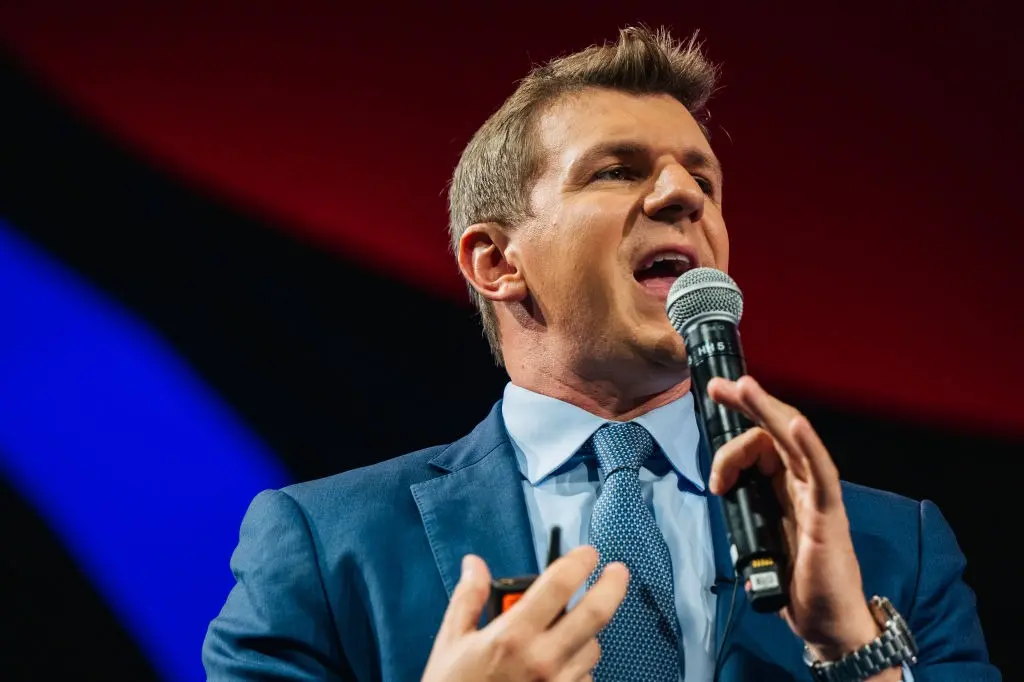
In what legal experts are calling a staggering collision of political theater and criminal liability, high-profile conservative activist James O’Keefe now finds himself on the wrong side of the law. O’Keefe, the polarizing founder of Project Veritas and current CEO of the O’Keefe Media Group, has built a career on orchestrating elaborate undercover stunts designed to expose institutional hypocrisy, media bias, and systemic vulnerabilities. However, his latest mission—aimed at laying bare alleged flaws in Minnesota’s electoral framework—has instead landed him in handcuffs.
On Wednesday, October 28, 2026, Hennepin County prosecutors formally slapped O’Keefe and right-wing social media influencer Cameron Higby with felony charges, including unlawful voting and identity theft. According to law enforcement and court documents, the duo disguised themselves, donned fake accents, and infiltrated Minneapolis polling places during the state’s August 11 primary election. Their goal was purportedly to demonstrate how easily bad actors could manipulate the North Star State’s voter registration and vouching procedures.
Instead of exposing a broken system, however, the stunt triggered a rapid security response by local election workers, resulting in a swift criminal indictment. While O’Keefe and Higby defend their actions as protected investigative journalism aimed at holding power accountable, local authorities argue that the duo crossed the bright line separating political provocation from felony-level election interference. As both men prepare for their upcoming court appearance on November 16, the case has reignited a fierce national debate over the ethics of undercover activism, the boundaries of the First Amendment, and the security of American elections.
Detailed Chronology: The August 11 Primary Operation
The sequence of events that led to the felony indictments began taking shape in the weeks leading up to Minnesota’s August 11 primary elections. O’Keefe and Cameron Higby targeted Minnesota due to its specific statutory mechanisms governing voter registration, specifically aiming their sights on the state’s long-standing "vouching" protocol.
According to Hennepin County prosecutors, the operation was meticulously planned to deceive election judges and test the human elements of poll security. On primary election day, O’Keefe and Higby executed their plan across multiple Minneapolis polling locations:
- The Disguises and Deception: Court filings state that both men utilized physical disguises—reportedly wearing altered clothing, hats, and adopting deliberate fake accents—to mask their appearances from poll workers and security cameras.
- The Impersonation: Moving from booth to booth, the activists allegedly provided election workers with the names and personal identifying details of actively registered voters without those individuals’ knowledge, consent, or participation.
- The Hidden Cameras: Throughout the encounters, the interactions were secretly filmed. The captured footage was intended to be edited into a viral exposé highlighting what the activists claimed were gaping holes in Minnesota’s election integrity infrastructure.
- The Catch: Despite their preparations, the duo failed to account for the vigilance of trained local poll workers. Precinct staff quickly grew suspicious of the unusual behavior, the inconsistencies in the registration process, and the demeanor of the individuals attempting to use the vouching system. Rather than falling for the ruse, workers immediately flagged the behavior and alerted local authorities, setting a formal criminal investigation into motion.
Neither O’Keefe nor Higby actually succeeded in casting a ballot or signing the legally binding vouching oaths required to complete the fraudulent registration. Nevertheless, prosecutors maintain that the act of actively misrepresenting one’s identity and manipulating the preliminary stages of the voting process constitutes a distinct and serious criminal offense under Minnesota state law.
Supporting Context & Metrics: Decoding Minnesota’s Vouching System
To understand the core motivation behind O’Keefe’s operation—and the precise legal threshold he allegedly crossed—it is necessary to examine how Minnesota handles voter registration on election days.
Unlike many jurisdictions that enforce rigid registration deadlines weeks ahead of an election, Minnesota permits Election Day registration. To accommodate citizens who register on the spot without traditional documentary proof of residence (such as a utility bill or state ID with a current address), the state utilizes a "vouching" system. Under this statutory safeguard:
- A person who is already registered to vote in the precinct can "vouch" for the identity and residence of a new registrant.
- The voucher must sign a formal, legally binding oath under penalty of perjury, swearing that they personally know the new registrant and know them to be a resident of the precinct.
- Committing perjury or falsifying information during this process carries severe legal penalties.
Critics of the vouching system, particularly within the conservative movement, have long argued that it creates an opening for malicious actors to introduce ghost votes or bypass baseline security checks. O’Keefe’s stated mission was to prove this vulnerability in real time.
However, state election officials and empirical data paint a starkly different picture of the system’s actual utilization and security. According to official data from the Minnesota Secretary of State’s office, the vouching process is statistically rare, accounting for fewer than 0.6% of all votes cast during the heavily scrutinized 2024 general election. Election administrators emphasize that the low utilization rate, combined with mandatory paper trails, strict audit procedures, and vigilant poll worker training, creates a multi-layered defense network.
Rather than exposing a crippled infrastructure, Hennepin County officials argue that the O’Keefe incident proved the exact opposite: that the system’s primary line of defense—human oversight by trained poll workers—successfully identifies, isolates, and reports anomalies before integrity can be compromised.
Official Statements and Legal Defense
The filing of felony charges has drawn sharply polarized reactions from the legal community, political commentators, and the defendants themselves.
The Prosecution’s Stance
Hennepin County Attorney Mary Moriarty announced the charges with an emphasis on upholding the inviolability of the democratic process. Moriarty asserted that the protections safeguarding elections must be defended against bad-faith actors, regardless of whether those actors claim to be journalists or political activists.
"The integrity of our election system relies on the honesty and good faith of everyone who interacts with it," prosecutors noted in court filings. "Misrepresenting your identity, utilizing disguises, and injecting fraudulent pretenses into a polling place is not investigative journalism—it is a direct threat to the democratic process and a clear violation of Minnesota law."
Authorities stressed that freedom of the press does not grant immunity to break criminal statutes, arguing that O’Keefe and Higby deliberately crossed the line from observation into active criminal participation.
The Defense’s Position
Attorneys and defenders for O’Keefe and Higby have framed the prosecution as a politically motivated assault on constitutional rights and aggressive watchdog journalism.
In public statements following his indictment, James O’Keefe vigorously defended his actions, maintaining that his work serves an essential public function by testing the safeguards put in place by taxpayers. He characterized the felony charges as an attempt by the establishment to silence independent investigators who dare to scrutinize government machinery.
"True journalism requires holding power accountable and stress-testing the systems that politicians claim are foolproof," representatives for O’Keefe argued in preliminary statements. "Exposing vulnerabilities is not a crime; it is a public service. Punishing journalists for demonstrating flaws in election security is a chilling attack on the First Amendment."
Cameron Higby echoed similar sentiments, maintaining their collective innocence and asserting that they never intended to cast illegal ballots, but rather to reveal systemic weaknesses that officials would otherwise ignore.
Historical Context: A Legacy of Undercover Confrontation
The 2026 indictment in Minnesota is merely the latest chapter in a long, highly litigious, and controversial career defined by aggressive undercover tactics. Over the past two decades, James O’Keefe has established a distinct brand of guerrilla journalism that has repeatedly blurred the lines between reporting, activism, and legality.
- The ACORN Investigation (2009): O’Keefe rocketed to national prominence when he and a collaborator released hidden-camera videos targeting the Association of Community Organizations for Reform Now (ACORN). The heavily edited videos led to immense political fallout and the eventual defunding of the organization. However, the controversy also resulted in O’Keefe paying a $100,000 settlement to a former ACORN employee after a successful lawsuit, though O’Keefe admitted no wrongdoing.
- Planned Parenthood Stings: Continuing his undercover trajectory, O’Keefe targeted Planned Parenthood clinics in subsequent years, deploying hidden recording equipment in attempts to expose alleged institutional wrongdoing.
- The Washington Post Sting (2017): In a rare instance where O’Keefe’s tactics were turned inward on mainstream media, reporters at The Washington Post caught an operative working for Project Veritas attempting to feed them a fabricated, scandalous story about then-candidate Roy Moore to test journalistic verification standards. The Post exposed the sting, dealing a major blow to the organization’s credibility.
Despite numerous controversies, legal challenges, and his eventual departure from Project Veritas to launch the O’Keefe Media Group, O’Keefe has remained steadfast in his methodology. Yet, legal analysts note that moving from corporate or institutional targets into active polling places during an official election cycle represents an unprecedented escalation in legal risk.
Future Outlook: What Lies Ahead
As the legal apparatus moves forward, all eyes are turning toward the courtroom. James O’Keefe and Cameron Higby are scheduled to make their mandatory initial court appearance in Hennepin County on November 16, 2026.
Neither man has been convicted of the charges, and the upcoming proceedings are expected to trigger a fierce legal battle over the precise statutory definitions of "unlawful voting" and "identity theft" within the context of investigative journalism.
Key Questions for the Legal Proceedings:
- The Intent Defense: Can the defense successfully argue that the absence of a completed ballot or signed voucher oath exempts the actions from felony voter fraud statutes?
- First Amendment Protections: Will the courts accept the argument that undercover stunts aimed at exposing election vulnerabilities constitute constitutionally protected newsgathering activity?
- Precedent for Future Activism: How this case is adjudicated could set a profound legal precedent for how states handle undercover operations inside polling places during future midterms and presidential election cycles.
For now, the message from Minnesota authorities remains unequivocal: while the state welcomes transparent oversight and public participation, the integrity of the ballot box is guarded by strict criminal boundaries that no individual—regardless of media profile or political ideology—is permitted to cross.