In the realm of digital product design and software engineering, a persistent adage echoes through every sprint planning session and code review: "There are only two hard things in Computer Science: cache invalidation and naming things." While caching issues often remain hidden under the hood, poorly chosen names are aggressively visible, polluting design files, complicating Pull Requests, and fracturing communication between cross-functional teams.
Language does not merely describe our work; it shapes how we conceptualize it. When designers, developers, product managers, and users speak different dialects for the exact same artifact, friction is inevitable. This systemic miscommunication breeds confusion around colors, UI components, layout structures, and behavioral features. It complicates the creation of resilient design tokens, clean HTML classes, and intuitive JavaScript variables.
Names that are overly generic fail to communicate intent, leaving team members guessing at a component’s purpose or constraints. Conversely, names that are hyper-specific lock systems into rigid paradigms, stripping away flexibility and reusability. Achieving the delicate balance between clarity and scalability requires rigorous methodologies, established conventions, and specialized tooling.
This guide synthesizes industry best practices, innovative mental models, and real-world case studies from major enterprise design systems. It provides practitioners with an authoritative framework for naming everything in the digital stack—from microscopic color values and design tokens to high-level UI components and consumer-facing features.
Detailed Chronology and Evolution of Naming Frameworks
The evolution of digital design systems over the past decade has fundamentally changed how teams approach nomenclature. In the early days of the web, naming was largely an ad-hoc, localized affair. Developers relied on idiosyncratic shortcuts or visual descriptions (blue-box-right), while designers organized Photoshop layers with arbitrary labels like Rectangle copy 4.
As digital products scaled into multi-platform, multi-brand ecosystems, this wild-west approach collapsed under its own weight. The historical trajectory of naming normalization can be broken down into three critical phases:
Phase 1: The Visual Description Era (Pre-2015)
In the infancy of modern front-end development and UI kits, naming conventions were tightly bound to visual properties. Elements were named based on what they looked like rather than what they did.
The Practice: Classes like .blue-button, .large-bold-text, or .float-right dominated CSS stylesheets.
The Fallout: When a redesign changed a button’s background from blue to red, developers were forced to perform risky refactors across thousands of lines of code or maintain semantically incorrect class names (e.g., maintaining .blue-button for a red button).
Phase 2: Structural and Methodological Standardization (2015–2020)
To combat visual coupling, the industry pivoted toward strict structural taxonomies. Methodology frameworks like BEM (Block, Element, Modifier), SMACSS, and OOCSS gained massive traction.
The Practice: Namespaces like .card__title--featured established clear relationships between structural blocks and modifiers. In design tools like Sketch and early Figma, layer organization adopted strict prefixes (e.g., atom/, molecule/, organism/) borrowed from Atomic Design principles.
The Fallout: While these systems solved modularity and scoping issues, they often introduced verbose, complex syntax that steepened the onboarding curve for newcomers and created heavy cognitive overhead during rapid prototyping cycles.
Today, modern design systems operate within tokenized, multi-brand frameworks. Naming is no longer just about writing cleaner CSS or organizing layers; it is about establishing a shared vocabulary that bridges design tokens, code variables, component APIs, and human language.
The Practice: Enterprise teams utilize multi-layered taxonomies (Primitive $rightarrow$ Semantic $rightarrow$ Component) and rely on community-vetted repositories, standardized component galleries, and automated linting tools to preserve naming integrity.
Supporting Context, Methodologies, and Practical Resources
Navigating the complexities of naming requires more than just internal team debates; it demands specialized toolsets and external benchmarks. Below is a comprehensive breakdown of the core domains of digital nomenclature, supported by leading community resources.
1. General Inspiration and Code-Level Naming
When writing HTML classes, CSS properties, or functional JavaScript, developers frequently hit a creative wall. Breaking out of habitual patterns requires exposure to diverse mental models.
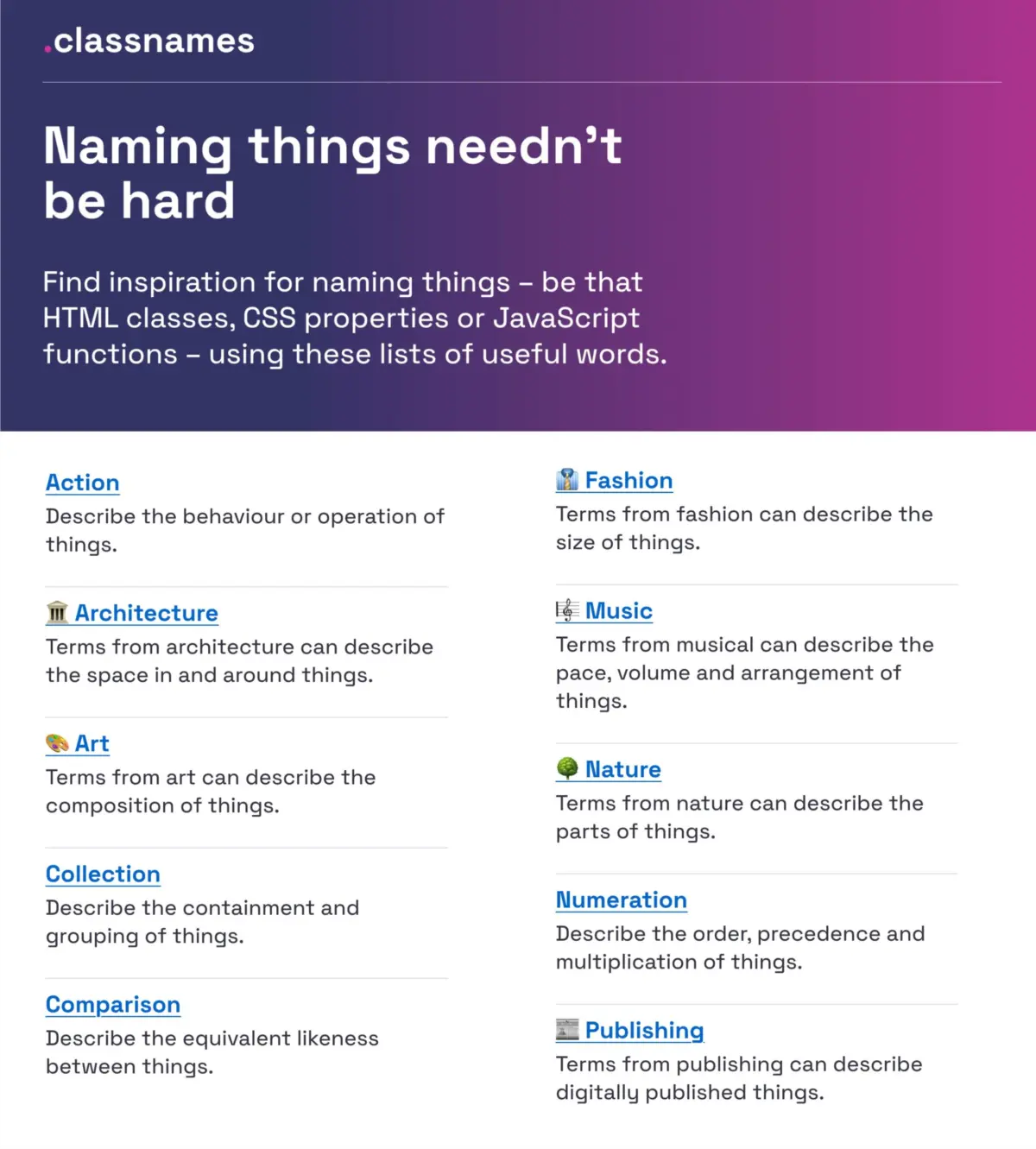
Classnames Resource: Developed by Paul Robert Lloyd, Classnames serves as an exceptional compendium of thematically grouped terminology. Rather than relying on generic modifiers, the site organizes words by behavior, likeness, order, and grouping, while drawing rich inspiration from non-technical fields like architecture, theater, publishing, fashion, and botany.
2. Color System Nomenclature
Naming colors systematically is notoriously difficult. Hex codes are opaque to humans, while descriptive names often lead to subjective debates (is a hue "teal," "cyan," or "seafoam"?).
Color Names Repository: Maintained by David Aerne, the Color Names Repository aggregates over 30,000 unique color names sourced from diverse references and thousands of community contributions. Paired with interactive pickers like Color Parrot, this resource gives teams an algorithmic and creative baseline for establishing robust color token palettes.
3. Layer and Group Structure in Design Files
Inconsistent layer naming in design files (Figma, Sketch, Adobe XD) wastes hours of developer handoff time and breaks automated token extraction pipelines.
Design Best Practices Guidelines: Javier Cuello’s Naming Guidelines establish that an effective design layer name must be short, structurally logical, universally understood, and decoupled from visual properties. His framework outlines granular do’s and don’ts for organizing component variants, layout groups, and nested states.
4. Design Token Taxonomies at Scale
Managing variables across multiple brands and themes presents a monumental structural challenge.
Intuit’s Case Study: Nate Baldwin detailed how Intuit successfully architected a flexible design token taxonomy to unify diverse financial products like QuickBooks, TurboTax, Mailchimp, and Mint. Their approach moved beyond single-brand branding to establish a foundational architecture capable of scaling globally.
Vodafone UK Variables Taxonomy Map: The Vodafone UK Design System team published their Variables Taxonomy Map on Figma Community, building upon Nathan Curtis’s foundational work on token naming. The map orchestrates four distinct collections—spanning from brand primitives and semantic tokens to component-specific implementations—allowing team members to instantly trace where a token is utilized and what it represents based solely on its name.
Design Token Guide and Inventory: Romina Kavcic’s Name Design Tokens Guide provides an interactive tool for configuring token structures across components, categories, states, and roles, complemented by a spreadsheet inventory that offers a bird’s-eye view of large-scale token libraries.
5. UI Component Standardization
Reinventing the wheel—or worse, inventing a novel name for an established pattern—causes severe cognitive friction for users.
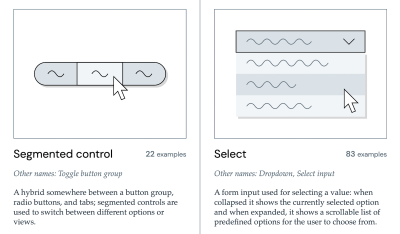
The Component Gallery: Iain Bean’s Component Gallery aggregates more than 50 real-world UI components sourced from top-tier design systems. It maps out primary names alongside alternative aliases used across the industry. For a quick visual dictionary, Name That UI serves as an invaluable reference.
6. Feature Discovery and Product Naming
Low feature adoption is frequently a symptom of poor discoverability caused by ambiguous naming.
Erin Gannon’s Practical Guide: In her essay “What Do We Call This Thing?”, Erin Gannon outlines how feature names must be driven by user problems and jobs-to-be-done. The golden rule: tap directly into the user’s natural vocabulary rather than relying on internal corporate jargon.
Onym: For naming entire products, services, or initiatives, Onym provides an exhaustive open-source repository of brainstorming tools, vetting frameworks, etymological guides, and methodological sprints.
Official Statements and Industry Insights
Industry leaders continually emphasize that nomenclature is an operational challenge, not merely a stylistic preference.
"The language we use shapes our mental models and dictates the quality of our cross-functional conversations," notes design systems architect Vitaly Friedman. "When designers, developers, and product managers speak in isolated dialects, system fragmentation is guaranteed. A great name eliminates ambiguity, reduces documentation bloat, and aligns the entire organization around user intent."
Furthermore, enterprise engineering leads stress that automated tooling relies fundamentally on predictable string parsing. Without strict adherence to naming taxonomies, modern design-token pipelines—which automatically sync Figma styles into iOS, Android, and web codebases—break down, resulting in manual overrides and desynchronized user experiences.
Future Outlook: The Next Frontier in Digital Nomenclature
As artificial intelligence, automated design generation, and multi-modal interfaces (voice, spatial computing, and augmented reality) mature, the importance of disciplined naming conventions will only intensify.
AI-Driven Token Management: Future design systems will increasingly rely on Large Language Models (LLMs) to automatically lint, categorize, and suggest design tokens based on semantic usage. However, these AI models will remain entirely dependent on human-authored taxonomies to understand context and intent.
Unified Semantic Graphs: The boundary between design tokens and code variables will continue to dissolve. We are moving toward a unified semantic graph where a change in a design system’s token name propagates effortlessly through automated AST (Abstract Syntax Tree) transformations in codebases, reducing the historical friction of cross-team refactoring.
Cross-Modal Adaptability: As spatial computing and conversational UI expand beyond traditional 2D screens, naming conventions must evolve to describe behavioral states and spatial relationships rather than static dimensions (e.g., transitioning from .padding-md to contextual spatial tokens like .proximity-conversational).
Wrapping Up
Investing time in establishing clear, scalable, and human-centric naming conventions is one of the highest-leverage activities a product team can undertake. Much of the friction in software development is not rooted in technical limitations, but in semantic confusion.
When user adoption lags, evaluate your nomenclature first. Audit your codebase and design files for naming conflicts, document your decisions in an accessible inventory, and bridge the gap between developer dialects and user language. By refining the words we use to build the web, we reduce frustration, accelerate delivery, and craft digital experiences that are profoundly more intuitive for everyone.