The landscape of search engine optimization (SEO) has shifted dramatically. Gone are the days when a digital marketer could rely on static, manually updated Excel spreadsheets to monitor website performance, keyword fluctuations, and Search Engine Results Page (SERP) features. Today’s algorithmic environment—characterized by hyper-personalized localized results, complex knowledge graphs, AI-driven search experiences like Google’s AI Overviews, and lightning-fast shifts in visibility—demands precision, agility, and absolute accuracy.
Investing in robust SERP tracking software is no longer a luxury for enterprise-level operations; it is a fundamental operational necessity for anyone managing organic traffic, clients, or digital revenue streams. Without real-time, granular data, marketers are flying blind, unable to validate the efficacy of their content initiatives or justify marketing budgets to stakeholders.
This comprehensive review explores the critical criteria for selecting modern rank-tracking tools and evaluates the seven best SERP tracking platforms on the market for 2025. By analyzing both standalone solutions and comprehensive, all-in-one SEO platforms, this report will help you determine the optimal software stack for your agency, enterprise, or small business.
Detailed Chronology & Evolution of SERP Tracking
To understand why modern rank tracking is so sophisticated, it is helpful to examine how the industry has evolved over the past decade.
The Early Era (Pre-2015): SEO professionals relied heavily on basic, scraper-based tools that updated weekly or bi-weekly. Data was often erratic, local search granularity was virtually non-existent, and tracking SERP features (such as featured snippets or video carousels) was manually intensive.
The Rise of Real-Time Infrastructure (2015–2020): As search engines grew more dynamic, traditional weekly tracking became obsolete. Platforms like AccuRanker pioneered on-demand, cloud-based data refreshes, allowing users to pull up-to-the-minute ranking metrics on demand. Concurrently, search engines introduced complex SERP layouts, forcing software developers to build feature-tracking capabilities.
The AI & Localization Boom (2020–Present): The current era is defined by extreme hyper-localization (down to the zip-code level) and the integration of artificial intelligence into search results. Modern SERP trackers must now account for zero-click searches, AI-generated answers, multi-engine tracking (including Baidu, Yandex, and YouTube), and seamless integration with broader business intelligence dashboards like Google Looker Studio (formerly Data Studio) and Databox.
Why Invest in Enterprise-Grade SERP Tracking Software?
Tracking changes in your search visibility is only the baseline. Modern SERP tracking software serves as the central nervous system of an effective SEO campaign. Executives and practitioners require software that directly ties search metrics to business outcomes.
Accurate tracking software enables organizations to:
Validate SEO Investments: Prove return on investment (ROI) by demonstrating measurable progress in competitive keyword rankings and organic visibility over time.
Capitalize on SERP Features: Identify which keywords trigger valuable features like AI Overviews, People Also Ask (PAA) boxes, and featured snippets, enabling content teams to steal "Position #0" from competitors.
Mitigate Algorithm Volatility: Quickly spot sudden ranking drops caused by core algorithm updates, allowing for rapid diagnosis and remediation.
Localize Campaigns Effectively: Monitor performance at the national, regional, state, or precise zip-code level for local business clients.
9 Essential Features to Look for in SERP Tracking Software
When evaluating the market for the best SERP tracking solution, ensure the platform features these core capabilities:
1. Accurate On-Demand Ranking Updates
SERP positions shift rapidly. Waiting days for a batch update is counterproductive. Look for tools that refresh your core keyword sets automatically every 24 hours while offering the ability to trigger instant, on-demand data refreshes with a single click.
2. Comprehensive SERP Feature Monitoring
Modern search results are packed with distractions and opportunities. You need visibility over 50+ different SERP features—including AI Overviews, knowledge cards, video carousels, and local packs—so you can spot optimization gaps and capture high-value real estate.
3. Multi-Engine Search Tracking
While Google remains dominant, a truly comprehensive tracker must support alternative search engines such as Bing, Yahoo, Baidu, Yandex, and YouTube, particularly for international campaigns or specific niche audiences.
4. Granular Location and Device Segmentation
A high-level overview is helpful, but granular data is critical. Ensure the platform allows you to segment performance by desktop versus mobile devices, as well as target specific geographic coordinates down to the city or postal-code level.
5. Mapping SERP Movements to Revenue and Traffic
Rankings alone do not pay the bills. The best tools integrate seamlessly with analytics platforms like Google Analytics or Adobe Analytics to correlate keyword movements directly with organic traffic, bounce rates, conversions, and bottom-line revenue.
6. Historical Rank Performance Analysis
Point-in-time snapshots limit strategic forecasting. Access to deep historical data allows SEO professionals to evaluate long-term trends, study seasonal volatility, and measure performance benchmarks against competitors.
7. Advanced Competitor Comparisons
Search visibility is a zero-sum game. Your gains are someone else’s losses. Robust tools group keywords into position brackets (e.g., positions 1–3, 4–10, 11–50) to make it easy to benchmark your ranking distribution directly against top competitors.
8. Tagging and Data Segmentation
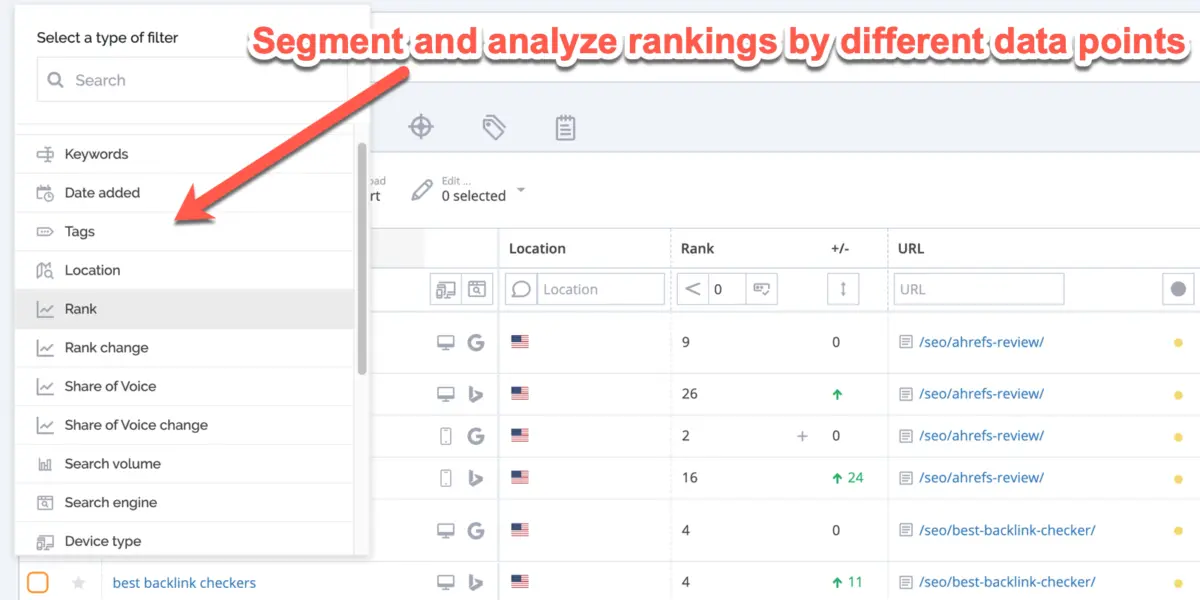
Not all keywords hold equal weight. Effective software allows you to tag and segment keywords by buyer persona, sales funnel stage, topic cluster, content asset type, or brand versus non-brand terms.
9. White-Label Reporting and BI Integrations
Client reporting should be seamless. Look for tools that feature native, white-label report scheduling alongside direct API connectors to business intelligence tools like Google Looker Studio and Databox.
Supporting Context & Industry Metrics
According to recent digital marketing benchmarks, over 68% of online experiences begin with a search engine, yet less than 1% of users click past the first page of results. Furthermore, the proliferation of SERP features has pushed organic blue links further down the page, making the capture of features like AI Overviews and featured snippets essential for maintaining traffic volume.
Industry data indicates that agencies utilizing automated, real-time rank tracking save an average of 14 hours per month per client compared to those relying on legacy reporting methods. This operational efficiency directly translates into higher profit margins and more agile client management.
The 7 Best SERP Tracking Tools for 2025
Countless options populate the marketplace, but the following curated shortlist highlights the top-performing standalone tools and all-in-one SEO platforms.
1. AccuRanker
Type: Standalone SERP Tracker
Best For: Agencies, consultants, and enterprises demanding lightning-fast, hyper-accurate data.
Overview: Trusted by over 32,000 companies—including global brands like HubSpot, IKEA, and Kinsta—AccuRanker is widely regarded as the gold standard for dedicated rank tracking. It delivers automated daily updates paired with instantaneous on-demand data refreshes.
Standout Features: Unrivaled data update speed, deep Landing Pages integration with Google Analytics, comprehensive Share of Voice calculations, and robust Looker Studio connectors.
Pricing: Plans start at $116/month for up to 1,000 tracked keywords.
2. Semrush (Position Tracker & SERP Gap Analyzer)
Type: All-in-One SEO Platform
Best For: Digital marketing professionals and enterprises seeking a comprehensive marketing suite with world-class rank tracking.
Overview: Semrush serves over 10 million users globally, including heavyweights like Samsung, Vodafone, and Booking.com. Its Position Tracking tool delivers enterprise-grade daily rank tracking across devices and hyper-local regions.
Standout Features: Highly accurate local map-pack tracking, multi-device comparison, and the innovative SERP Gap Analyzer app in the Semrush App Center, which scans SERPs to identify under-optimized content and uncovers low-hanging fruit via Google Search Console integration.
Pricing: Platform plans start at $139.95/month.
3. ProRankTracker
Type: Standalone SERP Tracker
Best For: Agencies and ecommerce brands looking for cost-effective, multi-language tracking across global markets.
Overview: ProRankTracker services over 60,000 users, offering a highly scalable and budget-friendly solution for tracking web and video rankings across multiple search engines and international locations.
Best For: In-house corporate marketing teams and enterprise agencies requiring extensive custom reporting.
Overview: A seasoned veteran in the SEO tool space, AWR is utilized by major brands like Microsoft. It is celebrated for its cloud-based architecture and robust white-label reporting engines.
Standout Features: Deep historical data archives, flexible user permissions, and robust enterprise API capabilities.
Pricing: Plans start at $99/month.
5. SERPWatcher (by Mangools)
Type: All-in-One SEO Suite Component
Best For: Small businesses, startups, and freelancers wanting simplicity without sacrificing data quality.
Overview: Part of the Mangools toolset (trusted by brands like Airbnb and Adidas), SERPWatcher is praised for its clean, intuitive user interface and unique Performance Index metric, which measures organic traffic potential.
Standout Features: Interactive visual charts, straightforward keyword grouping, and bundled access to complementary tools like SERPChecker.
Pricing: Mangools subscriptions start at $29.90/month.
6. SE Ranking
Type: All-in-One SEO Platform
Best For: Small-to-medium agencies and growing businesses needing versatile, accurate tracking.
Overview: SE Ranking simulates real user behavior across precise geographic locations to deliver dependable, 100% accurate ranking data across major search engines.
Standout Features: Comprehensive competitor matrix, professional white-label reporting, and automated auditing tools.
Pricing: Plans start at $52/month (based on daily tracking for 500 keywords).
7. Nightwatch
Type: Standalone SERP Tracker
Best For: Global enterprises, agencies, and tech companies managing massive keyword inventories.
Overview: Trusted by enterprises such as Shopify, Scotiabank, and Coinbase, Nightwatch tracks rankings across more than 107,000 global locations with exceptional precision.
Standout Features: Advanced data segmentation, automated site audits, and bespoke reporting capabilities.
Pricing: Plans start at $32/month for up to 250 keywords (with a 14-day free trial).
Official Statements & Industry Expert Insights
Industry leaders continually emphasize the necessity of integrating rank data with broader business intelligence metrics.
"The thing that really got me using them heavily in the last month or two is their Google Data Studio connector. Combining the tag feature, as well as the Share of Voice metric… has been a big help in making these reports immediately digestible."
— Ian Howells, Co-Founder, Traffic Think Tank
Furthermore, enterprise SEO practitioners praise the efficiency of modern dedicated platforms:
"It’s by far the best keyword ranking tracker in the market and has a ton of great reporting functions. If you want visibility on large volumes of keywords housed within a nice dashboard—this is for you."
— Matthew Howells-Barby, Co-Founder, Traffic Think Tank
Future Outlook: What Lies Ahead for SERP Tracking
As we look further into the decade, the evolution of search engine architecture will continue to test traditional tracking methodologies. With the rapid expansion of generative AI search experiences, standard 10-blue-link tracking is rapidly giving way to visibility share metrics, brand mention tracking within AI summaries, and multi-modal search tracking (voice, visual, and text).
Marketers must choose tools that not only report traditional ranking positions but also adapt to unstructured, conversational search queries. Whether you opt for a dedicated powerhouse like AccuRanker or a comprehensive suite like Semrush, ensuring your software stack is agile, precise, and integrated with your business intelligence tools will remain the cornerstone of digital marketing success.


![7 Best SERP Tracking Tools for 2022 [In-Depth Review]](https://www.robbierichards.com/wp-content/uploads/2020/05/Best-SERP-Trackers.jpg)
![7 Best SERP Tracking Tools for 2022 [In-Depth Review]](https://www.robbierichards.com/wp-content/uploads/2020/04/image16-2.png)
![7 Best SERP Tracking Tools for 2022 [In-Depth Review]](https://www.robbierichards.com/wp-content/uploads/2020/04/image2-3.png)
![7 Best SERP Tracking Tools for 2022 [In-Depth Review]](https://www.robbierichards.com/wp-content/uploads/2020/04/image6-2.png)
![7 Best SERP Tracking Tools for 2022 [In-Depth Review]](https://www.robbierichards.com/wp-content/uploads/2020/04/image15.jpg)
![7 Best SERP Tracking Tools for 2022 [In-Depth Review]](https://www.robbierichards.com/wp-content/uploads/2020/04/image12-1.png)
![7 Best SERP Tracking Tools for 2022 [In-Depth Review]](https://www.robbierichards.com/wp-content/uploads/2020/04/image13-2.png)
![7 Best SERP Tracking Tools for 2022 [In-Depth Review]](https://www.robbierichards.com/wp-content/uploads/2020/04/image3.jpg)
![7 Best SERP Tracking Tools for 2022 [In-Depth Review]](https://www.robbierichards.com/wp-content/uploads/2018/08/rj-employee_Robbie-color-new.png)
![7 Best SERP Tracking Tools for 2022 [In-Depth Review]](https://www.robbierichards.com/wp-content/uploads/2020/05/Databox-SEO-dashboard-1.jpg)
![7 Best SERP Tracking Tools for 2022 [In-Depth Review]](https://www.robbierichards.com/wp-content/uploads/2020/04/image4-2.png)
![7 Best SERP Tracking Tools for 2022 [In-Depth Review]](https://www.robbierichards.com/wp-content/uploads/2020/04/image5.jpg)
![7 Best SERP Tracking Tools for 2022 [In-Depth Review]](https://www.robbierichards.com/wp-content/uploads/2020/05/AccuRanker-Google-Data-Studio-integration.jpg)
![7 Best SERP Tracking Tools for 2022 [In-Depth Review]](https://www.robbierichards.com/wp-content/uploads/2018/11/Ian-Howells2.png)
![7 Best SERP Tracking Tools for 2022 [In-Depth Review]](https://www.robbierichards.com/wp-content/uploads/2019/01/Google-Data-Studio-KW-rankings-dashboard.png)
![7 Best SERP Tracking Tools for 2022 [In-Depth Review]](https://www.robbierichards.com/wp-content/uploads/2025/01/AccuRanker-home-page.jpg)
![7 Best SERP Tracking Tools for 2022 [In-Depth Review]](https://www.robbierichards.com/wp-content/uploads/2015/01/matthew-barby.jpg)
![7 Best SERP Tracking Tools for 2022 [In-Depth Review]](https://www.robbierichards.com/wp-content/uploads/2022/06/image1-1.png)
![7 Best SERP Tracking Tools for 2022 [In-Depth Review]](https://www.robbierichards.com/wp-content/uploads/2025/01/Semrush-SERP-Gap-Analyzer-1024x447.png)
![7 Best SERP Tracking Tools for 2022 [In-Depth Review]](https://www.robbierichards.com/wp-content/uploads/2025/01/Semrush-SERP-Gap-Analyzer-Search-Console-integration.png)
![7 Best SERP Tracking Tools for 2022 [In-Depth Review]](https://www.robbierichards.com/wp-content/uploads/2020/04/image10-2.png)
![7 Best SERP Tracking Tools for 2022 [In-Depth Review]](https://www.robbierichards.com/wp-content/uploads/2025/01/Advanced-Web-Ranking.jpg)
![7 Best SERP Tracking Tools for 2022 [In-Depth Review]](https://www.robbierichards.com/wp-content/uploads/2020/04/image11-1.png)
![7 Best SERP Tracking Tools for 2022 [In-Depth Review]](https://www.robbierichards.com/wp-content/uploads/2020/04/image14-2.png)