By the Editorial Desk | Industry Insights & Analysis
Executive Overview
For digital marketers, content creators, and SEO professionals, the pursuit of the ultimate keyword remains a constant mission. Yet, navigating the modern Search Engine Results Pages (SERPs) often feels like wading through an endless sea of software choices. Type "best keyword research tools" into a search engine, and you will be instantly met with dozens of listicles touting anywhere from 10 to 100 different applications.
Rather than compiling yet another generic list of theoretical software options, we decided to go straight to the source. We posed a straightforward, high-stakes question to 139 of the world’s leading search marketing experts, enterprise SEOs, and agency founders:
"If you could only use 3 tools for keyword research, which 3 would you choose?"
The goal was to strip away the noise, cut through the software marketing hype, and uncover the battle-tested applications that professionals actually rely on to build profitable online campaigns. The results reveal a clear hierarchy of digital marketing software, highlighting industry heavyweights like Semrush, Ahrefs, and the Google Keyword Planner, while surfacing clever alternative workflows utilized by top-tier practitioners.
Detailed Chronology & Methodology: Cutting Through the Noise
When building a high-performing organic or paid marketing campaign, tool selection dictates data quality, and data quality dictates ROI. However, as the industry has matured, the definition of "keyword research" has fundamentally shifted. Modern SEO is no longer just about plugging a seed phrase into a tool and chasing exact-match high-volume terms. It involves mapping search intent, identifying topical clusters, analyzing competitor content gaps, and understanding localized user behavior.
To understand how the industry’s elite approach this challenge, our ongoing survey captured responses from 139 practitioners representing global brands like Shopify, Lululemon, and major enterprise marketing agencies. Over multiple updates, these experts laid bare their daily tech stacks, revealing precisely which platforms earn a permanent spot on their browser bookmarks bars—and which ones they leave behind.
The Podium: The Top-Voted Tools
When the votes were tallied, three industry giants emerged as the undisputed leaders of the SEO landscape:
Semrush (87 Votes): Claiming the top spot, Semrush was praised for its massive keyword database (spanning over 23 billion keywords across 142 international databases), robust competitor intelligence, and versatile PPC insights.
Google Keyword Planner (57 Votes): Despite criticisms regarding restricted search volume data for non-advertisers, GKP remains a foundational baseline tool for gauging initial market demand and paid search metrics.
Ahrefs Keywords Explorer (55 Votes): A close contender, Ahrefs won over marketers with its incredible SERP overview reports, backlink-driven keyword difficulty metrics, and multi-engine keyword ideation (including Amazon, YouTube, and Bing).
Supporting Context & Metrics: A Closer Look at the Leaderboard Giants
1. Semrush: The All-In-One Powerhouse
Semrush dominated the expert roundup due to its comprehensive ecosystem. Key features highlighted by the contributors include:
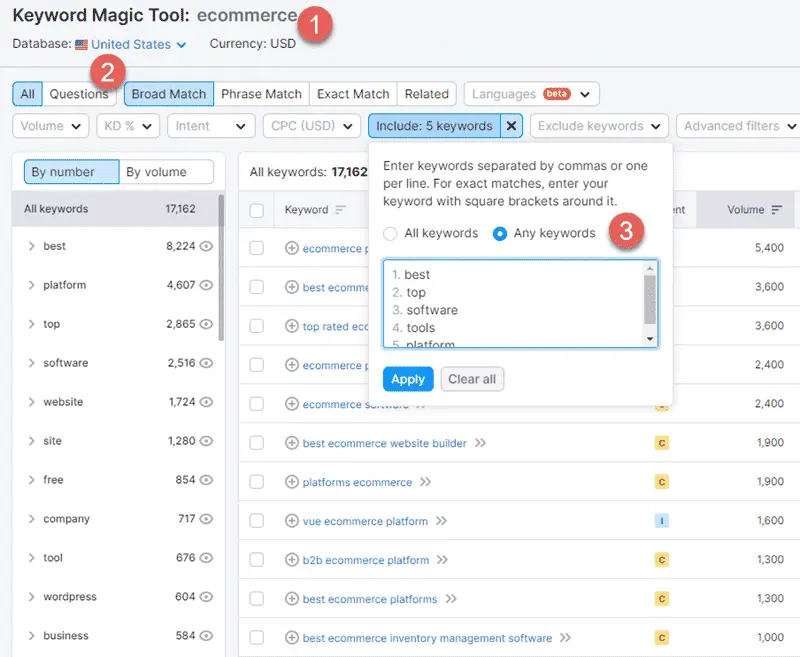
The Keyword Magic Tool: Allows users to segment keywords by topic, search intent, question type, and SERP features instantaneously, making topical clustering effortless.
The Keyword Gap Tool: Enables side-by-side keyword comparisons against up to five competitors, surfacing untapped organic and paid search opportunities.
2. Google Keyword Planner: Straight from the Source
While many modern SEOs decry its shift toward aggregated keyword groupings, veterans continue to lean on GKP. As Luke Monaghan, International SEO Manager at Lululemon, and numerous others point out, having visibility into paid search bids and official baseline metrics ensures marketers stay grounded in commercial realities.
3. Ahrefs Keywords Explorer: The Backlink & SERP Authority
Ahrefs earned widespread acclaim for its analytical depth. Contributors regularly cited its Keyword Ideas Report and granular SERP position history. By pairing search volume data with backlink profiles, Ahrefs allows marketers to realistically gauge whether they can break onto page one.
Expert Insights: Diverse Perspectives from the Trenches
While the big three platforms secured the lion’s share of the votes, the true value of our 139-expert survey lies in the unique combinations and alternative workflows shared by industry leaders.
The Power of Human-Centric & Semantic Research
A recurring theme among advanced practitioners was that tools alone are insufficient.
Kurt Frankenberg of Shoestring101 emphasized that his primary keyword research methodology involves actual human interaction: "My first, second, and third SEO tool is… actual human interaction, plus a yellow pad to jot down responses." By asking paying customers how they searched for a service, marketers uncover natural phrasing and slang that software databases frequently miss.
Paul Shapiro, Technical SEO Lead at Shopify, advocates for advanced workflows utilizing tools like MarketMuse for topic modeling and Seed Keywords to gather direct consumer feedback on search queries.
Leveraging Free and Niche-Specific Tools
Many experts noted that secondary and free applications play a vital role in rounding out an effective SEO strategy:
Google Search Console (GSC): Widely cited as the most underutilized tool in SEO. Leaders like Chris Dreyer (Rankings.io) and Charlie Williams (Screaming Frog) noted that GSC provides unvarnished data on what terms a site is already ranking for, unlocking immediate optimization wins.
AnswerThePublic & alsoasked.com: Praised by content strategists like John Doherty and Brogan Renshaw for uncovering question-based long-tail queries and mapping user search intent.
Keywords Everywhere: This browser extension received numerous nods for injecting search volume data directly into Google SERPs, autosuggest boxes, and Google Trends on the fly.
Official Statements & Industry Consensus
The collective wisdom of 139 practitioners yields several key takeaways for digital marketers heading into the future:
Say Goodbye to Single-Tool Reliance: No single platform holds a monopoly on accurate data. Experts consistently advocate for a "synergistic stack"—combining an all-in-one suite (like Semrush or Ahrefs) with data-enrichment utilities (like GSC, Google Trends, or a browser extension).
Intent Trumps Volume: As Brendan Hufford (ActiveCampaign) noted, ranking for a high-volume keyword is meaningless if the content does not match the user’s search intent. Modern keyword research must evaluate why people are searching, not just what they are typing.
Competitive Intelligence is Non-Negotiable: Whether evaluating organic keyword gaps or analyzing paid ad history to determine commercial intent, spying on competitors via tools like Semrush, Ahrefs, and SpyFu has become standard operating procedure for high-growth brands.
Future Outlook: The Evolution of Keyword Research
As search engines incorporate sophisticated machine learning models, natural language processing (NLP), and generative AI into their algorithms, the nature of keyword research continues to evolve. Tools like Keyword Insights are already automating semantic clustering at scale, shifting the marketer’s role from manual spreadsheet sorting to strategic content architecture.
However, the core principle remains unchanged: successful digital marketing starts with deeply understanding the audience. Whether you rely on the multi-billion-keyword database of Semrush, the backlink precision of Ahrefs, or old-fashioned conversations with real customers, the tools are merely vehicles. It is the strategist’s ability to interpret search intent, map buyer journeys, and craft exceptional content that ultimately wins the SERP.
Thank you to all 139 search marketing experts who contributed their insights to this comprehensive industry review. Stay tuned as we continue to track the tools shaping the future of SEO.