In the summer of 2024, a groundbreaking exploratory user research study set out to answer a pressing question in the tech industry: How can product teams effectively perform accessibility testing with individuals who have cognitive disabilities? Driven by Fable—where I serve as VP of Innovation—alongside academic partners at the University of California, Irvine, this research sought to evaluate whether participants with cognitive access needs uncover richer, more actionable usability insights than the general population.
The findings were definitive. Across three distinct AI-prototyped websites, participants with cognitive disabilities identified 1.8 times more usability issues and made 1.8 times more constructive suggestions than general population (gen pop) participants.
Cognitive disability—an umbrella term encompassing conditions that impact memory, focus, and information processing—is the most prevalent disability type in the United States, affecting 13.9% of the population according to the Centers for Disease Control and Prevention (CDC). Furthermore, data from Yale University shows that cognitive disabilities are increasing rapidly among U.S. adults.
Despite this massive demographic footprint, cognitive accessibility is frequently sidelined in product design cycles. This investigative report explores how integrating cognitive participants into UX research does not merely check an accessibility box; it transforms the entire digital experience, reducing cognitive load, boosting conversion rates, and building superior digital products for every single user.
Detailed Chronology: From Pilot Study to Comprehensive Usability Testing
To understand how we arrived at these conclusive metrics, it is vital to trace the step-by-step chronology of the research methodology developed by our expert working group.
Phase 1: Establishing Best Practices (Summer 2024)
As co-chair of a specialized working group of research experts, my initial objective was to determine best practices for running user interviews with individuals experiencing cognitive challenges. We began by reviewing existing published studies involving cognitive testers. Following this literature review, we drafted a targeted screener to recruit individuals who self-identified as having difficulties with memory, focus, and learning.
Phase 2: The Pilot Study
We tested our preliminary recruitment and interviewing methods with an initial cohort of 25 cognitive testers. Through iterative fine-tuning, we developed a comprehensive guide for conducting interviews with cognitive participants, alongside a specialized survey designed to quantify their digital product experiences. These findings were documented extensively to establish a repeatable framework.
Following the pilot, a compelling hypothesis emerged: Cognitive testers would naturally surface a significantly higher density of usability flaws than the traditional general population participants typically leveraged in corporate UX research. To validate this intuition, I partnered with Syed Fatiul Huq at the University of California, Irvine, alongside Fable researchers Pranav Pidathala, Ali Brown, and Michael Fagan.
Phase 3: The Multi-Website Usability Study
To test a wide array of user journeys, goals, and content architectures, we utilized an AI prototyping tool to generate three distinct websites:
Strong Snacks: A minimalistic, bright, brutalist website dedicated to three-ingredient high-protein recipes, featuring blog posts, category filtering, and a newsletter sign-up.
Turning Pages: A moodier, classic e-commerce bookstore featuring extensive genre filtering, a custom book-matching swiping feature, personalized lists, and a full checkout cart.
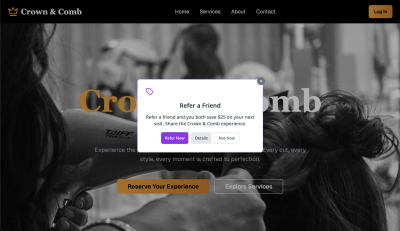
Crown & Comb: A bold, high-contrast, black-and-white hair salon website with intricate service bookings, VIP programs, and intentionally complex navigation designed to test difficult user flows (such as locating an elusive bridal package).
We executed 30 moderated online user interviews (10 per website), splitting participants evenly between cognitive self-identifiers and general population controls. At the conclusion of every session, participants completed the Accessible Usability Scale (AUS)—a free, Creative Commons-licensed 10-question survey measuring digital product usability on a scale from 0 to 100.
Supporting Context & Metrics: Data Analysis & Findings
To maintain absolute consistency, I personally reviewed all study recordings and transcripts. Every instance of a participant raising a concern, stumbling over functionality, missing a crucial task element, or proposing an improvement was meticulously cataloged as an "issue" or "suggestion."
Aggregate Results Across Three Websites
Across all evaluations, the quantitative data decisively confirmed our initial hypothesis:
Total Issues Identified: Cognitive participants surfaced 197 usability issues, compared to just 113 by the general population.
Total Suggestions Made: Cognitive participants offered 93 constructive recommendations, compared to 54 from the general population.
Proportional Multiplier: Across the board, cognitive users found 1.8x more issues and proposed 1.8x more improvements.
Website-by-Website Breakdown
1. Strong Snacks (Simple & Minimalist)
Given its simple brutalist design, this site recorded the lowest overall issues and highest median AUS scores. However, the disparity between user groups remained stark:
Gen Pop: Averaged 6.4 issues, 2.6 suggestions, and an AUS score of 90.5.
Cognitive: Averaged 9.8 issues (+3.4), 4.8 suggestions (+2.2), and an AUS score of 76.8 (13.7 points lower).
2. Turning Pages (Feature-Rich E-Commerce)
As the most complex site with four core tasks, this platform generated the highest volume of friction:
Gen Pop: Averaged 11 issues, 5.2 suggestions, and an AUS score of 78.0.
Cognitive: Averaged 17 issues (+6), 8.4 suggestions (+3.2), and an AUS score of 60.8 (17.2 points lower).
3. Crown & Comb (Intentional Complexity)
Designed to frustrate users with hidden pathways (specifically Task 3: finding the bridal package), this site yielded fascinating behavioral divergences:
Gen Pop: Averaged 5 issues, 3 suggestions, and an AUS score of 49.5.
Cognitive: Averaged 12 issues (+7), 5.4 suggestions (+2.4), and an AUS score of 63.8 (14.3 points higher than gen pop).
Why did cognitive participants rate Crown & Comb higher than Turning Pages, while general users did the exact opposite? Qualitative analysis reveals that the sheer number of unpredictable interaction errors on Turning Pages severely degraded cognitive participants’ confidence, whereas the avant-garde layout of Crown & Comb set clear expectations of difficulty right from the start.
Categorical Issue Distribution
When grouping issues by category, cognitive participants overwhelmingly surfaced problems tied to Content, Buttons and Links (affordances and function), Icons and Visual Elements, and Media (video/animations).
Issue Category
Gen Pop (Strong Snacks)
Cognitive (Strong Snacks)
Gen Pop (Turning Pages)
Cognitive (Turning Pages)
Gen Pop (Crown & Comb)
Cognitive (Crown & Comb)
Content
11
22
11
30
23
36
Navigation
18
22
25
17
2
7
Buttons & Links
0
5
7
20
3
0
Icons / Visuals
3
16
2
3
4
23
Media
0
2
0
1
0
0
Official Statements & Qualitative Insights
The qualitative impact of poorly optimized digital environments goes far beyond simple annoyance; it fundamentally drains a user’s emotional and cognitive reserves.
Consider the qualitative contrast between two participants who gave the lowest AUS scores during the Crown & Comb sessions:
General Population Participant: "As soon as you have a name of a treatment and a little explanation and like the duration and the price, as soon as you click onto that, it should be that you can interact with that service straight away. And I feel like if you’re seeing a service repeated on a page multiple times and you’re still not able to select it, it’s really, really frustrating. This feels not particularly engaging."
Cognitive Accessibility Participant: "For example, like, the mental energy aspect of it, like, sometimes there’s, like, okay, cookies, and then ads, pop-ups, or maybe the website or service has too many options to look through, and maybe I just want something that I already know. I have to go through a lot of stuff. It makes me, like, feel drained and less able to focus."
While the general population user experienced transient frustration regarding feature execution, the cognitive participant suffered from measurable fatigue and a diminished capacity to focus. When usability flaws multiply, they cross an invisible boundary, transforming from simple design bugs into absolute accessibility barriers.
As one UX Manager at Bell Media famously noted regarding inclusive testing:
"2 sessions with cognitive users feel like 200 because of the volume of insights we get."
Future Outlook: Why Cognitive Inclusion is Non-Negotiable
The imperative to integrate cognitive accessibility into standard UX pipelines is no longer theoretical—it is an economic and demographic necessity.
The Graying Population Wave
According to U.S. Census projections, the percentage of Americans aged 65 and older is climbing steeply from 17% to 25%. By 2060, one in four Americans will be an older adult. As the population ages, cognitive decline becomes an universal human experience. Companies that fail to design for simpler information processing, clear predictability, and reduced cognitive load will find themselves obsolete in an aging marketplace.
The Business Case for Inclusion
Failing to account for cognitive access needs directly damages business outcomes:
E-Commerce Leakage: Unclear cart interactions and ambiguous checkout flows on sites like Turning Pages systematically erode consumer trust and bleed revenue.
Customer Retention: General population users may "muddle through" a poorly designed site, but they will readily abandon ship the moment a cleaner competitor emerges. Brand loyalty is inextricably linked to effortless user experiences.
An On-Ramp to Broader Accessibility: For development teams overwhelmed by the complexities of testing for screen readers, screen magnifiers, or alternative navigation, cognitive accessibility provides a natural, intuitive starting point. Focusing first on clarity, predictable affordances, and minimal cognitive load builds a robust foundation for all subsequent accessibility efforts.
Conclusion
Cognitive inclusion in UX research is not a niche charity initiative; it is an optimization engine. By listening to users with cognitive access needs, product teams can streamline content, simplify user flows, and ship digital products that perform better for everyone.
Cognitive inclusion in UX research is not optional, and it’s not just about accessibility. It’s how UX teams can make their research more efficient, create clearer content, simpler flows, and ship better products for everyone.