

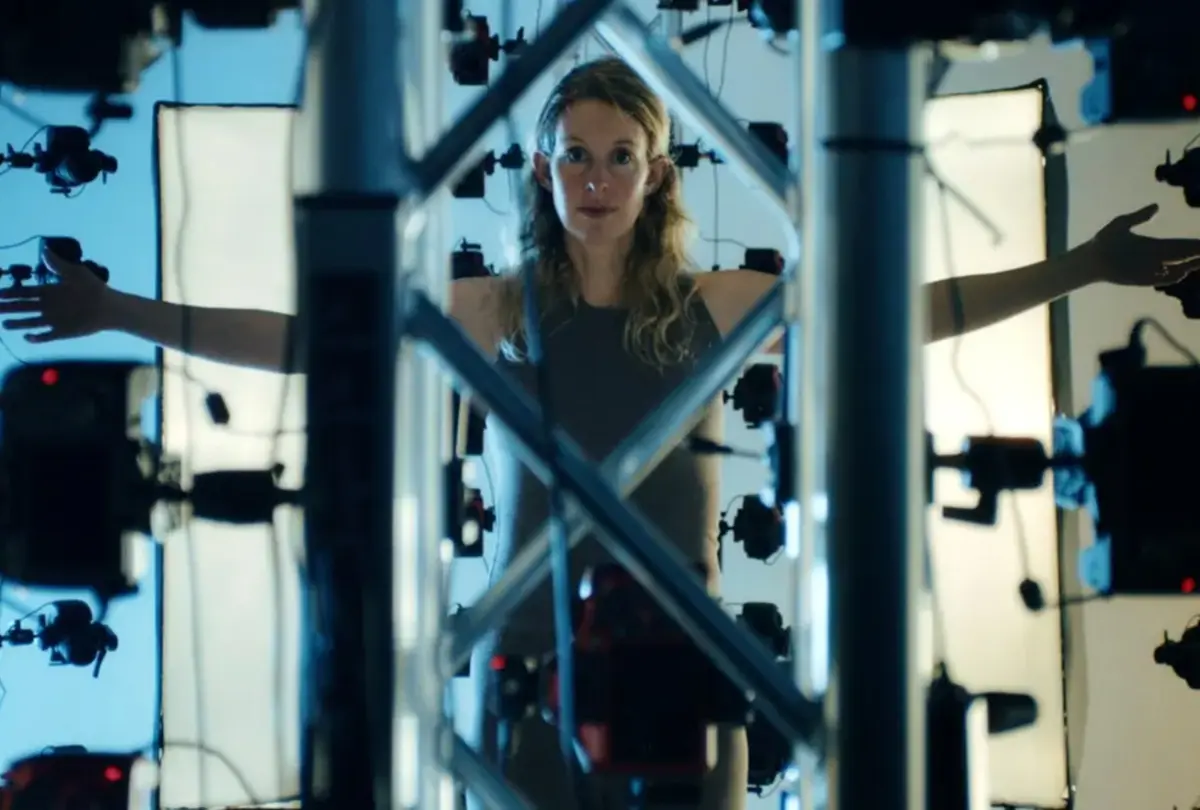
Executive Overview
In the sprawling landscape of contemporary documentary filmmaking, few projects arrive with the meta-textual weight, psychological density, and structural audacity of You Can See Everything. Directed by Nathan Fielder and Lance Oppenheim—and distributed by A24—the film centers on one of the most polarizing and parodied figures of the 21st century: Elizabeth Holmes, the disgraced founder of the defunct, fraudulent blood-testing startup Theranos.
Set against the ticking clock of Holmes’ impending 11-year federal prison sentence, the documentary avoids the well-trodden paths of investigative exposés like Hulu’s The Dropout or ABC’s The Inventor. Instead, it operates as a profound, often devastating character study. By fusing Fielder’s signature deadpan social probing with Oppenheim’s knack for immersive, hyper-stylized cinematic portraiture, You Can See Everything contextualizes fact with fiction, performance with pathology, and cold deception with a startling, almost cosmic brand of human tragedy.
At its core, the film asks an uncomfortable question: What happens when an individual is so completely consumed by their own mythology that they lose the ability to differentiate between manipulation and reality? Through intimate dinner table discussions in a San Diego rental, agonizingly awkward media literacy tests, and piercing examinations of the men who have orbited Holmes’ life, Fielder and Oppenheim have constructed a landmark work of metafiction. It challenges audiences to reconsider not just Elizabeth Holmes, but the performative nature of modern human existence itself.
Detailed Chronology & Production Context
The genesis of You Can See Everything is as unconventional as the subjects it portrays. Filming commenced in late 2026, precisely 34 days before Holmes was scheduled to surrender to federal authorities to begin serving her decade-plus sentence for wire fraud and conspiracy. For years following her conviction, Holmes had retreated from the public eye, her iconic turtleneck, baritone voice, and manicured persona reduced to internet lore and cautionary corporate folklore.
The timeline of the documentary’s production reads like a slow-motion psychological unspooling:
- The Approach: Fielder, whose HBO series The Rehearsal and How to With John Wilson famously blurred the boundaries between staged social experiments and authentic human vulnerability, approached Holmes with a proposal. Rather than a traditional interview, the production would serve as an observational sandbox—a space to examine how Holmes processes her impending incarceration and the public perception of her downfall.
- The San Diego Enclave: Production established a base in a rented beachside home in San Diego, California. Here, Holmes lived alongside her husband, hotel-chain heir William Evans, and briefly hosted visits from her parents. It is within the claustrophobic confines of this domestic setting that the documentary’s most vital interactions occur.
- The Disassembly of Theranos: In an early, surreal sequence, components of a deconstructed Theranos blood-analyzer are laid out across a dining room table. Holmes attempts to explain the mechanics of the device and where public misunderstanding occurred, only to collide once again with her inability to articulate complex concepts in a way that aligns with empirical reality.
- The Abbott and Costello Interlude: Roughly one-third of the way through the film, Fielder gathers Holmes and Evans on a living room couch to screen Abbott and Costello’s legendary "Who’s on First?" comedy routine. The sequence spirals from a lighthearted cinematic exercise into an emotional watershed moment, exposing Holmes’ profound disconnect from basic linguistic and conceptual nuances.
- The Third-Act Surprise: As the documentary progresses into its latter half, the arrival of an unexpected guest alters the trajectory of the narrative entirely, transforming the project into one of the most startling exercises in metafiction ever captured on celluloid.
Supporting Context & Metrics: The Anatomy of a Modern Huckster
To understand the resonance of You Can See Everything, one must examine the cultural ecosystem that birthed Elizabeth Holmes. At its peak, Theranos was valued at $9 billion, backed by elite venture capitalists, seasoned politicians, and media moguls, all seduced by the promise of a proprietary microfluidic technology that could run comprehensive blood tests from a single drop of blood.
When the house of cards collapsed following investigative reports by The Wall Street Journal’s John Carreyrou, the fallout was quantified in stark financial and legal metrics:
- Financial Loss: Investors lost an estimated hundreds of millions of dollars, with high-profile backers including media titan Rupert Murdoch and the Walton family absorbing heavy write-downs.
- Legal Judgment: Holmes was convicted on four counts of wire fraud and conspiracy in January 2022, culminating in an 11-year prison sentence.
- Cultural Footprint: The saga generated dozens of investigative podcasts, books, scripted television series (The Dropout), and feature-film adaptations, cementing Holmes as the definitive symbol of Silicon Valley’s "fake it ’til you make it" ethos.
Yet, while previous retellings focused on the mechanics of the fraud, You Can See Everything shifts the aperture toward neurodevelopmental patterns, behavioral masking, and trauma. The documentary introduces crucial context regarding Holmes’ past, notably a sexual assault she experienced at age 19 while attending Stanford University—a turning point her father, Christian Holmes, identifies as the catalyst for her dropping out and founding Theranos.
Furthermore, the film scrutinizes the domestic dynamics between Holmes and her husband, William Evans. Evans’ pervasive need to control the narrative—whether by interrupting interviews or dictating mundane household tasks—draws unsettling parallels to Holmes’ former romantic and business partner, Sunny Balwani, as well as her childhood trauma. Fielder’s camera captures the grim irony of a woman who built an empire on fabricated realities, only to find herself enveloped in a marriage defined by narrative management and emotional obfuscation.
Official Statements and Critical Reception
The arrival of You Can See Everything has ignited intense debate across cultural and cinematic institutions. While A24 has positioned the film as a crowning achievement in experimental documentary non-fiction, critics and legal analysts have parsed its ethical implications.
In promotional materials and early festival screenings, co-directors Nathan Fielder and Lance Oppenheim have emphasized that the film was never designed to be an investigative deposition.
"We weren’t interested in litigating the trial or finding a smoking gun," production notes suggest the filmmakers aimed to explore. "We wanted to look at the space where a person’s internal narrative becomes so disconnected from consensus reality that they can no longer find the exit."
Legal observers, conversely, have raised questions about the timing of the documentary. Filmed mere weeks before Holmes’ surrender, the project has been interpreted by some as a calculated maneuver by Holmes to shape her legacy before vanishing behind prison walls. The film’s very title—derived from a text message Holmes sent to Fielder during production reading, "You can see everything"—serves as an explicit acknowledgement of this tension. It dangles the illusion of total transparency while simultaneously weaponizing the camera’s inherent unreliability.
Early critical reception has hailed the film as a masterclass in discomfort. Reviewers have praised Fielder’s ability to disarm subjects not through aggressive interrogation, but through radical, unsettling empathy. The scene featuring the "Who’s on First?" sketch has been universally cited as a watershed moment in modern documentary history—a sequence where comedy bridges an impossible chasm of human incomprehension, resulting in tears that feel both manipulative and devastatingly real.
Future Outlook: The Legacy of a Meta-Documentary Experiment
As You Can See Everything rolls out to broader audiences, its long-term impact on the true-crime and documentary genres will likely be profound. For years, documentary filmmaking has trended toward either sensationalized exposés or dry, journalistic recaps. Fielder and Oppenheim have charted a third path: the subjective, self-reflexive meta-documentary.
By juxtaposing Fielder—a comedian defined by his hyper-awareness of social masking and artificiality—with Holmes—a corporate titan defined by her chilling, seemingly robotic lack of self-awareness—the film creates a fascinating dialectic. It posits that performance is not a unique pathology of fraudsters, but a fundamental mechanism of human survival in a society governed by rigid expectations of success.
For Elizabeth Holmes, the film serves as a monument constructed right at the precipice of oblivion. Whether her participation was an act of genuine vulnerability or a final, masterful confidence trick remains deliberately unresolved. But in leaving audiences with more questions than answers, You Can See Everything transcends the specifics of the Theranos scandal. It becomes an essential, haunting meditation on the limits of empathy, the loneliness of the human mind, and the terrifying cost of trying to make the world see a reality that exists only in your head.