In the fast-evolving landscape of search engine optimization (SEO), the modern marketer is routinely bombarded with an overwhelming array of software. Type “keyword research tools” into any search engine, and you will instantly find hundreds of top-10, top-20, or even top-100 lists. Rather than clarifying the path forward, this proliferation of options often leaves business owners, in-house marketers, and agency professionals paralyzed by choice.
To cut through the software marketing noise and get straight to the empirical truth, a targeted industry survey was conducted, putting a single, focused question to 139 of the world’s leading search marketing experts:
“If you could only use 3 tools for keyword research, which 3 would you choose?”
The goal was clear: strip away the marketing fluff and determine which platforms genuinely rise to the surface when seasoned professionals build profitable, high-performing organic and paid search campaigns. The results provide an unprecedented look into the actual toolkits powering the world’s top brands, agencies, and publishers.
Detailed Chronology and Industry Consensus
When analyzing the collective responses of 139 industry authorities, clear market leaders quickly emerge. While niche tools and scrappy alternatives populate individual responses, three software suites dominate the aggregate vote counts: Semrush (87 votes), Google Keyword Planner (57 votes), and Ahrefs (55 votes).
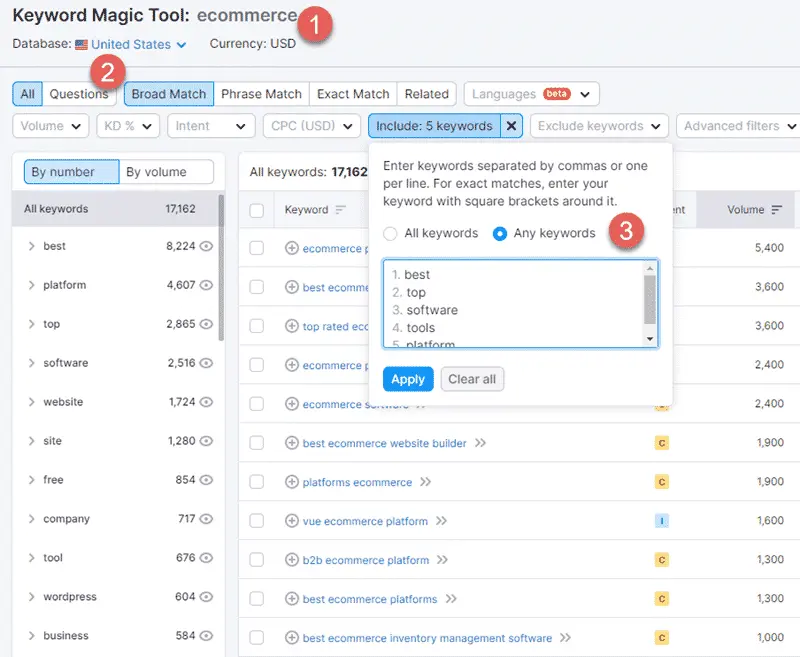
Securing the top spot with 87 votes, Semrush has cemented its status as an industry-leading, all-in-one SEO and digital marketing suite. Experts praised its massive international database—spanning over 23 billion keywords across 142 localized databases—and its exceptional balance of organic and PPC insights. Standout features highlighted by contributors include:
The Keyword Magic Tool: Highly regarded for its ability to segment keywords by topic, search intent, question type, and SERP features in seconds.
The Keyword Gap Tool: A favorite for competitive intelligence, allowing marketers to run side-by-side comparisons of up to five competing domains to uncover missed opportunities.
2. Google Keyword Planner
Despite transitioning primarily into a platform built for paid search advertisers, Google Keyword Planner pulled in 57 votes. While organic SEO professionals note its limitations—such as withholding exact search volume ranges for non-paying advertisers and lacking advanced filtering features—it remains the foundational baseline for pulling direct-from-source search data and initial keyword themes.
3. Ahrefs Keywords Explorer
Just behind with 55 votes, Ahrefs continues to be a powerhouse for technical and content-driven SEOs. Contributors heavily praised the Keyword Ideas Report for its cross-engine capabilities (pulling data from Google, Bing, Yahoo, YouTube, and Amazon) and the depth of its SERP overview metrics, which allow marketers to evaluate the actual traffic potential of a keyword based on backlink profiles.
Supporting Context & Metrics: How the Pros Operate
Beyond the big three, the expert consensus reveals a deeper tactical reality: professional SEOs rarely rely on a single software package. Instead, they curate specialized tool combinations tailored to specific stages of the content and optimization lifecycle.
The Rise of Topical Research and Search Intent
A recurring theme among top-tier practitioners is that traditional, isolated keyword metrics (like search volume and difficulty alone) are no longer enough. Modern SEO requires a focus on search intent and topical authority.
Experts like Brendan Hufford (Growth Content Marketer at ActiveCampaign) emphasize that writing for a single keyword without matching the underlying search intent is a recipe for failure:
"The best content ranks for thousands of keywords… simply doing the research and putting the keywords in the right places won’t help you rank if you don’t match the search intent."
To solve this, many contributors highlighted specialized semantic and intent-mapping tools:
AnswerThePublic & alsoasked.com: Widely cited as the premier resources for mapping question-based queries, prepositions, and long-tail variations derived from user behavior.
Keyword Insights: Leveraging natural language processing (NLP) and machine learning to cluster thousands of keywords automatically, helping marketers decide whether to target terms on a single page or split them into distinct content pieces.
SurferSEO & MarketMuse: Essential tools for content optimization, utilizing semantic algorithms to analyze top-ranking SERP competitors and build comprehensive content briefs.
Uncovering "Not Provided" and Zero-Click Gems
Several enterprise-level practitioners underscored the importance of mining internal data sources that competitors cannot see:
Google Search Console (GSC): Frequently championed as an underutilized goldmine. SEOs use GSC to identify terms where a site already generates high impressions but low click-through rates (CTR), signaling easy optimization wins.
First-Party Customer Research: Industry veterans like Carrie Hill (Sterling Sky) and Kurt Frankenberg (Shoestring101) reminded the SEO community that software cannot always replace human conversation. Interviewing customer service teams and talking directly to buyers often reveals unique slang, regional terminology, and intent triggers that no keyword database has indexed yet.
Official Statements and Expert Perspectives
The 139 expert submissions showcase a diverse range of operational strategies. Here is a curated cross-section of how industry leaders approach their daily keyword workflows:
Luke Monaghan (International SEO Manager, lululemon):
"If I had to choose three keyword research tools… 1) Semrush for the competitive insight… 2) SISTRIX for historical keyword performance and client-friendly visibility charts… 3) Keywordtool.io for long-tail variants. SEO has moved on from just targeting an exact-match, vanity keyword."
John Doherty (Founder, Credo):
"Ahrefs is killer for topic research. Semrush provides me domain-level analysis for competitors. Answer The Public nails question-based keyword research."
Paul Shapiro (Technical SEO Lead, Shopify):
"Instead of focusing on the 3 tools that everyone needs to cover the basics [Volume, Ideas, Depth], I’ll give you my top 3 to go above-and-beyond: KNIME for open-ended semantic analysis, MarketMuse for sophisticated topic modeling, and Seed Keywords to bring a direct human element to the research."
Nichole Elizabeth DeMeré (B2B SaaS Consultant):
"I use multiple keyword research tools at the same time… Ahrefs to find ideas and difficulty scores, Semrush for inspiration and brainstorming (with the largest database on the market), and Moz to track rankings. If I only used one of them, my strategies wouldn’t be nearly as effective."
Spencer Hawes (Founder, Niche Pursuits):
"Long Tail Pro differentiates itself because it provides you with an idea of how difficult a keyword is to rank for… Google Trends is an interesting way to see if a keyword is growing or shrinking… and Semrush is very useful for researching competitors and finding weaker niche sites ranking for valuable terms."
Future Outlook: The Evolution of Keyword Research
As search engines incorporate more sophisticated artificial intelligence, machine learning, and zero-click search features, the definition of "keyword research" continues to transform.
The insights shared by 139 of the industry’s sharpest minds point to three major shifts for the future of search marketing:
From Keywords to Entities and Topics: The era of stuffing exact-match variations into an article is dead. Future-proof SEO strategies focus on topic clusters, semantic relationships, and fulfilling the holistic intent of the user. Tools that utilize AI-driven content clustering and NLP analysis will become standard requirements rather than optional nice-to-haves.
Cross-Platform Search Discovery: Users no longer search exclusively on Google. With platforms like Amazon, YouTube, TikTok, and Bing capturing massive shares of product and informational queries, multi-engine keyword discovery (via tools like KeywordTool.io, Ahrefs, and specialized scrapers) is mandatory for comprehensive market coverage.
The Blending of Data and Human Insight: The most successful marketers of tomorrow will combine the raw algorithmic power of platforms like Semrush and Ahrefs with qualitative feedback extracted directly from customer service interactions, sales calls, and user surveys.
Summary Recap
When building out your SEO tech stack, the overwhelming consensus from 139 experts is clear: you do not need dozens of tools. Master an all-in-one competitive powerhouse like Semrush or Ahrefs, pair it with an ideation engine like AnswerThePublic or Google Keyword Planner, and anchor your entire strategy in a deep understanding of user intent.
What is your go-to keyword research stack? The debate continues in the industry—choose your tools wisely and let the data guide your growth.


![139 Experts Reveal Best Keyword Research Tools [Leaderboard]](https://www.robbierichards.com/wp-content/uploads/2021/01/Best-Keyword-Research-Tools-for-SEO.jpg)
![139 Experts Reveal Best Keyword Research Tools [Leaderboard]](https://www.robbierichards.com/wp-content/uploads/2021/10/Semrush-home-page-screenshot.jpg)
![139 Experts Reveal Best Keyword Research Tools [Leaderboard]](https://www.robbierichards.com/wp-content/uploads/2022/05/image12.png)
![139 Experts Reveal Best Keyword Research Tools [Leaderboard]](https://www.robbierichards.com/wp-content/uploads/2022/06/Keyword-Gap-Tool.jpg)
![139 Experts Reveal Best Keyword Research Tools [Leaderboard]](https://www.robbierichards.com/wp-content/uploads/2018/08/rj-employee_Robbie-color-new.png)
![139 Experts Reveal Best Keyword Research Tools [Leaderboard]](https://www.robbierichards.com/wp-content/uploads/2022/06/Google-Keyword-Planner.jpg)
![139 Experts Reveal Best Keyword Research Tools [Leaderboard]](https://www.robbierichards.com/wp-content/uploads/2022/06/Ahrefs-home-page.jpg)
![139 Experts Reveal Best Keyword Research Tools [Leaderboard]](https://www.robbierichards.com/wp-content/uploads/2021/08/Luke-Monaghan-headshot.jpg)
![139 Experts Reveal Best Keyword Research Tools [Leaderboard]](https://www.robbierichards.com/wp-content/uploads/2021/08/Gael-Breton-headshot.jpg)
![139 Experts Reveal Best Keyword Research Tools [Leaderboard]](https://www.robbierichards.com/wp-content/uploads/2015/04/KW-Expert-Roundup.jpg)
![139 Experts Reveal Best Keyword Research Tools [Leaderboard]](https://www.robbierichards.com/wp-content/uploads/2019/05/John-Doherty-150x150.jpg)
![139 Experts Reveal Best Keyword Research Tools [Leaderboard]](https://www.robbierichards.com/wp-content/uploads/2015/04/ana_hoffman.jpg)
![139 Experts Reveal Best Keyword Research Tools [Leaderboard]](https://www.robbierichards.com/wp-content/uploads/2021/08/Paul-Shapiro-headshot.jpg)
![139 Experts Reveal Best Keyword Research Tools [Leaderboard]](https://www.robbierichards.com/wp-content/uploads/2021/08/Chris-Castillo.jpg)
![139 Experts Reveal Best Keyword Research Tools [Leaderboard]](https://www.robbierichards.com/wp-content/uploads/2021/08/Matthew-Barby-headshot.jpg)
![139 Experts Reveal Best Keyword Research Tools [Leaderboard]](https://www.robbierichards.com/wp-content/uploads/2017/08/Chris-Dreyer-Rankings.io_-150x150.jpg)
![139 Experts Reveal Best Keyword Research Tools [Leaderboard]](https://www.robbierichards.com/wp-content/uploads/2017/06/Adam-Connell-Blogging-Wizard-150x150.jpg)
![139 Experts Reveal Best Keyword Research Tools [Leaderboard]](https://www.robbierichards.com/wp-content/uploads/2021/08/Rich-Missey-headshot.jpg)
![139 Experts Reveal Best Keyword Research Tools [Leaderboard]](https://www.robbierichards.com/wp-content/uploads/2017/08/Charlie-Williams-Screaming-Frog-150x150.jpg)
![139 Experts Reveal Best Keyword Research Tools [Leaderboard]](https://www.robbierichards.com/wp-content/uploads/2015/04/ChristineChurchill-Red-150_400x400.jpg)
![139 Experts Reveal Best Keyword Research Tools [Leaderboard]](https://www.robbierichards.com/wp-content/uploads/2021/08/Everett-Sizemore-headshot.jpg)
![139 Experts Reveal Best Keyword Research Tools [Leaderboard]](https://www.robbierichards.com/wp-content/uploads/2021/08/Brogan-Renshaw.jpg)
![139 Experts Reveal Best Keyword Research Tools [Leaderboard]](https://www.robbierichards.com/wp-content/uploads/2018/04/Melissa-Fach-150x150.jpg)
![139 Experts Reveal Best Keyword Research Tools [Leaderboard]](https://www.robbierichards.com/wp-content/uploads/2021/08/Ian-Cleary-headshot.jpg)
![139 Experts Reveal Best Keyword Research Tools [Leaderboard]](https://www.robbierichards.com/wp-content/uploads/2021/08/Brian-Dean-headshot.jpg)
![139 Experts Reveal Best Keyword Research Tools [Leaderboard]](https://www.robbierichards.com/wp-content/uploads/2018/04/Liz-Cortez-150x150.jpg)
![139 Experts Reveal Best Keyword Research Tools [Leaderboard]](https://www.robbierichards.com/wp-content/uploads/2021/08/Jon-Morrow-headshot.jpg)
![139 Experts Reveal Best Keyword Research Tools [Leaderboard]](https://www.robbierichards.com/wp-content/uploads/2018/11/Kevin-Indig-150x150.jpg)
