

Executive Overview
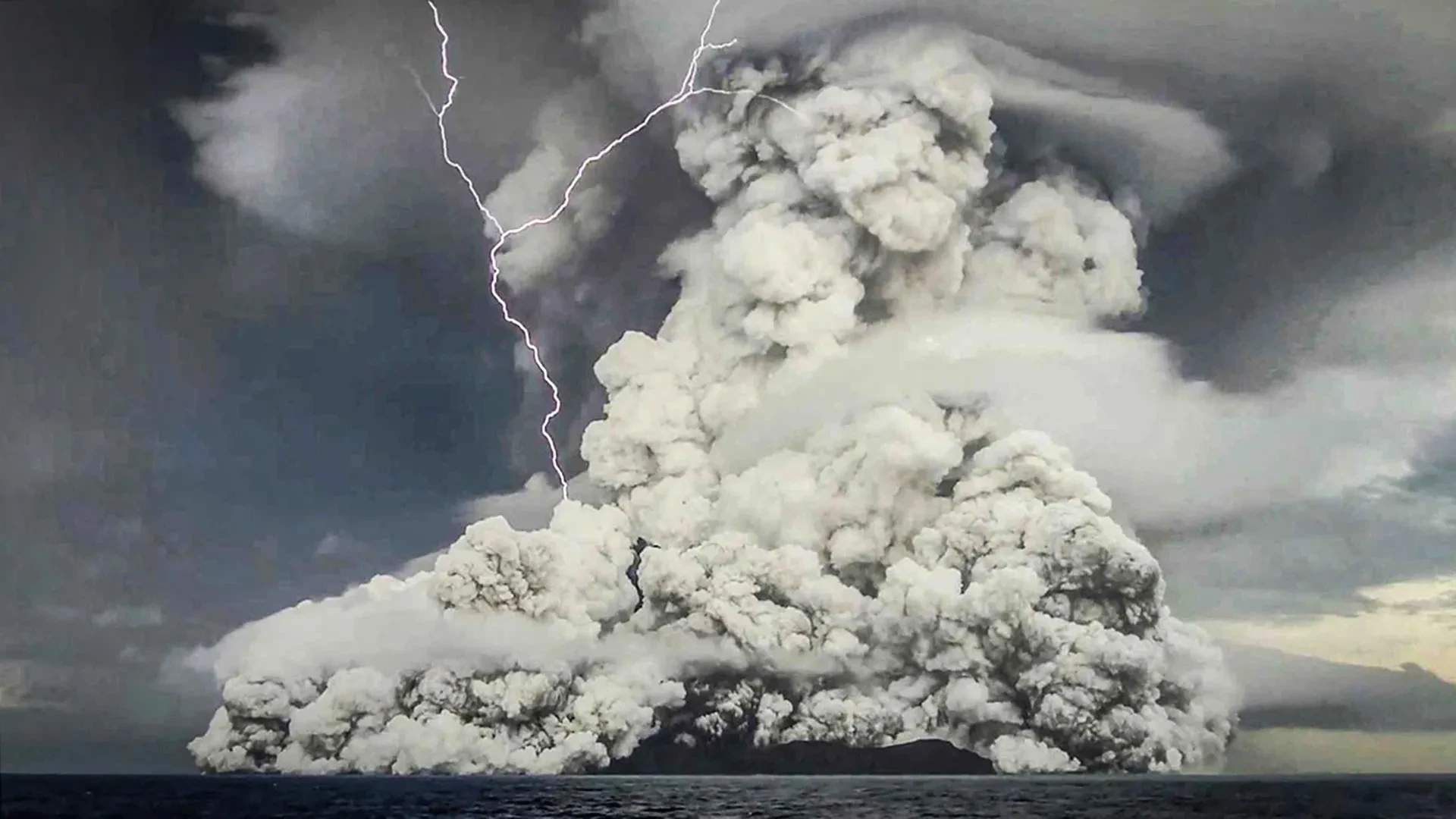
When the Hunga Tonga-Hunga Ha’apai submarine volcano erupted beneath the South Pacific waves in January 2022, it unleashed one of the most cataclysmic natural explosions of the modern era. The colossal blast sent shockwaves around the globe, triggered tsunami waves across oceans, and injected unprecedented volumes of water vapor and particulate matter high into the stratosphere.
Yet, amidst the violence of this geological behemoth, researchers have uncovered a deeply counterintuitive and astonishing silver lining. A team of international scientists has discovered that the massive plume generated by the eruption did not merely pollute the atmosphere; it actively helped cleanse it. By acting as a massive, high-altitude chemical laboratory, the volcanic cloud catalyzed the destruction of massive quantities of methane—a potent greenhouse gas—offering humanity a fascinating, albeit volatile, blueprint for potential future climate interventions.
Published in the journal Nature Communications, the study highlights a previously unknown chemical pathway involving volcanic ash, salty seawater, and intense sunlight. As researchers tracked the drifting plume via advanced satellite instrumentation for ten days all the way to South America, they realized they were witnessing a continuous, large-scale methane-destruction machine.
This unexpected revelation arrives at a critical juncture for climate science. Methane accounts for roughly one-third of current global warming. While carbon dioxide dominates long-term climate discussions due to its centuries-long persistence, methane traps heat with ferocious efficiency—roughly 80 times more potently than carbon dioxide over a 20-year timescale. Because methane breaks down naturally in the atmosphere within about a decade, experts view it as an "emergency brake" for the climate system: rapidly slashing methane emissions could yield noticeable cooling benefits within a generation.
Understanding how nature accelerates this breakdown opens up daring new avenues for atmospheric research, potentially inspiring engineered approaches to methane removal while forcing scientists to rewrite the global accounting formulas that track greenhouse gases.
Detailed Chronology: From Submarine Blast to Satellite Discovery
The chain of events leading to this groundbreaking discovery began in the remote waters of the Tongan archipelago and played out across computer screens and satellite telemetry laboratories thousands of miles away.
Phase 1: The Cataclysmic Explosion (January 2022)
The Hunga Tonga-Hunga Ha’apai volcano sat submerged beneath the South Pacific, its caldera hidden from view until a series of violent phreatomagmatic eruptions—triggered by the violent interaction of molten magma and cold seawater—shattered the silence. On January 15, 2022, the final, supreme blast ripped through the ocean surface. It was heard as far away as Alaska and registered on barometers worldwide. The eruption punched a hole straight through the troposphere and injected tens of millions of tons of water vapor, sulfur dioxide, and pulverized rock directly into the stratosphere, an altitude rarely reached by typical volcanic plumes.
Phase 2: The Airborne Anomalies
As the plume spread across the Southern Hemisphere, Earth-orbiting satellites began scanning its composition. Among these was the TROPOMI (TROPOspheric Monitoring Instrument) aboard the European Space Agency’s Sentinel-5P satellite. Designed primarily to monitor air quality and trace gases in the lower atmosphere, TROPOMI was suddenly tasked with reading a chaotic, high-altitude stratospheric brew.
Scientists analyzing the data noticed an anomaly: exceptionally high concentrations of formaldehyde. In atmospheric chemistry, formaldehyde ($HCHO$) is a well-known intermediate byproduct. It is created briefly during the chemical reactions that break down methane. Because formaldehyde degrades within a matter of hours, finding massive, sustained quantities of it acted as a chemical "smoking gun," indicating that methane destruction was not just happening, but was actively ongoing within the plume on a massive scale.
Phase 3: Tracking the Plume Across Oceans
Dr. Maarten van Herpen of Acacia Impact Innovation BV, the lead author of the study, and his colleagues tracked the formaldehyde signature as the volcanic cloud drifted eastward.
"When we analyzed the satellite images, we were surprised to see a cloud with a record-high concentration of formaldehyde," Dr. van Herpen noted. "We were able to track the cloud for 10 days, all the way to South America. Because formaldehyde only exists for a few hours, this showed that the cloud must have been destroying methane continuously for more than a week."
This persistent destruction shattered existing paradigms. While scientists had long known that active volcanoes emit methane during eruptions, the idea that volcanic ejecta could simultaneously tear that pollutant apart was entirely unprecedented.
Supporting Context & Metrics: The Chemistry of the Plume
To understand why this discovery stunned the scientific community, one must examine the complex choreography of atmospheric chemistry, oceanic minerals, and solar radiation that made it possible.
The Iron Salt Aerosol Mechanism
The chemical pathway behind the Hunga Tonga phenomenon has a recent precedent, though in an entirely different environmental context. In 2023, scientists discovered that Saharan dust blown across the Atlantic Ocean can mix with sea salt generated by breaking waves. This union creates microscopic airborne particles known as iron salt aerosols.
When sunlight strikes these iron salt aerosols, a cascade of photochemical reactions releases highly reactive chlorine atoms. Chlorine acts as an atmospheric battering ram; it is intensely reactive and aggressively attacks stable methane ($CH_4$) molecules, stripping away hydrogen atoms and breaking the gas down into simpler, less harmful compounds. Until recently, this chemistry was understood to occur primarily within the troposphere.
Stratospheric Surprises
The Hunga Tonga eruption supercharged this process by thrusting the essential ingredients—salty seawater and mineral-rich volcanic ash—directly into the stratosphere.
- The Ingredients: The submarine nature of the eruption blasted enormous quantities of brine and pulverized rock upward.
- The Catalyst: Intense, unobstructed stratospheric sunlight beat down upon this mixture of ash and sea salt.
- The Reaction: The sunlight triggered the release of reactive chlorine atoms, which immediately set to work dismantling the methane present in the plume.
Quantifying the Impact: The Numbers Behind the Eruption
The scale of this natural chemistry is staggering when translated into real-world equivalents. According to the research team’s quantitative models:
- Methane Emission: The volcano initially released approximately 300 gigagrams (Gg) of methane during its explosive phases. To put that into perspective, it roughly matches the total annual methane emissions produced by two million cattle.
- Methane Destruction: Concurrently, the reactive plume successfully removed approximately 900 megagrams (Mg) of methane per day. Remarkably, this daily destruction rate is also equivalent to the daily methane footprint of two million cows.
This dynamic meant that the eruption essentially created a self-neutralizing pollution event, where the very system spewing the greenhouse gas was also equipped with the chemical tools to destroy a significant fraction of it.
Official Statements and Expert Analysis
The implications of the Hunga Tonga study stretch far beyond volcanology, forcing a re-evaluation of global atmospheric budgets and opening doors to radical new climate strategies.
Bridging Disciplines
Professor Matthew Johnson of the Department of Chemistry at the University of Copenhagen, who participated in both the 2023 Saharan dust research and the new Hunga Tonga study, emphasized the shock of finding this mechanism at such high altitudes.
"What is new—and completely surprising—is that the same mechanism appears to occur in a volcanic plume high up in the stratosphere, where the physical conditions are entirely different," Professor Johnson stated.
He also pointed out the necessity of correcting long-held scientific models. "We now know that atmospheric dust—for example from a volcanic eruption—impacts the methane budget, meaning the budget of how much methane is added to the atmosphere and how much is removed. Because dust has not previously been taken into account, it is important that we correct the data on which these estimates are based."
Overcoming Measurement Hurdles
Proving that methane destruction was occurring via satellite data was no small feat. TROPOMI was never engineered to read stratospheric volcanic plumes laden with interfering gases like sulfur dioxide.
Dr. Isabelle De Smedt of the Royal Belgian Institute for Space Aeronomy detailed the rigorous adjustments required:
"Retrieving formaldehyde from TROPOMI in a stratospheric volcanic plume is far outside the instrument’s standard operating conditions—we had to carefully correct the satellite’s sensitivity for the unusual altitude of the signal and account for interference from the high sulfur dioxide concentrations. Getting these corrections right was essential to confirm that what we were seeing was real."
The Problem of Verification
For scientists exploring artificial atmospheric methane removal—a burgeoning field aimed at engineering ways to purge the sky of excess greenhouse gases—proving efficacy has always been the ultimate hurdle. Because methane is diffused across vast atmospheric expanses, tracking minor reductions is notoriously difficult.
Dr. Jos de Laat of the Royal Netherlands Meteorological Institute and senior author of the study highlighted how this research solves a foundational dilemma:
"How do you prove that methane has been removed from the atmosphere? How do you know your method works? It’s very difficult. But here we address that problem by showing that methane breakdown can in fact be observed using satellites."
Future Outlook: A Blueprint for Engineered Climate Solutions?
As the scientific community digests the findings published in Nature Communications—with support from organizations like Spark Climate Solutions—attention is inevitably turning toward the future. Can humanity safely replicate what nature achieved by accident?
The "Emergency Brake" on Warming
Methane’s short atmospheric lifespan of roughly a decade makes it the most responsive lever humanity has for altering near-term climate trajectories. While carbon dioxide reductions remain non-negotiable for multi-century temperature stabilization, cutting methane is the only way to cool the planet in the immediate future. Doing so reduces the harrowing risk of tripping irreversible climate tipping points, such as the collapse of major ice sheets or the massive release of permafrost-bound carbon.
If industrial engineers and climate technologists can harness the chlorine-aerosol mechanism demonstrated by Hunga Tonga, it could provide a viable pathway for atmospheric methane removal.
Proceeding with Extreme Caution
However, any proposal to intentionally seed the stratosphere or troposphere with reactive chemical agents will face intense scrutiny. Geoengineering carries profound inherent risks. Unintended consequences—ranging from ozone layer depletion to shifting hydrological cycles—must be exhaustively modeled and evaluated before any field tests can even be considered.
Professor Johnson summarized the delicate balance required moving forward:
"It’s an obvious idea for industry to try to replicate this natural phenomenon—but only if it can be proven to be safe and effective. Our satellite method could offer a way to help figure out how humans might slow global warming."
Ultimately, the Hunga Tonga-Hunga Ha’apai eruption has provided earth scientists with an invaluable, high-altitude masterclass. By turning a cataclysmic natural disaster into an open-air laboratory, nature has shown us not only how vulnerable our atmosphere is to sudden shocks, but perhaps, how we might one day harness its own hidden chemistry to heal it.