

Executive Overview
In the high-stakes world of modern freelance writing, time is quite literally currency. Whether crafting deep-dive fintech features for publications like The Financial Brand or producing high-end corporate content, the foundation of authoritative writing often relies on Subject Matter Expert (SME) interviews. A standard 20-minute conversation with an industry insider easily generates upwards of 3,000 words of raw dialogue. Historically, capturing those insights meant enduring a grueling, iterative transcription process: listening to the same audio recording five or six times, frantically scribbling notes, or spending hours typing out manual transcripts before the actual writing could even begin.
For years, this bottleneck held back productivity, forced split attention during live interviews, and compromised the quality of conversational flow. Enter automated transcription technology. Having relied on Otter.ai since 2020 for SME interviews, client strategy calls, and conference recordings, freelance veteran and operational lead Liz Froment breaks down whether the platform’s $100-per-year Pro tier is genuinely worth the investment for independent writers. This report explores the operational realities, financial return on investment (ROI), platform limitations, and comparative landscape of using AI transcription tools in modern digital publishing workflows.
Detailed Chronology & Workflow Evolution
To understand the transformative impact of AI-driven transcription, one must look closely at how the modern freelance workflow has evolved over the past decade.
The Pre-Automation Era
Prior to the mainstream adoption of real-time speech-to-text engines, writers faced a stark dilemma during interviews. Dividing focus between actively engaging with an expert—asking probing follow-up questions and navigating organic conversational tangents—and frantically transcribing quotes in real-time inevitably resulted in compromised outcomes. The conversation suffered because the writer’s cognitive bandwidth was anchored to their keyboard.
Post-interview, the administrative burden only intensified. A 20-minute audio file demanded a minimum of 60 to 90 minutes of meticulous playback and manual transcription. For writers operating on tight weekly deadlines, this setup created an immense friction point. Outsourcing to human transcription services offered higher accuracy but introduced a crippling 3-to-5-day turnaround time, accompanied by steep rush fees that eroded profit margins.
The Integration of Otter.ai (2020–Present)
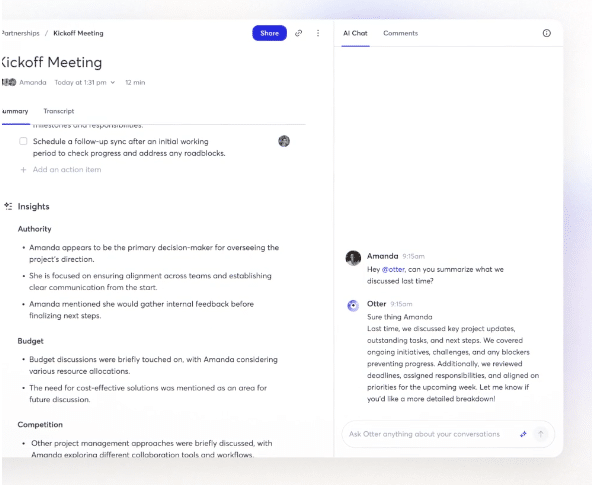
The adoption of tools like Otter.ai fundamentally re-engineered this timeline. By integrating automated audio capture directly into virtual meeting platforms or desktop environments, the workflow shifted from reactive note-taking to proactive curation.
- Pre-Call & Live Integration: Calendar sync capabilities allow the AI assistant to automatically join scheduled Zoom, Google Meet, or Microsoft Teams sessions, or be deployed instantly on the fly.
- Uninterrupted Engagement: With the technical burden offloaded, the writer’s attention remains 100% focused on the interviewee. This freedom enables deeper, more natural conversations, yielding richer quotes and more nuanced narrative angles.
- Instantaneous Turnaround: Transcripts are generated concurrently with the meeting’s conclusion. Rather than waiting days for human processors or spending hours hunched over a media player, the writer transitions directly from the interview phase to the outlining and drafting phases.
Supporting Context & Metrics: Breaking Down the ROI
For independent contractors and agency freelancers, software subscriptions must justify their cost through tangible time savings and revenue enhancement. At roughly $100 annually ($8.33/month billed annually) for the Pro plan, Otter.ai occupies a strategic niche in the freelance toolkit.
The Financial Math of Time Saved
Consider a standard assignment paying $1,200 for a 1,000-word reported article featuring one SME interview. A typical, optimized workflow breaks down as follows:
- Research & Sourcing: 1 hour
- Interview & Transcription Cleanup: 1 hour (down from 3+ hours of manual work)
- Outlining & Drafting: 3 hours
- Total Time Invested: 5 hours
- Effective Hourly Rate: $240/hour
By eliminating manual transcription entirely and replacing it with a quick 10-minute accuracy pass over an automated transcript, total project time drops to four hours, driving the effective hourly rate up to $300/hour.
[Traditional Workflow: 6 hrs total] --> $200/hr effective rate
[AI-Enhanced Workflow: 4 hrs total] --> $300/hr effective rate
When scaling this across three to four interview-driven articles per month, the time saved amounts to 3 to 5 hours monthly—meaning the software pays for itself within the first few weeks of deployment.
Key Technical Features Driving Value
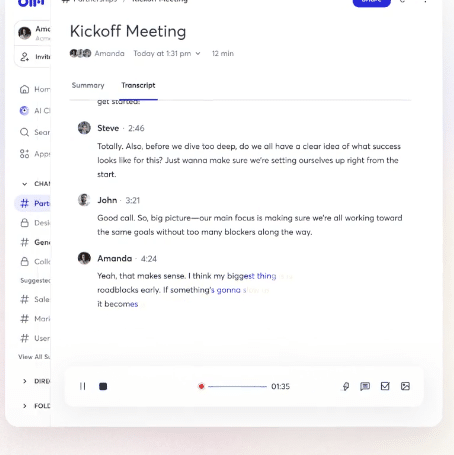
- AI Chat Search: Beyond basic text rendering, users can query the transcript conversationally. If an expert touched upon "credit card fraud" or "AI personalization" amidst a sprawling tangent, a quick chatbot prompt instantly surfaces the relevant sections and summaries.
- Audio-to-Text Cross-Referencing: Clicking any line in the transcript immediately triggers the audio player to jump to that exact timestamp. This synergy allows writers to rapidly verify garbled phrasing or industry-specific jargon without scrubbing blindly through a timeline.
- A Usable Free Tier: The Basic plan offers 300 monthly minutes (with 30-minute recording caps), giving prospective users ample runway to stress-test the platform against their specific reporting habits before committing financially.
Operational Limitations & Nuances
Despite its utility, real-world reporting environments expose distinct operational friction points that users must navigate.
1. The Speaker Mode Constraint
Otter relies on computer speakers capturing both sides of a conversation when using built-in hardware configurations. Plugging in headphones frequently results in the software capturing only the user’s voice while missing the remote participant entirely. While easily managed in a private home office or dedicated coworking booth, this limitation poses privacy and acoustic challenges in public or shared spaces.
2. Real-World Accuracy Margins
While marketing materials often cite up to 95% accuracy, practical field conditions—particularly during specialized SME interviews involving complex jargon, overlapping dialogue, or accented speech—yield an actual accuracy rate closer to 80% to 85%. Proper nouns, acronyms, and technical terminology are frequently mangled. Consequently, relying on unverified AI text for direct publication is a professional hazard; verification via the audio playback link remains a mandatory step.
3. Speaker Identification Inconsistencies
In multi-party calls, webinars, or fast-paced exchanges where participants share similar vocal tonalities, Otter occasionally mislabels speakers, defaulting to generic designations (Speaker 1, Speaker 2). Writers handling complex panel discussions must double-check attributions to avoid costly misquotes in print.
Comparative Analysis: AI vs. Alternatives
When evaluating transcription methodologies, writers generally weigh three primary paths:
| Transcription Method | Speed / Turnaround | Cost | Accuracy | Workflow Friction |
|---|---|---|---|---|
| Manual Transcription | Very Slow (1:3 ratio) | Free (Time investment) | High (if diligent) | Extreme; drains cognitive energy |
| Human Services (e.g., Rev) | Slow (3–5 days) | High ($1.25+/minute) | Very High | Requires lead time; expensive |
| AI Tools (Otter, Fireflies, Fathom) | Instantaneous | Low ($8–$20/month) | Moderate-High (80-85%) | Requires light verification pass |
While competitors like Fireflies.ai, Fathom, and Rev offer robust feature sets tailored to corporate meetings or legal depositions, Otter’s longevity, intuitive interface, and seamless calendar syncing make it a battle-tested choice for journalistic and freelance writing workflows.
Future Outlook & Industry Recommendations
As generative AI and natural language processing continue to mature, the gap between automated transcription and human-level comprehension will continue to narrow. For freelance writers, adopting these tools is no longer a futuristic novelty—it is a baseline operational necessity to remain competitive in a fast-moving media landscape.
Who Should Invest?
- High-Volume Content Writers: Professionals conducting multiple interviews weekly for journalism, content marketing, or B2B publications.
- Podcasters and Interviewers: Creators who need searchable archives of long-form audio discussions.
- Busy Solopreneurs: Anyone looking to streamline client briefings, coaching calls, or brainstorming sessions.
Who Can Skip It?
- Writers who rely exclusively on asynchronous written communication (email pitches, Slack interviews) and rarely engage in live voice calls.
- Generalists whose output requires zero primary research or direct source interviews.
The Verdict: For roughly the cost of one billable hour per year ($100), Otter.ai eliminates one of the most tedious administrative burdens in freelance writing. By reclaiming hours of lost time and protecting conversational focus during interviews, the platform proves itself to be an indispensable asset for independent professionals scaling their businesses.