

Executive Overview
The global apple market and the specialized subculture of boutique pomology are experiencing a significant cultural and sensory reckoning. In an era dominated by hyper-homogenized, mass-produced grocery store staples—such as the ubiquitous Red Delicious and its aggressively marketed modern peers—a counter-movement led by adventurous culinary critics is turning its attention to heritage, rare, and wild-harvested fruit varieties.
The culmination of this seasonal assessment has yielded a provocative new batch of data. This investigation examines a series of rigorous, sensory-driven evaluations conducted on seven distinct and largely esoteric apple cultivars: Kickapoo Spice, St. Edmunds Pippin, Sops of Wine, Fenceline Surprise, Americus Crab, Campfield (False), and Graham.
Far from a standard agricultural report, this review blends rigorous gastronomic critique with psychological self-reflection, historical deep-dives, and pop-culture cross-examination. The findings suggest that while modern consumers are conditioned to expect uniform sweetness and non-threatening textures, the true frontier of pomology lies in the chaotic, high-tannin, occasionally jaw-threatening realm of heritage fruit. As experts prepare to track regional harvests across New York, New England, and Canada, this report breaks down the ratings, characteristics, and underlying narratives of the latest batch of autumn fruit evaluations.

Detailed Chronology of the Evaluation Process
The evaluation protocol followed by leading independent tasters requires a strict methodological framework, balancing visual inspection, olfactory assessment, structural integrity tests (bite dynamics), and immediate gustatory feedback.
Phase I: The Introduction of the Kickapoo Spice
The assessment cycle began with the Kickapoo Spice, a cultivar whose nomenclature immediately invokes cultural touchstones ranging from classic rock ballads to historic American geography.
- Structural Analysis: Described as a "dense boy" and a "weird friend," the Kickapoo Spice presented exceptional physical mass paired with a notably dry interior.
- Flavor Profile: The fruit delivered a heavily weighted spice component dominated by nutmeg, secondary notes of cinnamon, and a subtle whisper of clove. Observers noted a distinct lack of free-flowing juice, accompanied by a polarizing aftertaste reminiscent of freshly cut grass.
- Maturity & Storage: Pomological experts noted that the fruit’s performance underscored the fickle nature of post-harvest storage—some apples improve dramatically off the tree, while others enter an immediate structural decline.
- Final Metric: The Kickapoo Spice secured a respectable 6.9 out of 10.
Phase II: The Triumphant Entry of St. Edmunds Pippin
Moving chronologically into the season’s premier offerings, the St. Edmunds Pippin emerged as an early favorite.

- Tactile and Auditory Feedback: Though critics noted that the fruit’s exterior skin possessed a rough texture comparable to "licking a shark backward," the bite revealed a deeply satisfying auditory and physical pop and crunch.
- Flavor Profile: Exhibiting a high juice-to-flesh ratio, the Pippin delivered a bright, herbal complexity with distinct fennel pollen undertones, balanced expertly against a foundational sweetness.
- Final Metric: Earning an impressive 8.3 out of 10, this cultivar proved that tart-sweet balance remains the gold standard of elite pomology.
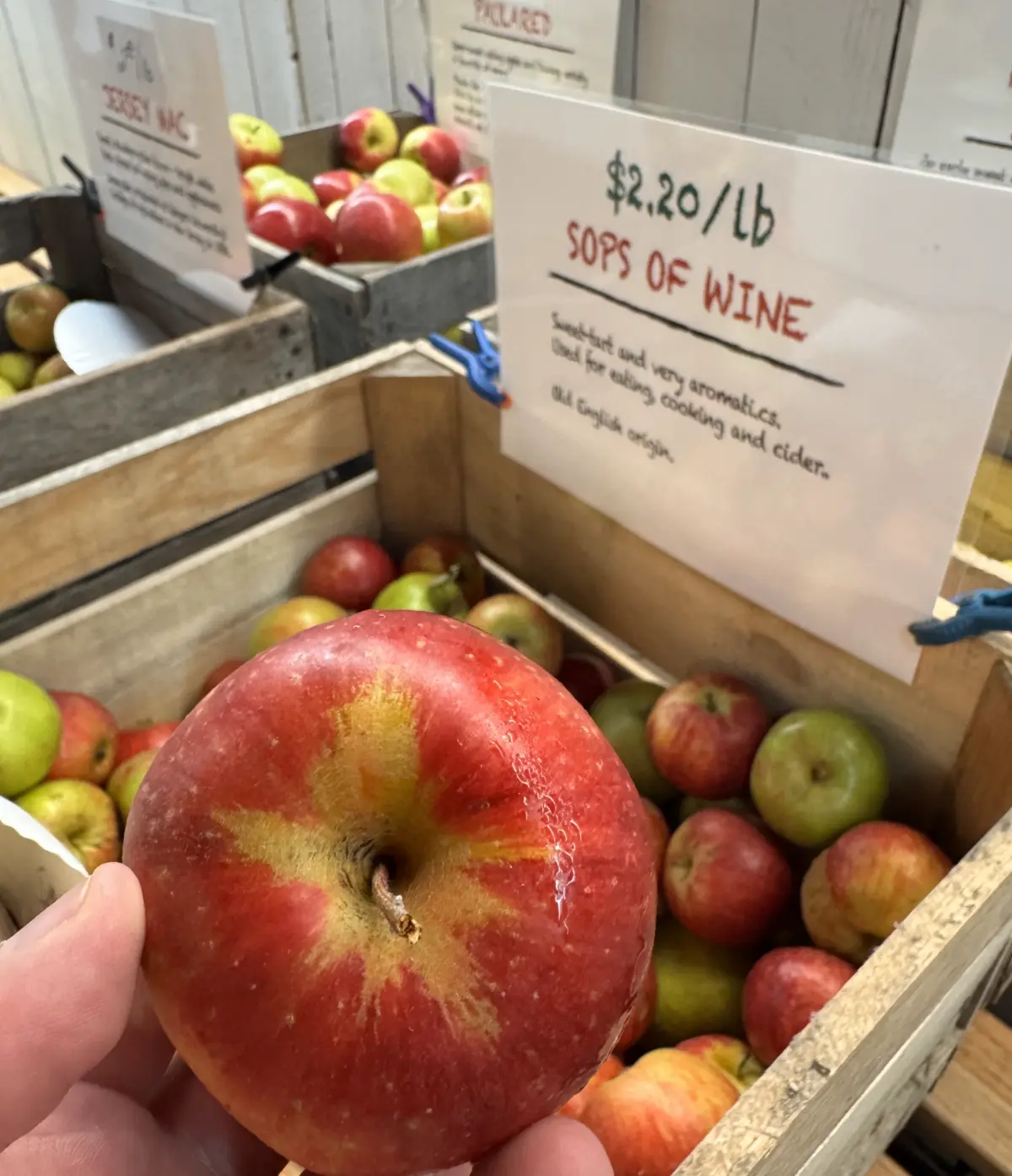
Phase III: The Psychological Disturbance of Sops of Wine
The evaluation took a surreal psychological turn with the introduction of Sops of Wine, a historic variety that inexplicably triggered cinematic auditory hallucinations—specifically, the cinematic image of Denethor consuming a tomato in The Lord of the Rings, accompanied by the hollow-skull echoing of the phrase, "SOPS OF WINE."
- Texture & Quality: Despite promising heritage roots, the fruit suffered from a mealy and gritty texture, likely exacerbated by improper post-harvest timing.
- Flavor & Genetics: While the flavor profile offered pleasant, funky "subacid" notes featuring hints of vanilla and spice, the physical experience fell flat. Furthermore, pomological confusion abounds regarding whether Sops of Wine represents a singular true variety or an umbrella term for various historical types.
- Final Metric: A disappointing 3.5 out of 10.
Phase IV: The Disappointment of Fenceline Surprise
True to its moniker, the Fenceline Surprise delivered an outcome that lived up to its ominous title.
- Sensory Assessment: Billed on signage as a "firm apple," the cultivar manifested instead as a bland, mushy disappointment. A fleeting, highly muted pear-like mist grazed the palate before dissolving entirely, leaving behind a mouthfeel akin to beach sand.
- Analysis: Analysts concluded the fruit had likely crossed the threshold from viable produce to "cold worm-food" long before reaching the consumer.
- Final Metric: Scraping the bottom of the scale at 1.0 out of 10, spared from absolute zero only by its poetic name and handsome visual presentation.
Phase V: The Industrial Romance of Americus Crab
Stepping into the wilder, unrefined side of the orchard, the Americus Crab presented an entirely different category of challenge.

- Nomenclature & Imagery: Critics noted that the name evokes a steampunk inventor or a silver-age comic book superhero dedicated to defending maritime borders against villains like "Brine Man."
- Culinary Utility: As a crabapple, it was deemed wholly unsuitable for raw, out-of-hand consumption due to its aggressively savory profile, searing tartness, structural toughness, and high tannin load.
- Final Metric: A niche 2.5 out of 10, recommended strictly for the daring adventurer.
Phase VI: The Historical Enigma of Campfield (False)
Labeled cryptically as Campfield (False), this cultivar prompted both physiological resistance and deep archival research.
- Physical Experience: The apple offered a chewy, callused consistency. It combined cloying sweetness with an overwhelming wave of tannins, creating the uncanny sensation that the fruit was consuming the consumer in real time.
- Historical Provenance: The cultivar ties directly into early American history. Archival records link the Campfield lineage to Matthew Canfield (also spelled Campfield), an anti-royalist Puritan arriving from Harleston, England, in 1637 during the Great Puritan Migration. A founding father of New Haven, Norwalk, and Newark—where he is reportedly buried beneath City Hall—Canfield operated under colonial edicts requiring freeholders to cultivate orchards for hard cider production.
- Final Metric: 4.1 out of 10, heavily subsidized by its rich historical pedigree.
Phase VII: The Jaw-Shattering Triumph of the Graham
The evaluation series concluded with the Graham, an agricultural marvel boasting physical density that tested the limits of human dental anatomy.
- Structural Integrity: Described as having "washboard abs" impervious to 20-gauge birdshot, biting into the Graham required intense physical effort, breaking apart "like a calving glacier" and threatening the taster with Temporomandibular Joint (TMJ) strain.
- Flavor Revelation: Beneath its impenetrable armor lay a flavor profile that shocked the panel: an unadulterated, unapologetic blast of Juicy Fruit gum.
- Final Metric: An astounding 8.0 out of 10, penalised only for its aggressive looksmaxxing and jaw-smashing defense mechanisms.
Supporting Context & Metrics
To contextualize this round of evaluations, industry metrics show a growing divergence between commercial supermarket offerings and heirloom preservation orchards. While commercial varieties are bred for shelf-life, uniform coloration, and transport durability, heritage cultivars prioritize complex secondary metabolites, including volatile organic compounds that produce notes ranging from fennel pollen and cut grass to industrial bubblegum.

| Cultivar Name | Primary Flavor Notes | Texture Profile | Rating (out of 10) |
|---|---|---|---|
| Kickapoo Spice | Nutmeg, cinnamon, clove, cut grass | Dense, dry | 6.9 |
| St. Edmunds Pippin | Herbal, fennel pollen, sweet-tart | Crisp, juicy, sharp-breaking | 8.3 |
| Sops of Wine | Vanilla, spice, subacid | Mealy, gritty | 3.5 |
| Fenceline Surprise | Faint pear mist | Bland, mushy, sandy | 1.0 |
| Americus Crab | Savory, tart, high tannin | Tough, unrefined | 2.5 |
| Campfield (False) | Tannic, sweet | Chewy, astringent | 4.1 |
| Graham | Juicy Fruit gum | Extreme density, glacier-like | 8.0 |
Official Statements and Expert Perspectives
Pomological researchers and culinary historians emphasize that the cultural resurgence of heirloom apple tasting is vital for agricultural biodiversity. Traditional orchards serve as living seed banks, preserving genetic variants that survived colonial expansion, industrial shifts, and modern monoculture.
"When we consume mass-market fruit, we are tasting for logistics," notes one leading independent agricultural commentator. "When we step into the heritage market—encountering the jaw-breaking resistance of a Graham or the historical complexities of a Campfield—we are tasting for history, art, and uncompromising flavor chemistry."
Furthermore, cultural analysts note that the psychological cross-pollination occurring during these tastings—where historical figures, cinematic hallucinations, and fictional superheroes intersect with pomology—demonstrates how deeply ingrained agriculture remains within the human imaginative landscape.

Future Outlook
As the autumn harvest shifts northward, the focus of the pomological community turns toward the upcoming expeditionary phase spanning New York, New England, and Canada.
With regional orchards offering a completely different microclimate and set of historical apple varieties, critics and casual fruit enthusiasts alike anticipate a new wave of culinary discoveries. Observers are advised to monitor official appearance schedules, prepare their dental health for high-density heritage cultivars, and—above all—come prepared to supply regional experts with fresh, unexpected specimens from the branch. The future of apple tasting is wild, tannic, unapologetically strange, and entirely unyielding.