

Executive Overview
In the fast-paced world of digital marketing, relying on manual spreadsheets to track search engine rankings is a relic of the past. As search engine results pages (SERPs) become increasingly dynamic—dominated by AI-generated summaries, video carousels, local packs, and a shifting array of vertical features—managing keyword data demands sophisticated automation. Today’s SEO professionals, in-house marketing teams, and agency leaders need real-time, highly granular insights to prove ROI, outpace competitors, and tie organic visibility directly to revenue.
This comprehensive guide examines the evolving landscape of SERP tracking software for 2025. We evaluate why investing in dedicated tracking infrastructure is critical for modern brands, highlight the nine core features that separate mediocre software from enterprise-grade powerhouses, and deliver an in-depth breakdown of the top seven SERP tracking tools on the market today. Whether you are looking for a standalone rank tracker or a robust module embedded within an all-in-one SEO platform, this review will help you choose the right tool to future-proof your search strategy.

Detailed Chronology and Evolution of SERP Tracking
The evolution of rank tracking mirrors the maturation of search engine optimization itself. In the early days of SEO, tracking performance was a straightforward, albeit tedious, process. Practitioners checked manual rankings once a week, often logging into localized browsers or relying on basic scrapers that frequently yielded inaccurate or delayed results.
As search engines grew more sophisticated, introducing personalized search results, localized map packs, and dynamic SERP layouts, the old methods broke down entirely.

- Phase 1: The Manual Era (Early 2000s): SEOs relied on spreadsheets, updating rankings manually. Data was infrequent, volatile, and prone to human error.
- Phase 2: Automated Scraping & Weekly Updates (Late 2000s to 2010s): Desktop-based software and early cloud tools emerged, allowing users to schedule weekly or bi-weekly ranking checks. However, these tools struggled with API limitations and frequent search engine layout changes.
- Phase 3: Real-Time Cloud Infrastructure & On-Demand Data (Mid-2010s to 2020s): Cloud-native platforms like AccuRanker introduced on-demand data refreshes and automated daily checks, shifting the paradigm toward immediate visibility and historical trend analysis.
- Phase 4: The AI-Driven, Multi-Feature Era (2025 and Beyond): Modern SERP trackers must account for artificial intelligence integrations (such as AI Overviews), hyper-local zip-code targeting, cross-engine monitoring (including Baidu, Yandex, Bing, and YouTube), and complex data integrations with business intelligence dashboards.
Today, SERP tracking is no longer just about checking where a URL ranks for a keyword; it is about understanding how a page commands attention across a multi-faceted search ecosystem and how that visibility translates into concrete business outcomes.
Supporting Context & Core Metrics: Why Invest in SERP Tracking Software?
Securing executive buy-in and budget for search engine optimization requires tangible proof of performance. One of the leading indicators used to validate SEO efforts is the ability to accurately track movements across different search engines, geographic locations, and device types.

Without advanced SERP tracking software, organizations fly blind. The right tool enables digital marketers to:
- Monitor granular ranking fluctuations across national, regional, and hyper-local scales.
- Identify emerging threats and capitalize on competitor keyword gaps.
- Correlate ranking improvements with organic traffic growth, user behavior metrics, and bottom-line revenue conversions.
- Streamline client and stakeholder reporting through automated, white-labeled dashboards.
9 Essential Features to Look for in SERP Tracking Software
When evaluating software vendors, ensure the platform delivers on these nine critical criteria:

- Access Accurate On-Demand Ranking Updates: SERP positions change rapidly. You need a platform that updates automatically every 24 hours while offering on-demand manual refreshes at the click of a button.
- Monitor Performance Across SERP Features: To capture high-value real estate like Position #0, AI Overviews, People Also Ask (PAA) boxes, and video carousels, your tool must track the presence of 50+ distinct SERP features.
- Track Movement Across All Major Search Engines: While Google dominates, tracking performance on Bing, Baidu, Yandex, and YouTube is vital for international campaigns and specific niche markets.
- Granular Location and Device Segmentation: Look for software that allows you to parse data by country, state, city, or zip code, while cleanly separating desktop and mobile rankings.
- Map SERP Movements to Traffic and Revenue: Advanced platforms integrate directly with analytics suites (such as Google Analytics or Adobe Analytics) to combine ranking data with revenue, bounce rates, and conversion metrics.
- Comprehensive Historical Performance Data: Point-in-time snapshots are insufficient. You need deep historical trendlines to evaluate long-term keyword trajectory against market volatility.
- Robust Competitor Comparisons: Grouping keywords into performance buckets (e.g., positions 1–3, 4–10, 11–50) allows you to benchmark your visibility share directly against top competitors.
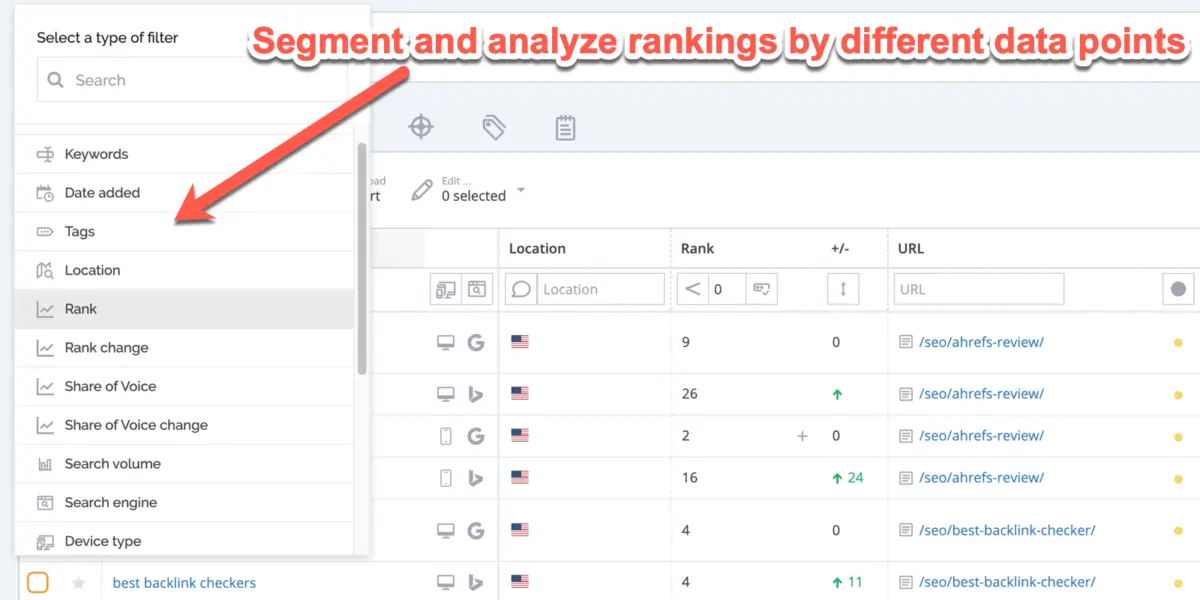
- Advanced Tagging and Segmentation: Categorize keywords by topic, sales funnel stage, or content type to derive actionable insights from massive keyword portfolios.
- White-Label and Third-Party Reporting: Seamlessly push data into reporting hubs like Google Looker Studio or Databox via native connectors to deliver polished, branded reports to clients and executives.
The 7 Best SERP Tracking Tools for 2025
The market is flooded with options, categorized broadly into dedicated standalone trackers and modules within all-in-one SEO platforms. Below is our curated shortlist of the best solutions available in 2025.
1. AccuRanker
Overview
AccuRanker is widely recognized as an elite standalone SERP tracking tool, relied upon by over 32,000 companies—including enterprise giants like HubSpot, IKEA, and Kinsta. It is engineered specifically for agencies and SEO professionals who require lightning-fast data updates, granular competitor analysis, and seamless integration with revenue metrics.

Key Features
- On-Demand Data Refreshes: Automated daily updates complemented by instant, on-demand ranking refreshes.
- Comprehensive SERP Feature Analysis: Monitors over 50 distinct SERP features in a unified dashboard.
- Multi-Engine Support: Tracks performance across Google, Bing, Baidu, Yandex, and YouTube.
- Landing Page Analytics: Integrates with analytics platforms to merge keyword metrics with bounce rates, load times, and conversion data.
Who Is It For?
Agencies, enterprise brands, and dedicated SEO professionals who need ultra-fast, highly accurate data across multiple search engines and devices.
Pricing
Subscription plans scale based on tracked keywords, starting at $116 per month for up to 1,000 keywords.

2. Semrush (Position Tracker & SERP Gap Analyzer)
Overview
Semrush is a titan in the digital marketing space, serving over 10 million users from brands like Samsung, Vodafone, and Booking.com. While it operates as a comprehensive all-in-one SEO suite, its Position Tracking Tool and App Center extensions rival the accuracy and depth of any standalone tracker on the market.
Key Features
- Hyper-Accurate Position Tracking: Monitors national down to hyper-local map pack rankings across desktop and mobile.
- SERP Gap Analyzer App: Scans SERPs to uncover under-optimized content, identifying quick-win keywords and providing actionable optimization blueprints.
- Search Console Integration: Merges native rank data with Google Search Console insights to highlight low-hanging fruit.
- Visibility Score & Competitor Grouping: Organizes keywords into precise performance buckets to benchmark against competitors.
Who Is It For?
Marketing professionals, e-commerce brands, and enterprises seeking a powerful, cost-effective all-in-one platform with exceptional tracking capabilities.

Pricing
Comprehensive platform plans start at $139.95 per month.
3. ProRankTracker
Overview
ProRankTracker is a robust, highly scalable standalone tracking and reporting solution trusted by over 60,000 users worldwide. It bridges the gap between enterprise capability and cost-efficiency, making it a favorite among growing agencies and video marketers.

Key Features
- Advanced multi-language support and international targeting.
- Comprehensive video rank tracking for YouTube optimization campaigns.
- Flexible white-label reporting engines.
Who Is It For?
SEO agencies, international e-commerce sites, and video marketers requiring multi-device, multi-location accuracy.
Pricing
Plans start at an accessible $39 per month.

4. Advanced Web Ranking (AWR)
Overview
Advanced Web Ranking (AWR) is a veteran standalone SERP tracker utilized by thousands of enterprises and in-house teams—including tech leaders like Microsoft. Known for its robust cloud infrastructure, AWR excels in deep data processing and customized reporting.
Key Features
- Flexible cloud-based tracking across infinite locations and devices.
- Deep historical data archiving for long-term trend analysis.
- Highly customizable white-label reporting suites.
Who Is It For?
In-house enterprise teams and agencies that require deep data customization and reliable historical benchmarking.

Pricing
Subscription tiers begin at $99 per month.
5. SERPWatcher (by Mangools)
Overview
SERPWatcher is the dedicated rank tracking component of the Mangools all-in-one SEO toolset. Renowned for its intuitive user interface and budget-friendly pricing, it is trusted by massive global brands like Airbnb and Adidas.

Key Features
- Performance Index: Measures organic traffic potential across all tracked terms rather than relying solely on raw position numbers.
- Interactive Visualizations: Clean, simplified charts that make complex data immediately digestible.
- SERPChecker Integration: Companion tool designed to evaluate keyword difficulty and SERP competitor strength.
Who Is It For?
Startups, small business owners, and freelancers who want straightforward, beautiful, and affordable rank tracking.
Pricing
Plans start at $29.90 per month.

6. SE Ranking
Overview
SE Ranking is a feature-rich, all-in-one SEO platform equipped with a high-performance Position Tracking tool. The software simulates real user behavior across precise geographic coordinates to ensure high data fidelity.
Key Features
- 100% accurate data collection via localized user simulation.
- Comprehensive competitor tracking across all major search engines.
- Integrated marketing tools covering site auditing, backlink monitoring, and competitor research.
Who Is It For?
Small-to-medium digital agencies and business owners looking for a balanced, all-inclusive SEO toolset.

Pricing
Plans start at $52 per month (based on daily tracking for 500 keywords).
7. Nightwatch
Overview
Nightwatch stands out as one of the most precise daily SERP trackers available, trusted by enterprises such as Shopify, Scotiabank, and Coinbase. It draws data from over 107,000 global locations, offering unmatched geographic precision.

Key Features
- Hyper-local tracking across more than 107,000 global locations.
- Advanced data segmentation and correlation engine.
- Automated reporting tailored for agency client management.
Who Is It For?
Freelancers, SMBs, and large enterprises looking for precise local tracking and flexible multi-tier scaling.
Pricing
Paid plans start at $32 per month for up to 250 keywords, backed by a 14-day free trial.

Future Outlook: The Next Generation of SERP Tracking
As we look deeper into 2025 and beyond, the role of SERP tracking software will continue to expand. The rapid proliferation of generative AI search features means that traditional "blue link" rankings represent only a fraction of true search visibility. Future-proof trackers are shifting toward holistic "Share of Voice" metrics that account for AI Overviews, conversational search intents, and cross-channel visibility.
Choosing the right tool ultimately depends on your organization’s unique scope and budget. If you require a dedicated, lightning-fast standalone tracker, AccuRanker remains the gold standard. If you prefer an all-in-one ecosystem that combines elite position tracking with deep content optimization—such as the innovative SERP Gap Analyzer—Semrush is an exceptional investment.
Evaluate your keyword volume, reporting requirements, and technical workflows against the features outlined in this review to select a platform that will drive your organic growth for years to come.