

Executive Overview
In the fast-evolving digital marketing landscape of 2025, search engine results pages (SERPs) are more dynamic, volatile, and feature-rich than ever before. Gone are the days when a weekly manual spreadsheet update sufficed for monitoring keyword movements. Today’s search results are heavily influenced by personalized localization, continuous algorithmic adjustments, multi-device experiences, and the omnipresence of AI-driven search components like AI Overviews, featured snippets, and dynamic carousels.
For modern SEO agencies, enterprise brands, and in-house marketing teams, accurate and real-time SERP tracking is no longer a luxury—it is a critical operational necessity. Without robust data architecture, proving the return on investment (ROI) of organic search campaigns becomes nearly impossible.

This comprehensive review explores the fundamental mechanics of modern SERP tracking software, outlines the nine mandatory features every professional should demand from their toolset, and delivers an exhaustive evaluation of the seven best SERP tracking solutions available in 2025. Whether you require a specialized standalone rank tracker or a comprehensive all-in-one SEO suite, this guide provides the clarity needed to make an informed, ROI-driven software investment.
Detailed Chronology: The Evolution of Rank Tracking
To understand where SERP tracking stands in 2025, it is vital to examine how the industry arrived here.

Phase 1: The Manual Era (Early 2000s)
In the infancy of search engine optimization, practitioners relied heavily on manual spot-checking and simple, self-maintained spreadsheets. SEOs would open multiple browser windows, clear cookies, type in target keywords, and manually log positions. This approach was inherently flawed: data was static, subjective to local data centers, prone to human error, and completely incapable of scaling alongside growing keyword portfolios.
Phase 2: Automated Desktop Scraping (Late 2000s–2010s)
The introduction of downloadable desktop software allowed agencies to input thousands of keywords and automate the scraping process. While this removed the manual labor bottleneck, it introduced severe infrastructure challenges. Desktop scrapers required dedicated local resources, proxy management to bypass search engine CAPTCHAs, and frequent software updates to keep pace with shifting search engine layouts.

Phase 3: The Cloud-Based SaaS Revolution (Mid 2010s–2020)
The industry shifted dramatically toward cloud-based software-as-a-service (SaaS) architectures. Platforms moved data processing to secure cloud infrastructures, offering team collaboration features, scheduled reporting, and automated daily updates. However, these tools were largely limited to traditional "blue link" tracking and basic desktop versus mobile differentiation.
Phase 4: The Intelligent, Multi-Feature SERP Era (2021–Present)
Today, search engines have transformed into dynamic answer engines. With the integration of AI Overviews, People Also Ask (PAA) boxes, interactive video carousels, and localized map packs, modern SERP tracking has evolved into complex SERP intelligence. Platforms now incorporate machine learning, on-demand data refreshing, deep analytics integrations, and advanced metric calculations like Share of Voice (SoV) to help marketers capture high-visibility real estate beyond standard organic rankings.

Supporting Context & Metrics: Why SERP Tracking Drives Business Revenue
Investing in enterprise-grade SERP tracking software is rarely about vanity metrics or simply watching a keyword jump from position five to position three. Instead, it is about connecting search engine visibility directly to business revenue, pipeline growth, and bottom-line profitability.
Validating SEO Investments
Securing executive buy-in or agency retainer renewals requires transparent proof of progress. Granular SERP tracking software allows marketing leaders to demonstrate consistent movement across target keyword groups, validating the time, capital, and resources allocated to content creation and technical optimization.

Moving Beyond Rankings: Share of Voice and Traffic Integration
Advanced SERP tracking tools combine raw position data with holistic metrics like Share of Voice (SoV)—measuring your brand’s total visibility in the search results relative to your competitors based on search volume. Furthermore, top-tier platforms integrate seamlessly with analytics providers like Google Analytics or Adobe Analytics. By merging ranking movements with landing page performance, bounce rates, conversion goals, and revenue data, organizations gain a complete, unobstructed view of how organic search impacts financial performance.
9 Essential Features to Look for in SERP Tracking Software
When auditing the marketplace for the best SERP tracking software, decision-makers must evaluate platforms against a rigorous criteria checklist. Ensure your chosen tool incorporates the following nine core capabilities:

1. Access Accurate On-Demand Ranking Updates
Traditional tools run scheduled updates once every 24 hours. However, in highly competitive verticals, rankings shift rapidly throughout the day. Look for platforms that offer automated daily updates combined with on-demand, single-click data refreshes so you can instantly verify the impact of recent site changes or algorithmic updates.
2. Monitor Performance Across Advanced SERP Features
With modern search engine real estate dominated by AI Overviews, featured snippets, knowledge cards, and local packs, your tracker must identify which keywords trigger these features. Platforms should provide a unified view to track hundreds of SERP features, allowing your team to spot optimization opportunities and steal Position #0 from competitors.

3. Track SERP Movement Across Major Search Engines
While Google commands the lion’s share of global search traffic, international campaigns or specific regional markets often require monitoring alternate search engines. Ensure your chosen platform supports major global and regional alternatives such as Bing, Baidu, Yandex, and YouTube.
4. Granular Tracking (Location and Device Segmentation)
Consumer search behavior differs vastly between mobile devices and desktop computers. Furthermore, local SEO campaigns require hyper-local visibility down to the state, city, or zip code level. Your SERP tracker must offer multi-tiered geographic and device-specific segmentation.

5. Map SERP Movements to Traffic and Revenue
Data silos kill marketing efficiency. The best trackers bridge the gap between SEO and business intelligence by integrating directly with analytics suites, mapping keyword positions and landing page metrics to real conversions and revenue.
6. View Historical Rank Performance
Point-in-time data offers limited strategic value. Comprehensive historical tracking allows teams to analyze long-term ranking trends, seasonal fluctuations, and the historical impact of past optimizations against competitor baselines.

7. Run Competitor Comparisons
Understanding your own trajectory is only half the battle. Effective software categorizes keywords into functional ranking buckets (e.g., positions 1–3, 4–10, 11–50) and tracks competitor positioning side-by-side to expose market threats and untapped keyword gaps.
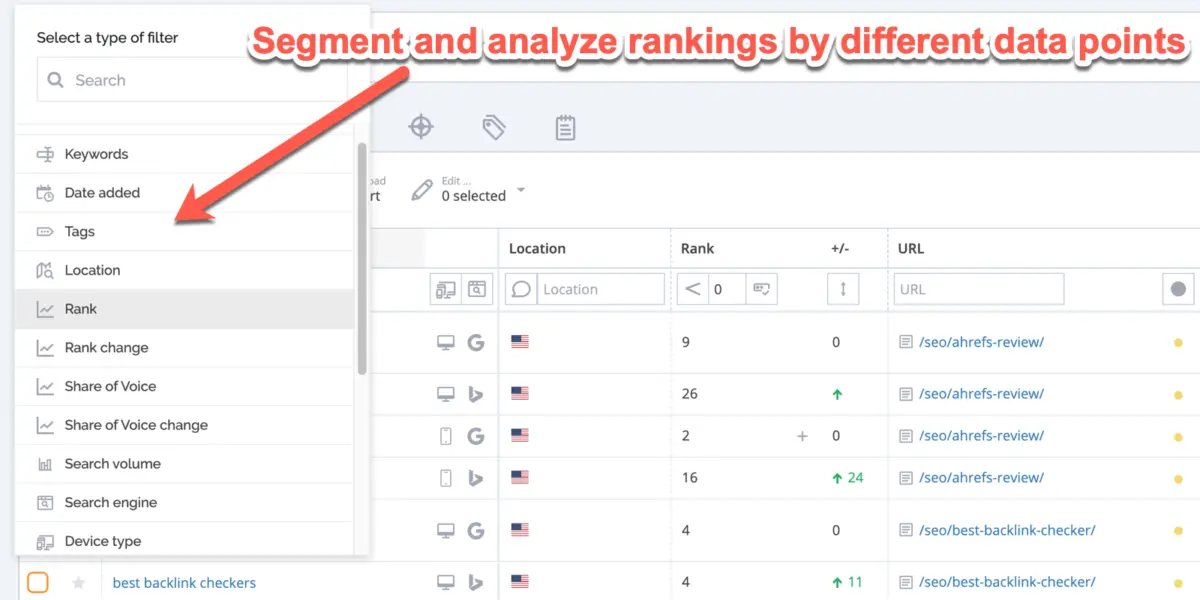
8. Tag and Segment Rankings Data
Large enterprise campaigns often involve millions of keywords spanning diverse product lines, user intent funnels, and content types. Robust keyword tagging and multi-parameter filtering are mandatory to analyze performance by topic, funnel stage, or asset type.

9. Generate White-Label Reports
For agencies and client-facing consultants, seamless reporting is paramount. Look for tools that offer native white-label scheduling or robust integrations with visualization and reporting tools like Google Looker Studio (formerly Data Studio) and Databox.
The 7 Best SERP Tracking Tools for 2025
The software market features countless options, but a select few platforms consistently outperform the competition. Below is an in-depth review of the top four standalone SERP trackers and three all-in-one SEO platforms.

1. AccuRanker (Best Standalone SERP Tracker)
Overview
AccuRanker is widely recognized as a premier standalone SERP tracking platform. Trusted by over 32,000 companies—including enterprise giants like HubSpot, IKEA, and Kinsta—it is engineered specifically for agencies and consultants who demand lightning-fast, highly accurate data.
Key Features
- On-Demand Data Refreshes: Automated 24-hour updates accompanied by instant, manual data refreshing capabilities.
- Advanced SERP Feature Analysis: Monitors 50+ distinct SERP features in a single, filterable dashboard.
- Deep Analytics Integration: Merges seamlessly with Google Analytics and Adobe Analytics to connect keyword movements directly to revenue.
- Granular Tagging & Share of Voice: Sophisticated segmentation empowering users to analyze specific content silos and market visibility.
Pricing
Subscription plans scale based on tracked keyword volume, starting at approximately $116/month for up to 1,000 keywords.

2. Semrush Position Tracker & SERP Gap Analyzer (Best All-in-One SEO Platform)
Overview
Semrush is an established powerhouse in the digital marketing industry, serving over 10 million users across major brands like Samsung, Vodafone, and Booking.com. While operating primarily as an all-in-one SEO and content marketing suite, its Position Tracking tool rivals the accuracy of dedicated standalone trackers.
Key Features
- Hyper-Accurate Position Tracking: Scalable monitoring from global down to hyper-local map pack levels across desktop and mobile devices.
- SERP Gap Analyzer (App Center): An innovative add-on tool that scans SERPs to uncover under-optimized content, analyzes competitor weaknesses, and integrates with Google Search Console to pinpoint low-hanging fruit optimization opportunities.
- Comprehensive Competitor Grouping: Classifies keywords into precise ranking tiers to benchmark visibility against market rivals.
Pricing
Comprehensive SEO platform plans start at $139.95/month.

3. ProRankTracker (Best Cost-Effective Standalone Tracker)
Overview
ProRankTracker is a robust, highly scalable standalone tracking and reporting tool utilized by over 60,000 customers worldwide. It is designed to deliver precise ranking data across multiple languages and devices without enterprise-level pricing barriers.
Key Features
- Multilingual and Global Tracking: Comprehensive support for international campaigns across diverse geographic coordinates.
- Video and Local Pack Monitoring: Specialized tracking capabilities for YouTube video rankings and localized map packs.
- Automated Client Reporting: Fully customizable, scheduled reporting options tailored for agency environments.
Pricing
Entry-level plans start at an accessible $39/month.

4. Advanced Web Ranking – AWR (Best for Enterprise Scalability)
Overview
Advanced Web Ranking (AWR) is a dependable standalone SERP tracking solution trusted by thousands of enterprise brands and in-house teams, including Microsoft. AWR is celebrated for its robust cloud infrastructure capable of managing massive keyword inventories.
Key Features
- Custom White-Label Dashboards: Highly tailored reporting modules built specifically for enterprise clients and multi-stakeholder organizations.
- Flexible Data Delivery: Reliable tracking across all major search engines, devices, and deep localization tiers.
- Robust API Access: Seamless data exporting capabilities for custom enterprise data warehouses.
Pricing
Subscription plans begin at $99/month.

5. SERPWatcher by Mangools (Best for Simplicity and Usability)
Overview
Developed by Mangools, SERPWatcher is an intuitive, streamlined SERP tracking tool designed for users who value simplicity without sacrificing core analytical depth. It is trusted by global brands like Airbnb and Adidas.
Key Features
- Performance Index Metric: A proprietary metric that calculates your website’s cumulative organic traffic potential based on current rankings and search volumes.
- Interactive User Interface: Clean, highly digestible visual dashboards that eliminate data fatigue.
- Complementary Toolset Access: Bundled access to auxiliary tools like SERPChecker for deep SERP analysis.
Pricing
Mangools platform plans start at $29.90/month, making it one of the most budget-friendly professional options.
6. SE Ranking (Best Hybrid Tool for Small-to-Midsize Businesses)
Overview
SE Ranking is a feature-rich, all-in-one SEO platform equipped with a powerful Position Tracking module. The platform simulates authentic user behavior across specific geographic coordinates to guarantee data integrity.
Key Features
- Simulated User Behavior Tracking: Advanced scraping mechanisms designed to mirror localized user interactions precisely.
- Comprehensive Competitor Matrix: Detailed historical visibility charts and competitor comparison matrices.
- White-Label Agency Pack: Professional reporting features branded entirely to agency specifications.
Pricing
Plans begin at $52/month based on daily tracking for 500 keywords.

7. Nightwatch (Best for Hyper-Localized and Global Enterprise Tracking)
Overview
Nightwatch is an ultra-precise daily SERP tracker utilized by prominent technology and financial institutions including Shopify, Scotiabank, and Coinbase. The platform is engineered to extract exact search engine rankings across more than 107,000 global locations.
Key Features
- Massive Location Database: Unrivaled geographical coverage reaching down to precise municipal and postal code coordinates.
- Custom Data Segmentation: Flexible grouping tools that allow complex filtering across multi-channel campaigns.
- Automated Insights Engine: Intelligent alerting systems highlighting unexpected ranking volatility.
Pricing
Offers a 14-day free trial, with paid plans starting at $32/month for up to 250 keywords.

Future Outlook: The Next Generation of SERP Intelligence
As we look further into the back half of the 2020s, the evolution of search engine technology will continue to reshape how marketers interact with SERP tracking software.
The Rise of Generative AI and Answer Engine Optimization (AEO)
With search engines increasingly serving direct answers via AI-generated summaries rather than traditional links, future SERP trackers must evolve beyond simple integer positioning (e.g., tracking whether a URL is #1 or #2). The next generation of tools will need to measure brand citation frequency within generative answers, tracking how often a brand’s assets are referenced inside AI Overviews and conversational search interfaces.

Predictive Analytics and Automated Remediation
We anticipate that leading SERP tracking platforms will increasingly incorporate predictive machine learning models. Instead of merely reporting past ranking drops, future tools will automatically diagnose why a drop occurred—whether due to technical latency, content freshness decay, or a competitor link surge—and output automated, one-click content optimization recommendations.
Conclusion: Making Your Choice
Selecting the right SERP tracker ultimately depends on your organization’s specific structural needs, budget, and operational scale. If you operate an agency or enterprise brand requiring uncompromising data freshness and standalone depth, AccuRanker remains the gold standard. If you prefer a unified ecosystem where your rank tracking coexists alongside comprehensive keyword research, site auditing, and backlink analysis tools, Semrush provides an unmatched all-in-one solution.

Evaluate your keyword volume, geographical scope, and reporting requirements today, and invest in a platform capable of future-proofing your organic search strategy for years to come.