In the contemporary digital economy, copywriting has evolved from a traditional creative
discipline into a core engine for measurable customer acquisition and direct revenue growth. As digital channels saturate and prospective buyers develop heightened resistance to superficial marketing tactics, the mandate for content creators and marketers has shifted dramatically: success is no longer defined by literary eloquence or vanity metrics such as page views and social shares, but by clear, actionable conversion metrics and demonstrated return on investment (ROI).
Data from digital marketing leaders, including platforms such as Copyblogger, underscores a critical shift in online strategy. Multi-million dollar digital enterprises and high-converting marketing campaigns are increasingly built on disciplined direct-response copywriting principles. By leveraging rigorous customer research, systematic market analysis, strategic artificial intelligence (AI) integration, and precise metric tracking, modern copywriters are redefining how audience attention is monetized. This comprehensive analysis details the ten foundational pillars required to transform content creation into a scalable, high-yielding growth asset.
Detailed Chronology: The 10 Operational Pillars of High-Converting Copywriting
Achieving consistent, multi-figure returns through digital content requires moving past raw intuition toward a structured methodology. Below is a detailed, step-by-step breakdown of the ten operational strategies that drive modern copywriting success.
1. Voice-of-Customer (VoC) Research and Objection Mapping
The primary objective of copy is to capture attention, build institutional trust, present a clear solution, neutralize objections, and guide the prospect toward a transaction. Achieving this requires a granular understanding of the customer’s lived reality, including their daily friction points, emotional triggers, and decision-making hesitate points.
Rather than relying on abstract benefit statements (e.g., "Our software saves you time"), elite copywriters mirror the prospect’s exact internal dialogue back to them. When prospective clients read an explicit description of their everyday struggles—such as long work hours, unproductive routines, or frustrating manual processes—they infer that the offer was custom-built for their specific situation.
Practical VoC Gathering Tactics:
Sales Call Transcript Analysis: Review audio and text transcripts from live customer calls to identify repeating phrasing, explicit pain points, and sales objections.
Artificial Intelligence Clustering: Process call transcripts or public discussions through Large Language Models (LLMs) to automatically categorize recurring objections and high-intent buyer language.
Niche Community Mining: Conduct qualitative research within targeted online forums (such as Reddit or specialized Facebook Groups) to observe unvarnished user commentary, terminology, and emotional frustration points.
2. Competitive Intelligence via Ad Archive Analysis
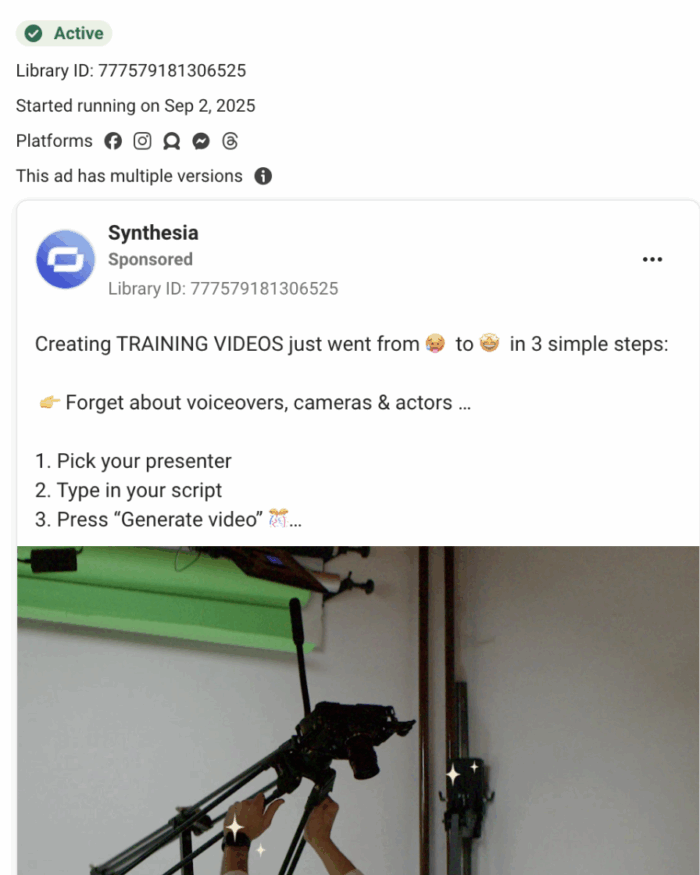
Top-performing competitors invest substantial capital into testing ad messaging, hooks, and value propositions. Rather than drafting campaigns from scratch, copywriters can inspect long-running competitor advertisements to determine which value propositions have passed empirical market testing.
+---------------------------------------------------------------------------+
|                    COMPETITOR AD ARCHIVE METHODOLOGY                      |
+---------------------------------------------------------------------------+
| Step 1: Access Public Repositories (Meta Ad Library / LinkedIn Ads)      |
| Step 2: Filter for Ads Active > 30 Days (Indicates Profitability)         |
| Step 3: Deconstruct Key Elements (Hook, Core Pain Point, Specific CTA)    |
| Step 4: Map Identified Pain Points to Original Value Proposition          |
+---------------------------------------------------------------------------+
Because paid advertising channels require continuous capital deployment, ads that remain live over extended durations (e.g., 30 days or longer) almost universally deliver a positive ROI. By analyzing repositories such as the Meta Ad Library or LinkedIn Ads Transparency Center, strategists can isolate the precise pain points competitors prioritize—such as data clutter in CRM systems or logistical overhead in video production—and deploy those proven angles across sales pages, email sequences, and organic content.
3. Systematic Swipe File Curation
High-performing copywriters maintain a structured "swipe file"—a curated repository of exceptional sales pages, email sequences, landing pages, and headlines. Reviewing historical and contemporary examples of high-converting copy helps calibrate creative instinct and speeds up the drafting phase.
While personal swipe files capture individual industry observations, referencing established industry resources (such as Neville Medhora’s SwipeFile.com) exposes writers to campaigns vetted by experienced direct-response professionals. This prevents novice copywriters from misjudging visually appealing but low-converting copy as effective marketing.
4. Workflow Standardization and Outlining Protocols
To write high-converting copy consistently and eliminate writer’s block, practitioners must build a standardized, process-driven workflow. Relying on inspiration leads to inconsistent output and missed structural requirements.
A structured editorial pipeline forces copywriters to assemble essential converted components before writing narrative text:
Keyword and Intent Mapping: Defining the target audience’s exact search intent or situational context.
Structural Skeleton Creation: Building an outline populated with subheadings, target call-to-action (CTA) placements, and mapped objections.
Core Composition and Polish: Filling out narrative sections while preserving clear readability and conciseness.
5. Practical Execution Through Owned Projects
Theoretical knowledge of copywriting principles yields minimal results without practical application. High-earning copywriters refine their skills by managing projects where words directly impact financially measurable outcomes.
High-Leverage Practice Models:
Personal Social Publishing: Building an audience on platforms like LinkedIn or X (formerly Twitter) to understand hook mechanics, engagement dynamics, and direct message (DM) lead generation.
Affiliate and Search Engine Publishing: Building niche media sites optimized for search engines to master high-purchase-intent keyword targeting over low-value informational traffic.
Micro-SaaS and E-Commerce Deployment: Developing and marketing niche digital products, dropshipping stores, or micro-tools (utilizing no-code or AI-assisted development tools) to manage product positioning, checkout conversion rates, and email funnels directly.
6. Pragmatic AI Integration
Modern copywriters treat AI engines not as automated article generators, but as specialized research assistants, editorial sounding boards, and iteration tools. Using AI to generate unedited, end-to-end articles often yields generic, disengaged copy. However, deploying AI for targeted tasks dramatically accelerates production without compromising quality.
+---------------------------------------------------------------------------+
|                       TARGETED AI WORKFLOW MATRIX                         |
+---------------------------------------------------------------------------+
| Task Category       | Optimal Prompting Objective                         |
+---------------------+-----------------------------------------------------+
| Pain Point Discovery| "Analyze these transcripts and list top 5 buyer     |
|                     | hesitations regarding price."                       |
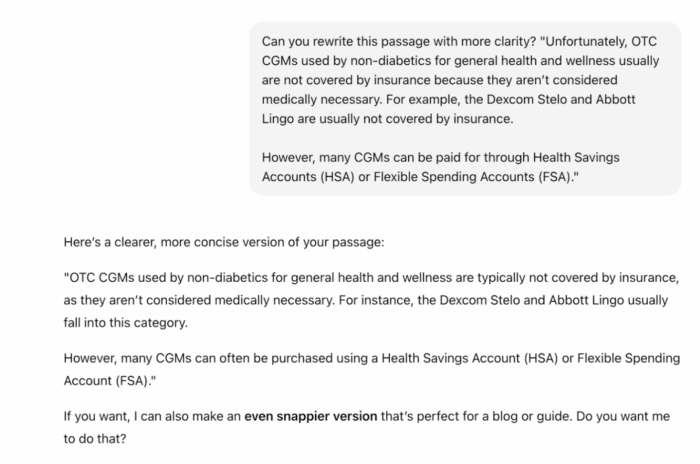
| Rephrasing/Clarity  | "Rewrite this section to improve conciseness        |
|                     | while keeping an authoritative tone."               |
| Expert Citation     | "Find public quotes from verified industry leaders  |
|                     | regarding [Topic]."                                 |
+---------------------+-----------------------------------------------------+
7. Strategic Specialization by Distribution Channel
Each digital medium operates under distinct algorithmic constraints, audience expectations, and structural formats. High-performing copywriters achieve mastery over a single channel before expanding into multi-channel campaigns.
B2B Executive Publishing (e.g., LinkedIn): Requires concise industry analysis, strong point-of-view hooks, and conversational authority that encourages high-level professional engagement.
Search Engine Content (e.g., Blogs/Organic Search): Requires comprehensive coverage of user search intent, logical structural formatting, contextual internal linking, and clear conversion paths.
Direct Response Email Funnels: Demands compelling subject lines, clear psychological narrative progression, persistent objection handling, and focused call-to-action mechanisms.
By mastering the mechanics of a specific distribution channel, copywriters can optimize user distribution, demonstrate clear return on ad spend (ROAS) or customer acquisition cost (CAC) improvements, and command premium service fees.
8. Strict ROI Measurement and Conversion Tracking
Evaluating copywriting purely through qualitative peer feedback introduces subjective bias. Professional copywriters track clear conversion data to evaluate copy performance accurately.
+---------------------------------------------------------------------------+
|                    ATTRIBUTION MEASUREMENT FRAMEWORK                      |
+---------------------------------------------------------------------------+
| Distribution Medium  | Primary Success Metric    | Tracking Method        |
+----------------------+---------------------------+------------------------+
| Executive/Social     | Lead ICP Profile Depth    | Self-Reported Form     |
| Ghostwriting         | & Sales Qualified Leads   | Attribution ("How did  |
|                      | (SQLs)                    | you hear about us?")   |
+----------------------+---------------------------+------------------------+
| Search & Content     | Goal Conversions / Product| GA4 Custom Event       |
| Marketing            | Signups Generated         | Pathing & Goal Setups  |
+----------------------+---------------------------+------------------------+
| Sales Pages & Email  | Conversion Rate (CR) &    | Direct Purchase Gate   |
| Marketing Funnels    | Average Order Value (AOV) | & Checkout Analytics   |
+----------------------+---------------------------+------------------------+
9. Expert Feedback and Professional Community Engagement
Writing in isolation often blinds creators to subtle flaws in structural logic, tone, and positioning. Participating in high-level copywriting communities exposes copywriters to critiques from experienced practitioners who have managed multi-million-dollar campaigns.
Engaging with established peers helps writers catch weak hooks, missed objections, or vague calls to action early in the editing process. It also provides access to industry benchmarking data, client referral networks, and evolving channel strategies.
Building a successful copywriting career requires balancing fast daily execution with patient long-term expectation management—a concept popularized by investor Naval Ravikant.
Copywriters must move aggressively on daily tasks—conducting research, drafting outlines, testing new headlines, and publishing consistently—while recognizing that significant SEO rankings, audience accumulation, and conversion optimization take months to compound.
Supporting Context & Metrics: Quantitative Evaluation of High-Converting Copy
To understand why direct-response copywriting outperforms generic content creation, organizations must analyze the underlying metrics that drive customer acquisition economics.
The Conversion Metric Paradigm
Traditional brand-building content prioritizes top-of-funnel (ToFu) metrics such as raw page views, impressions, and video views. However, direct-response copywriting focuses on bottom-of-funnel (BoFu) metrics that correlate directly with enterprise valuation and net revenue.
Quantitative Case Study Analysis: Intent vs. Volume
To illustrate the commercial impact of targeting high-intent copy over general traffic volume, consider a comparative study of two distinct content campaigns for a software product:
While Campaign A achieved 20x the traffic volume of Campaign B, Campaign B yielded 2x the total enterprise revenue. High-converting copywriters design campaigns around intent capture rather than passive impression consumption.
Official Statements & Case Studies
Key figures across digital media, software, and direct marketing continuously reinforce the necessity of audience-centric, objection-focused copy over stylistic prose.
Case Study 1: Ramit Sethi’s Earnable Landing Page Framework
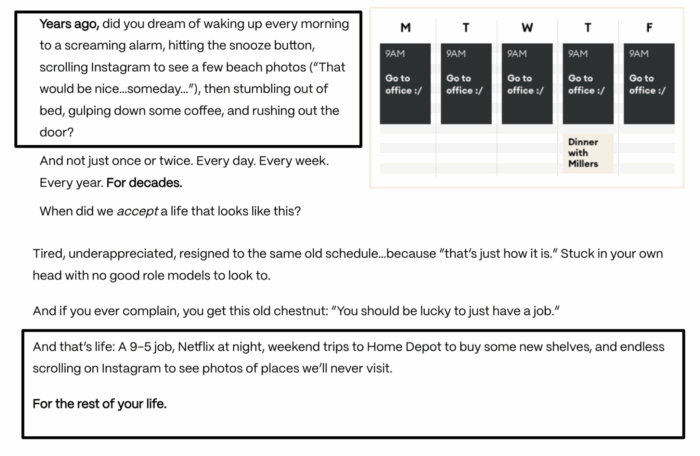
In analyzing the sales infrastructure of Ramit Sethi’s flagship platform, Earnable, market strategists highlight the deep integration of specific customer scenarios. Rather than relying on generic statements like "build a flexible business," Sethi’s copy speaks directly to the reader’s routine:
"You get home at 6:30 PM. You order takeout, turn on Netflix, scroll through Instagram, and think about how much better life would be if you were your own boss…"
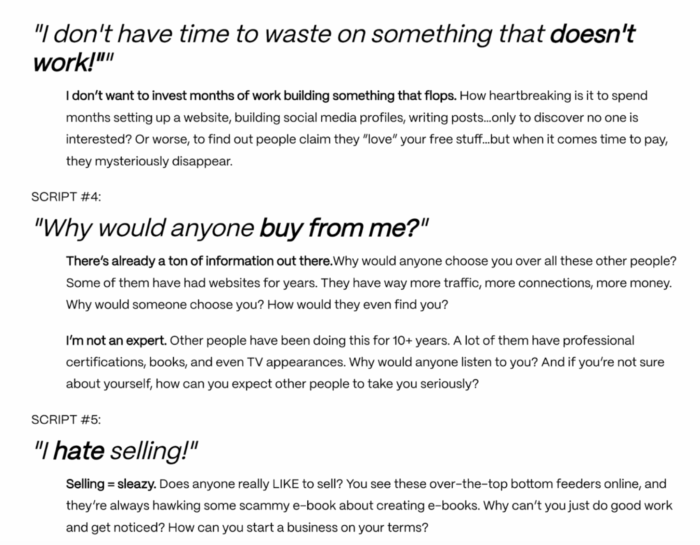
By calling out specific daily habits and lingering thoughts, the copy systematically dismantles viewer skepticism. Sethi further categorizes audience hesitations into labeled objection scripts, neutralizing doubts regarding time availability, technical skill, and market saturation before presenting the purchase CTA.
+---------------------------------------------------------------------------+
|              RAMIT SETHI'S OBJECTION NEUTRALIZATION MATRIX                |
+---------------------------------------------------------------------------+
| Prospective Objection     | Copy Neutralization Script                    |
+---------------------------+-----------------------------------------------+
| "I don't have enough time"| Explicitly breaks down weekly time slots and   |
|                           | demonstrates how 3 hours/week is sufficient.  |
+---------------------------+-----------------------------------------------+
| "I lack a unique idea"    | Provides systemic frameworks showing how to   |
|                           | monetize existing skills without inventing    |
|                           | a new industry.                               |
+---------------------------+-----------------------------------------------+
Case Study 2: Corporate Paid Advertising Strategies (HubSpot, Synthesia, Close)
Analysis of institutional SaaS advertising reveals a heavy emphasis on zeroing in on clear operational frustrations:
HubSpot: Focuses ad copy on the complexity and confusion of managing fragmented customer data across disparate platforms, positioning its software as a single unifying solution.
Synthesia (AI Video Generation): Highlights the time and monetary expenses of traditional video production shoots—equipment rentals, actors, location permits—to emphasize the efficiency of its automated platform.
Close (CRM Software): Addresses lead decay caused by cluttered sales pipelines, using ad copy that ties disorganized data directly to lost sales revenue.
Strategic Commentary: The Copyblogger Methodology
Reflecting on the evolution of digital marketing and content monetization, leadership at Copyblogger underscores that sustainable income in modern digital publishing depends entirely on treating writing as a conversion driver:
"Becoming a better copywriter doesn’t mean you write more eloquently. In fact, the opposite is often true. Great copywriters are clear, concise, and ultimately convert readers into customers. If you can prove that your copywriting generates a higher ROI than market averages, you will secure a far more lucrative career."
Future Outlook: The Evolution of Modern Copywriting
As generative AI models continue to lower the barrier to raw text generation, the market value of basic content production will continue to decline. However, the commercial value of strategic, conversion-oriented copywriters will rise.
Heightened Demand for Authenticity and Original Research: As automated content fills search results and social feeds, readers prioritize content backed by real human experience, unique data sets, and direct expert quotes.
Shift from Traffic to Direct Attribution: Marketing budgets are increasingly allocated toward channels and strategists offering precise conversion attribution (such as custom GA4 event paths and self-reported form tracking) over broad awareness initiatives.
Hybrid AI-Human Production Models: High-earning writers will increasingly act as creative directors, using AI models to run audience data analyses and quickly iterate copy options, while manually refining the final message, emotional hooks, and strategic angle.
Platform Specialization: Deep technical knowledge of specific distribution ecosystems—such as LinkedIn B2B algorithms, YouTube script structure, or retention-focused email sequences—will remain a primary factor in setting premium copywriter pricing.
By moving past subjective artistic preferences and mastering audience psychology, data analytics, and conversion mechanics, modern copywriters can build resilient, high-margin careers that consistently drive top-line revenue growth across the digital economy.