

Executive Overview
In the modern digital marketing arena, relying on static, manually updated spreadsheets to monitor search engine performance is no longer viable. As search engines evolve at an unprecedented pace—incorporating complex algorithmic updates, localized map packs, and real-time AI-driven search features—digital marketers, enterprise brands, and SEO agencies require advanced, automated solutions.
SERP tracking tools have transformed from simple keyword loggers into sophisticated intelligence suites. These platforms ingest massive volumes of real-time data, mapping keyword fluctuations directly to business bottom lines, traffic acquisitions, and revenue conversions.
![7 Best SERP Tracking Tools for 2022 [In-Depth Review]](https://www.robbierichards.com/wp-content/uploads/2020/05/Best-SERP-Trackers.jpg)
This comprehensive review examines the current state of search engine results page (SERP) tracking for 2025. We will deconstruct the critical capabilities separating elite platforms from basic tools, explore the industry’s premier standalone and all-in-one software suites, and analyze how data-driven organizations leverage these tools to secure competitive advantages.
Detailed Chronology: The Evolution of Rank Tracking
To understand why modern SERP tracking software is indispensable, it is helpful to review how the industry arrived at its current technological state.
![7 Best SERP Tracking Tools for 2022 [In-Depth Review]](https://www.robbierichards.com/wp-content/uploads/2020/04/image16-2.png)
Phase 1: The Manual Era (Pre-2010s)
In the early days of search engine optimization, practitioners relied heavily on manual browser searches or rudimentary scraping scripts. Spreadsheets populated with weekly or monthly ranking checks were the industry standard. Data was frequently inaccurate due to personalization, localization variables, and data-center latency, making it nearly impossible to prove immediate Return on Investment (ROI) to stakeholders.
Phase 2: The Rise of Automated Software (2010–2018)
As search engines grew in complexity and search volume exploded, desktop-based rank trackers and early cloud-SaaS solutions emerged. These tools automated daily or weekly data pulls, allowing agencies to track thousands of keywords simultaneously. However, they were often plagued by slow update cycles, limited geographic granularity, and a total lack of insight into shifting SERP layouts (such as the proliferation of featured snippets).
![7 Best SERP Tracking Tools for 2022 [In-Depth Review]](https://www.robbierichards.com/wp-content/uploads/2020/04/image2-3.png)
Phase 3: The Real-Time Intelligence & AI Integration Era (2019–Present)
Today’s ecosystem is defined by speed, multi-engine capability, and deep analytical integrations. Platforms like AccuRanker introduced on-demand, cloud-based data refreshes, while all-in-one suites like Semrush integrated position tracking with competitive gap analysis and traffic analytics. Furthermore, the advent of generative search experiences and AI-driven features has forced tracking software to adapt, ensuring marketers can monitor not just traditional blue links, but a vast array of modern SERP features.
Supporting Context & Metrics: Why Invest in SERP Tracking?
Validating SEO efforts and justifying budget allocations to executive boards hinges on granular performance tracking. According to recent industry benchmarks, organizations utilizing automated, real-time rank trackers experience a 40% reduction in time spent on manual reporting, allowing teams to pivot strategies dynamically during algorithmic turbulence.
![7 Best SERP Tracking Tools for 2022 [In-Depth Review]](https://www.robbierichards.com/wp-content/uploads/2020/04/image6-2.png)
An enterprise-grade SERP tracker provides organizations with the ability to:
- Quantify Share of Voice (SoV): Measure exact market dominance across designated keyword clusters relative to competitors.
- Correlate Rankings with Revenue: Bridge the gap between ranking positions and actual conversions by integrating with analytics platforms.
- Identify Content Decay & Opportunities: Spot declining positions early to initiate content refreshing before organic traffic drops significantly.
Essential Features of Modern SERP Tracking Software
When evaluating software options for your organization, look for nine core features that separate elite platforms from basic keyword loggers.
![7 Best SERP Tracking Tools for 2022 [In-Depth Review]](https://www.robbierichards.com/wp-content/uploads/2020/04/image15.jpg)
1. Accurate On-Demand Ranking Updates
SERP positions fluctuate rapidly throughout the day. Waiting days for scheduled weekly updates leaves teams vulnerable to unaddressed algorithmic drops. Solutions like AccuRanker offer automated 24-hour refreshes alongside on-demand manual updates executed with a single click.
2. Multi-SERP Feature Monitoring
Modern search results are cluttered with AI Overviews, featured snippets, "People Also Ask" (PAA) boxes, video carousels, and knowledge cards. Advanced trackers allow you to monitor 50+ distinct SERP features across your keyword catalog in a unified view, helping you capitalize on Position #0 opportunities.
![7 Best SERP Tracking Tools for 2022 [In-Depth Review]](https://www.robbierichards.com/wp-content/uploads/2020/04/image12-1.png)
3. Cross-Search Engine Tracking
While Google dominates global market share, localized campaigns or international operations often require visibility across alternative engines such as Bing, Baidu, Yandex, and YouTube. Elite tools support multi-engine tracking to provide a holistic view of online visibility.
4. Granular Geographic and Device Segmentation
Local search intent requires localized data. Top-tier tools allow tracking down to the zip code or city level, while cleanly separating desktop and mobile rankings—a vital distinction given the vast differences in mobile versus desktop SERP layouts.
![7 Best SERP Tracking Tools for 2022 [In-Depth Review]](https://www.robbierichards.com/wp-content/uploads/2020/04/image13-2.png)
5. Revenue and Traffic Mapping
Rank tracking in a vacuum has limited business value. Integrating ranking data with Google Analytics or Adobe Analytics—as seen in platforms like AccuRanker—enables reporting that ties specific landing pages, organic traffic surges, and conversion goals directly to keyword movements.
6. Comprehensive Historical Data
Point-in-time snapshots are insufficient for long-term strategic planning. Robust historical databases allow SEO professionals to view long-term trending curves, evaluating how a specific keyword has performed over years of algorithmic evolution.
![7 Best SERP Tracking Tools for 2022 [In-Depth Review]](https://www.robbierichards.com/wp-content/uploads/2020/04/image3.jpg)
7. Advanced Competitor Benchmarking
Understanding competitor movement highlights impending threats and untapped market gaps. Leading tools bucket keywords into rank groups (e.g., positions 1–3, 4–10, 11–50) to evaluate how your ranking distribution stacks up against rival domains.
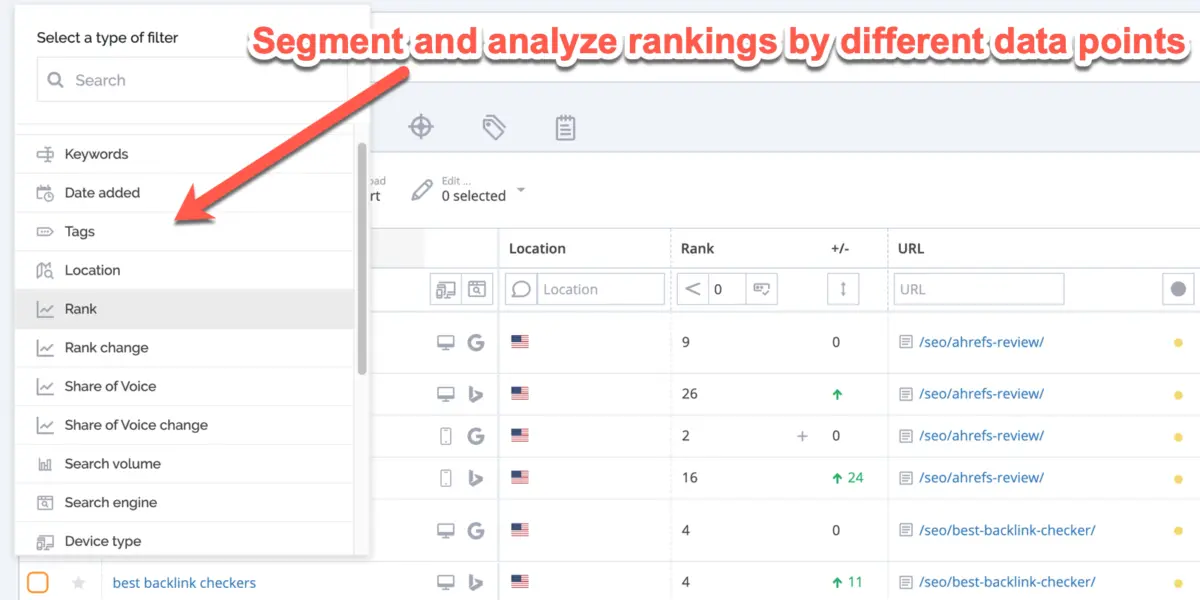
8. Custom Tagging and Segmentation
Not all keywords hold equal weight. Advanced tagging capabilities empower teams to segment data by marketing funnel stages, content formats, product categories, or brand versus non-brand search terms.
![7 Best SERP Tracking Tools for 2022 [In-Depth Review]](https://www.robbierichards.com/wp-content/uploads/2018/08/rj-employee_Robbie-color-new.png)
9. White-Label Reporting & Integrations
For agencies and large consultancies, client-ready reporting is vital. Native white-label scheduling and seamless integrations with visualization platforms like Google Looker Studio (formerly Data Studio) or Databox streamline communication.
The 7 Best SERP Tracking Tools for 2025
The market features countless options, categorized into specialized standalone trackers and robust all-in-one SEO platforms. Below is our curated shortlist for 2025.
![7 Best SERP Tracking Tools for 2022 [In-Depth Review]](https://www.robbierichards.com/wp-content/uploads/2020/05/Databox-SEO-dashboard-1.jpg)
1. AccuRanker (Best Standalone SERP Tracker)
Trusted by over 32,000 companies—including enterprise giants like HubSpot, IKEA, and Kinsta—AccuRanker is widely considered the gold standard for dedicated keyword tracking.
- Key Strengths: Lightning-fast, on-demand data refreshes, deep Share of Voice analytics, comprehensive landing page reporting via analytics integrations, and robust multi-engine support.
- Ideal For: SEO agencies, enterprise brands, and professionals requiring rapid, ultra-accurate ranking data and API access.
- Pricing: Plans start at $116/month for up to 1,000 tracked keywords.
2. Semrush Position Tracker & SERP Gap Analyzer (Best All-in-One Solution)
Serving more than 10 million users globally, Semrush integrates an industry-leading position tracker into its massive digital marketing suite.
![7 Best SERP Tracking Tools for 2022 [In-Depth Review]](https://www.robbierichards.com/wp-content/uploads/2020/04/image4-2.png)
- Key Strengths: Exceptional tracking accuracy, deep local map-pack monitoring, and access to the unique SERP Gap Analyzer app in the Semrush App Center, which scans SERPs to uncover under-optimized content and integrates directly with Google Search Console.
- Ideal For: Marketing professionals and enterprises seeking a comprehensive ecosystem that combines world-class rank tracking with technical audits, backlink analysis, and content marketing tools.
- Pricing: Platform subscriptions start at $139.95/month.
3. ProRankTracker (Best Scalable & Cost-Effective Standalone Tool)
Utilized by over 60,000 customers, ProRankTracker offers robust, highly accurate rank tracking, analysis, and reporting tailored to multi-device and international campaigns.
- Key Strengths: Multilingual support, advanced video/YouTube tracking, and highly scalable data processing.
- Ideal For: International brands, digital agencies, and video marketers on a budget.
- Pricing: Entry-level plans start at $39/month.
4. Advanced Web Ranking – AWR (Best for Enterprise & Custom Reports)
A staple in the SEO community, AWR is a powerful standalone tracker trusted by massive enterprises for granular location tracking and deeply customized white-label client reports.
![7 Best SERP Tracking Tools for 2022 [In-Depth Review]](https://www.robbierichards.com/wp-content/uploads/2020/04/image5.jpg)
- Key Strengths: Exceptional reporting flexibility, enterprise-grade user permission controls, and dependable cloud infrastructure.
- Ideal For: In-house corporate teams and large agencies managing complex, multi-brand portfolios.
- Pricing: Subscriptions start at $99/month.
5. SERPWatcher by Mangools (Best for Simplicity & Value)
Designed by Mangools, SERPWatcher provides an approachable, streamlined user interface without sacrificing core metric depth.
- Key Strengths: The proprietary Performance Index calculates organic traffic potential instantly; highly intuitive dashboard design; affordable bundle pricing.
- Ideal For: Small business owners, startups, and freelancers who need simple, clean rank tracking alongside basic SEO utilities.
- Pricing: Mangools plans start at $29.90/month.
6. SE Ranking (Best Feature-Rich Mid-Market Suite)
SE Ranking provides an all-in-one SEO toolset featuring a highly reliable position tracker that simulates genuine user behavior across targeted geographical locations.
![7 Best SERP Tracking Tools for 2022 [In-Depth Review]](https://www.robbierichards.com/wp-content/uploads/2020/05/AccuRanker-Google-Data-Studio-integration.jpg)
- Key Strengths: 100% accurate data simulation, competitor ranking matrices, and comprehensive site audit integrations.
- Ideal For: Small-to-medium agencies and growing businesses seeking a versatile, cost-effective SEO toolkit.
- Pricing: Plans start at $52/month based on daily checks for 500 keywords.
7. Nightwatch (Best for Hyper-Localized & Global Scale)
Trusted by major brands like Shopify and Coinbase, Nightwatch stands out for its massive geographic database, allowing tracking across over 107,000 unique locations worldwide.
- Key Strengths: Incredible location granularity, custom data segmentation, and clean, modern visualization panels.
- Ideal For: Businesses operating across dispersed geographical markets, from local franchises to global enterprises.
- Pricing: Free 14-day trial available; paid plans start at $32/month for up to 250 keywords.
Official Statements & Industry Perspectives
Industry leaders consistently emphasize the shift toward integrated, multi-metric reporting.
![7 Best SERP Tracking Tools for 2022 [In-Depth Review]](https://www.robbierichards.com/wp-content/uploads/2018/11/Ian-Howells2.png)
"It’s by far the best keyword ranking tracker in the market and has a ton of great reporting functions. If you want visibility on large volumes of keywords housed within a nice dashboard—this is for you."
— Matthew Howells-Barby, Co-Founder of TrafficThinkTank
Similarly, agency practitioners note the immense value of connecting rank data to visualization pipelines:
![7 Best SERP Tracking Tools for 2022 [In-Depth Review]](https://www.robbierichards.com/wp-content/uploads/2019/01/Google-Data-Studio-KW-rankings-dashboard.png)
"The thing that really got me using them heavily in the last month or two is their reporting connectors. Combining the tag feature, as well as the Share of Voice metric, has been a big help in making these reports immediately digestible."
— Ian Howells, Co-Founder of Traffic Think Tank
Future Outlook
As we look further into 2025 and beyond, the SERP tracking industry will continue to be reshaped by artificial intelligence and changing search behaviors. With search engines increasingly delivering direct answers via generative AI rather than traditional blue links, traditional rank tracking metrics (such as rigid position numbers) are expanding to encompass "visibility share" and real-time SERP feature saturation.
![7 Best SERP Tracking Tools for 2022 [In-Depth Review]](https://www.robbierichards.com/wp-content/uploads/2025/01/AccuRanker-home-page.jpg)
Organizations that invest in agile, multi-engine, AI-aware tracking tools will maintain a decisive edge. Whether you choose a dedicated powerhouse like AccuRanker or an all-in-one ecosystem like Semrush, adopting automated, accurate SERP tracking software is no longer an optional luxury—it is the foundational pillar of modern digital growth.