

Executive Overview
A profound, border-crossing disillusionment is rippling through the modern geopolitical landscape. Across Western Europe and deep into the heart of South Asia, a technologically connected, highly literate generation is mobilizing. What began a month ago as localized student demonstrations in the northern suburbs of Paris has mutated into a sprawling, transnational wave of civil unrest. From Lisbon to Milan, Brussels to Belgrade, and even stretching thousands of miles away to India, hundreds of thousands of citizens—led primarily by youth and students—are taking to the streets.
Crucially, this wave of global unrest cannot be reduced to a single ideological crusade or a unified grievance. It is not an organized resurgence of traditional 20th-century communism, nor is it a manufactured cultural panic. Rather, it represents an existential roar of frustration directed at a system that has long promised prosperity, security, and upward mobility: liberal democracy.
For decades, the architects of global capital and centrist politics assured the public that the forced marriage of market capitalism and parliamentary governance was the final, triumphant stage of human socioeconomic evolution. Today, a new generation is delivering a blunt verdict: Democracy, in its current neoliberal incarnation, has failed to deliver for the vast majority of people. Facing soaring housing costs, crumbling public infrastructure, stagnant real wages, underfunded educational systems, and a deafening political apathy toward climate change, citizens are pushing back.
This commentary-driven deep dive investigates the roots of the 2026 global protests, examining how local grievances have coalesced into a transnational indictment of centrist politics, how right-wing populists are attempting to hijack the narrative via xenophobic rhetoric, and why the pillars of Western liberal democracy may be standing on increasingly brittle ground.
Detailed Chronology: From Parisian Suburbs to a Global Wave
The current wave of anti-establishment defiance did not erupt overnight, nor did it emerge from a coordinated international command center. Instead, it unfolded through a series of cascading local detonations that eventually caught fire across borders.
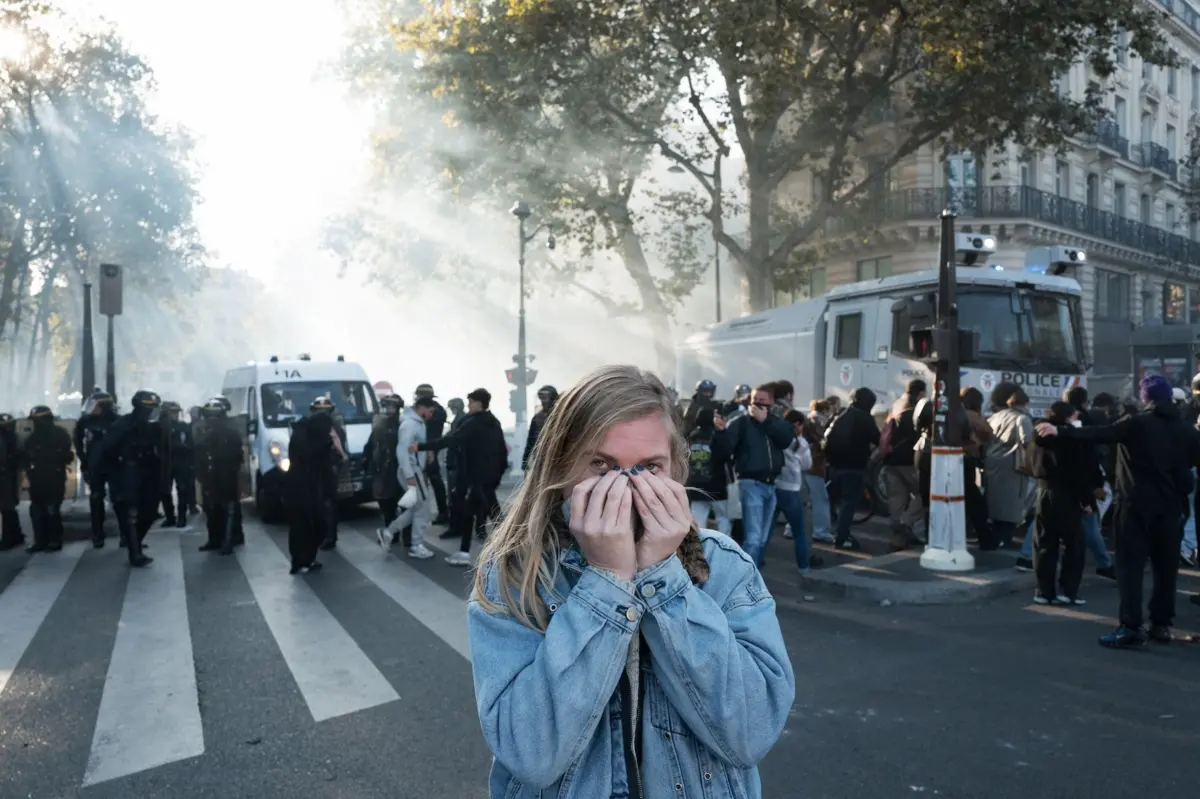
- Late September 2026 (Paris, France): The spark was struck in the secondary schools of northern Paris. Frustrated by deteriorating conditions in public education, cuts to youth services, and an acute cost-of-living crisis, teenagers walked out of classrooms. Within days, these student demonstrations morphed into broader street actions, drawing in labor unions, left-wing activists, and urban youth. Confrontations with law enforcement at iconic locations like the Place de la République frequently turned violent, characterized by tear gas, property damage, and intense clashes with riot police.
- Early to Mid-October 2026 (Western and Southern Europe): The French contagion crossed borders with startling speed. By mid-October, youth-led protests, strikes, and street skirmishes had broken out in at least six to seven European nations. In Belgium, Italy, Spain, Portugal, Greece, Serbia, and Albania, students and working-class citizens adopted the energy of the French mobilization, fusing it with pre-existing domestic grievances.
- Mid-October 2026 (The Balkan and Southern Peripheries): In countries like Albania and Serbia, anti-government demonstrations—deeply rooted in anger over entrenched state corruption and compromised electoral systems—gained massive new momentum, feeding off the visual spectacle of European youth challenging the status quo. Simultaneously, protests in Greece centered on crumbling public-sector infrastructure, low wages, and a glaring lack of workplace safety following years of unaddressed economic austerity.
- The Global Echo (India): Thousands of miles away from the barricades of Paris, India’s youth population was engineering its own anti-establishment earthquake. Launched earlier in the year as a hybrid of political satire and social media experimentation, the Cockroach Janta Party (CJP)—the "Voice of the Lazy & Unemployed"—transformed by midsummer 2026 into a formidable mass movement. Pushing back against the autocratic Hindu nationalist governance of Prime Minister Narendra Modi, the CJP demonstrated that the crisis of youth opportunity is truly global, transcending Western geographic and cultural boundaries.
- Late October 2026 (The Political Backlash): As the imagery of burning barricades in Paris flooded international newsfeeds, right-wing leaders and conservative commentators rushed to frame the unrest through an anti-immigrant lens. United States political figures, alongside European leaders such as Germany’s Friedrich Merz and Hungary’s newly installed Prime Minister Péter Magyar, utilized the chaos to argue that the crisis was the direct result of "open borders" and failed integration policies—a narrative fiercely contested by the demographics and stated demands of the protesters themselves.
Supporting Context & Metrics: The Anatomy of Intergenerational Despair
To understand why hundreds of thousands of unmasked, predominantly working- and middle-class citizens have flooded European avenues, one must examine the socio-economic metrics driving this intergenerational rage.
The Cost-of-Living Squeeze and Housing Crisis
In nations like Spain and Portugal, the protests are fundamentally economic. A generation of young adults faces a housing market utterly detached from reality, warped by years of unregulated tourism booms and the explosion of Airbnb-style short-term rentals. In major urban centers across the European Union, young professionals find themselves spending upwards of 60% to 70% of their income on basic rent, rendering traditional milestones of adulthood—such as homeownership or starting a family—permanently out of reach.
"Elite Overproduction" and Stagnant Wages
Sociologists have long warned of "elite overproduction"—a structural phenomenon where an economy produces far more university graduates than it can supply with commensurate, high-skilled white-collar employment. Across the Western world, real wages have remained stagnant or steadily declined since the 1970s, save for brief, localized tech booms. Today, university graduates find themselves working as baristas, gig-economy drivers, or low-wage service workers while carrying immense burdens of student debt. They are literate enough to perceive the systemic failures around them, yet economically trapped by design.
The Failure of Centrist Governance
For decades, centrist technocrats—epitomized by figures like outgoing French President Emmanuel Macron—have championed neoliberal reform: deregulation, privatization, and austerity budgets dressed up as fiscal responsibility. These policies have systematically hollowed out public services. Schools are underfunded, healthcare systems are strained, and infrastructure is crumbling. Yet, when confronted with climate catastrophes, soaring inflation, and rapid technological disruption (such as the unbridled expansion of data centers, AI infrastructure, and mass government surveillance), centrist politicians have offered little more than bland rhetoric and regulatory window-dressing.
Official Statements and Ideological Battles
The global wave of unrest has triggered a fierce ideological battle over how the protests are defined, weaponized, and interpreted by the political establishment.
The Right-Wing Securitization Narrative
Conservative figures across the globe immediately seized upon the unrest to validate their pre-existing political agendas. Donald Trump took to social media platform Truth Social to declare that France was being "conquered, looted and burned to the ground by migrants, jihadists and communists who hate Christianity."
This fantastical framing was eagerly adopted by various European leaders. Embattled German Chancellor Friedrich Merz and Hungarian Prime Minister Péter Magyar both pointed to high rates of migration and assimilation failures as catalysts for the sudden violence. Even nominally liberal commentators, such as The New York Times columnist Frank Bruni, lent credence to the premise that rapid racial, religious, and ethnic diversification over the past quarter-century had naturally culminated in angry high school students and window-smashing anarchists in French cities.
The Reality Check from Critical Economics
In a striking counter-narrative, The Economist—traditionally the house organ of global capital and an early, enthusiastic backer of Emmanuel Macron—published a leading editorial that dismantled the anti-immigrant talking points:
"Even if some young protesters in France wear Algerian football shirts or chant pro-Palestinian slogans, the upheaval in Europe today is not about race or religion. Over 500,000 people marched in France on Saturday and they were largely unmasked and white. They were fired up, as in other countries, by the cost of living and poor public services. They want more fuel subsidies, more spending on schools…"
The editorial went on to capture the raw emotional core of the movement, identifying it as pure, unadulterated rage:
"Rage at the failure of the state and against the floundering centrist politicians who govern. Rage at high prices and economic dysfunction. And for some, rage against the idea of centrist politics at all."
The Defense of the Status Quo
For his part, French President Emmanuel Macron—nearing the end of a largely turbulent and unpopular decade in power—has pushed back against foreign interference and racist mischaracterizations. While acknowledging deep domestic dissatisfaction, Macron strongly condemned the "stupid comments" made by foreign leaders alleging that France had been overrun by hordes of migrants and Islamists. Nevertheless, critics argue that Macron and his fellow centrist leaders remain entirely out of touch, fundamentally lacking the transformative ideas required to heal a fractured social contract.
Future Outlook: Whither Liberal Democracy?
As the dust settles on the immediate clashes in Paris, Milan, and Mumbai, the long-term implications of the 2026 youth protests loom large over the global order.
Liberal democracy—the post-Cold War synthesis of market capitalism, parliamentary representation, and civil liberties—is undergoing its most severe structural stress test since its inception. For generations, it functioned as a roaring economic engine, generating broad middle-class wealth. But as wealth concentration accelerates, social safety nets are dismantled, and governments prove incapable of managing planetary crises like climate change and economic inequality, the foundational legitimacy of the system is evaporating.
History demonstrates that radical systemic collapse rarely announces itself with clear, unambiguous sirens. As Marxist and critical political theorists have long noted, those who confidently predict the exact demise of capitalism or liberal democracy are invariably caught off guard by the timing and nature of real change.
Students in Marseille, Milan, and Mumbai may eventually return to their classrooms. They may temporarily reconcile themselves to the constrained realities of their daily lives. But the specter of their discontent cannot be un-seen or un-lived. They have torn back the curtain on the hollow promises of centrist technocracy.
Whether the system responds with genuine, structural reinvention—or whether it continues down the path of hardening authoritarianism, police crackdowns, and populist polarization—remains to be seen. What is certain, however, is that the path forward is fraught with dark passages and profound transformations. The generation that marched in 2026 has exposed the cracks in the foundation of the modern democratic state; sealing those cracks will require far more than the exhausted rhetoric of the past.