

By The Editorial Desk
Published: October 19
Executive Overview
In the hyper-competitive arena of seasonal food marketing, heritage brands face an ongoing struggle to remain culturally relevant. As consumer preferences shift toward artisanal alternatives, direct-to-consumer meal kits, and digitally native food disruptors, legacy institutions often find themselves relying on tired tropes of traditional holiday warmth. However, The Honey Baked Ham Company has chosen a decidedly more authentic path for its upcoming holiday campaign. By anchoring its narrative in genuine personal history rather than manufactured suburban fantasy, the brand is leveraging the star power of cultural phenomenon Kylie Kelce—not merely as a hired face, but as a creative collaborator whose childhood memories dictate the contours of the strategy.
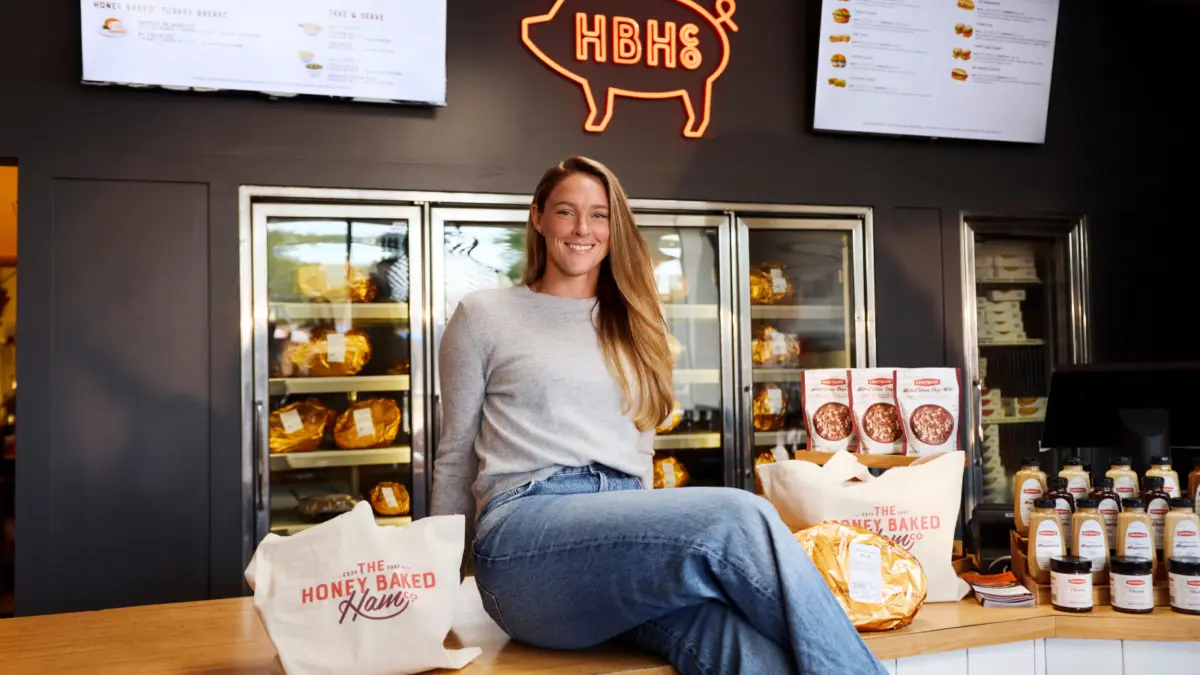
At the center of this new campaign is an unremarkable storefront situated in a suburban Philadelphia strip mall in Broomall, flanked by a Wawa, a dry cleaner, and a nail salon. To the casual passerby, it is just another local commerce outpost. But to Kylie Kelce—who rose to national prominence through her authenticity, her down-to-earth persona, and her marriage to former Philadelphia Eagles center Jason Kelce—this specific location is a repository of core childhood memories. It is the exact place where she, alongside her grandmother "Mimi," would procure the centerpiece for the family’s holiday table.
When given the opportunity to spearhead a major national campaign for the brand, Kelce rejected generic studio backlots and polished concept art in favor of this unglamorous strip mall reality. Her insistence on featuring the actual Broomall store and recounting her genuine history with the brand highlights a broader evolution in advertising: the premium placed on unvarnished truth over glossy illusion. This article investigates the anatomy of Honey Baked Ham’s new holiday initiative, examining the strategic alignment between the brand and Kelce, the mechanics of modern nostalgia marketing, the economic stakes for legacy food retailers, and what this campaign portends for the future of seasonal advertising.
Detailed Chronology: From Broomall Memories to National Campaign
The genesis of this strategic partnership did not begin in a Madison Avenue boardroom or a high-end talent agency office. Rather, it traces its roots back decades to the western suburbs of Philadelphia, where a young Kylie McDevitt navigated the aisles of local retail hubs with her grandmother.
The Formative Years in Delaware County
Long before national television appearances, viral podcast moments, and massive social media followings, Kylie McDevitt grew up immersed in the rhythms of Delaware County, Pennsylvania. Holiday traditions in the McDevitt household were anchored by specific culinary touchpoints, chief among them the spiral-sliced, sweet-glazed hams provided by the local Honey Baked Ham franchise in Broomall.
For McDevitt and her grandmother Mimi, these visits were ritualistic. The experience of entering the shop—engulfed by the distinct aroma of wood smoke and caramelized brown sugar—served as a sensory marker for the arrival of the holiday season. While many families inherit recipes, the Kelce-McDevitt holiday blueprint relied on the consistent, reliable craftsmanship of a commercial staple that had managed to ingrain itself deeply into the local culinary fabric. These formative impressions established an unfeigned brand loyalty that would lie dormant for years before becoming one of the most valuable assets in the company’s marketing arsenal.
The Rise of a Cultural Icon
As McDevitt grew into Kylie Kelce—an accomplished field hockey player, coach, and eventually the wife of future Hall of Famer Jason Kelce—her public persona developed a reputation for uncompromising candor. Amid the media circus surrounding the NFL, the "New Heights" podcast, and global superstar integrations, Kylie maintained a refreshing normalcy that resonated deeply with the American public. She became a symbol of down-to-earth Midwestern and Mid-Atlantic values, celebrated for her rejection of pretension, her dedication to grassroots community work, and her staunch defense of her authentic self.
Recognizing this unique cultural footprint, corporate brands naturally began circling. However, unlike celebrities who accept endorsement deals based purely on financial remuneration, Kelce has historically exercised strict curation over her partnerships, demanding alignment with products she genuinely uses and respects.
The Pitch Meeting That Changed the Campaign
When discussions began between Kelce’s team and executives at The Honey Baked Ham Company regarding a major holiday push, the brand expected a standard celebrity endorsement framework: scripted lines, professional kitchen sets, and idealized family gatherings.
Instead, Kelce disrupted the standard playbook. During early creative sessions, she brought up the Broomall store unprompted. She explained that if she were to represent the brand, the campaign had to honor reality. She recounted her childhood trips with Mimi, pointing to the exact strip mall location next to the Wawa as the epicenter of her holiday traditions.
Chief commercial officer Maegan Markee and her marketing team faced a choice: stick to the safe, scalable, and sterile advertising concepts designed for broad national appeal, or pivot entirely to accommodate Kelce’s hyper-local, deeply personal narrative. Choosing the latter, the brand dispatched production crews to the unassuming Broomall strip mall, transforming a routine commercial shoot into an authentic homecoming chronicle.
Supporting Context & Metrics: The Economics of Authenticity
To understand why Honey Baked Ham’s leadership embraced Kelce’s unconventional pitch, one must analyze the current landscape of consumer behavior and the measurable value of authenticity in the food retail sector.
The Psychology of Nostalgia in Retail
In periods of macro-economic uncertainty and cultural rapid-fire change, consumer sentiment routinely trends toward comfort and nostalgia. Psychological studies consistently demonstrate that nostalgic marketing triggers emotional security, reducing consumer skepticism and fostering deep brand trust. However, modern consumers have developed sophisticated filters for detecting inauthentic nostalgia—the kind manufactured by marketing agencies using vintage filters and paid actors.
+-----------------------------------------------------------------+
|                   THE NOSTALGIA SPECTRUM                        |
|                                                                 |
|  [Manufactured Nostalgia] ---------> [Authentic Heritage]       |
|  • Stock footage                     • Real hometown locations  |
|  • Scripted family dynamics          • Lived personal history   |
|  • Generic holiday tropes            • Unfiltered storytelling  |
+-----------------------------------------------------------------+
By anchoring the campaign in a specific, verifiable geographic location—a nondescript suburban strip mall—Honey Baked Ham bypassed the trap of manufactured sentimentality. The juxtaposition of a national brand with the mundane reality of a Broomall strip mall (complete with neighboring dry cleaners and nail salons) grounds the campaign in truth. Consumers do not just see a celebrity pitching a ham; they see a real person returning to the exact physical space that shaped her youth.
The "Kelce Effect" on Brand Equity
In the wake of the Travis Kelce and Taylor Swift phenomenon, the entire Kelce family ecosystem has become one of the most potent driving forces in American media and commerce. However, while media coverage has heavily favored Travis and Jason, Kylie Kelce has quietly emerged as an independent commercial powerhouse.
Market research indicates that audiences respond overwhelmingly to Kylie’s perceived lack of artifice. Brands that partner with her inherit a rare commodity: trust. In the food and beverage industry, where quality claims are easily commodified, trust is the ultimate differentiator.
- Audience Resonance: Campaigns featuring relatable, unpretentious figures yield significantly higher engagement rates on social media compared to traditional high-glam endorsements.
- Local-to-National Scale: By starting with a hyper-local anchor (Broomall, PA), the campaign achieves a broader national resonance because the narrative feels universally accessible. Everyone has a specific, unglamorous local landmark tied to their childhood memories.
- Dwell Time and Conversion: Digital content that incorporates storytelling elements—such as the relationship between Kylie and her grandmother Mimi—generates longer user attention spans, directly correlating with higher seasonal conversion rates.
Official Statements and Industry Insights
The collaboration between Kelce and Honey Baked Ham represents a calculated evolution in how legacy brands communicate with modern consumers. Leadership at the company has been vocal about the transformative nature of this creative direction.
Maegan Markee on Creative Partnership
Maegan Markee, Chief Commercial Officer of The Honey Baked Ham Company, reflected on the moment Kelce reframed the campaign during their initial planning sessions.
"When you work with cultural figures of Kylie’s caliber, the temptation is always to build a world around them that looks like a magazine cover," Markee noted during an industry briefing. "Kylie completely flipped the script on us. She didn’t want a Hollywood kitchen; she wanted the Broomall strip mall. She wanted Mimi. She wanted the reality of what Honey Baked Ham has meant to real families for generations. As a marketer, when your partner offers you a story that genuine, you don’t hesitate—you lean in."
Markee emphasized that the brand’s executive team recognized that today’s consumers are fatigued by perfection. "The modern consumer values transparency above all else. They want to know that the people representing your product actually have a history with it. Kylie’s memories in Broomall aren’t a marketing construct; they are her life. That gives our brand an irrefutable layer of credibility."
Cultural Analysts Weigh In
Industry analysts have pointed to this campaign as a masterclass in modern brand stewardship. Dr. Elena Vance, professor of consumer psychology at the Wharton School, observed that the strategy reflects a broader shift away from aspirational marketing toward relational marketing.
"For decades, food advertising relied on aspiration—showing families in sprawling, immaculate dining rooms eating food that looked entirely too perfect to be real," Dr. Vance explained. "Today, consumers reject that because it feels unattainable and fake. By highlighting a strip mall next to a Wawa and a nail salon, Honey Baked Ham is doing something radical: they are validating the ordinary, everyday spaces where real American life happens. Pairing that with Kylie Kelce—who embodies down-to-earth authenticity—creates a powerhouse of consumer trust."
Future Outlook: What This Means for Seasonal Food Marketing
As The Honey Baked Ham Company rolls out its multi-channel holiday campaign across television, digital platforms, and social media, the implications extend far beyond a single seasonal push. The campaign serves as a case study for legacy brands navigating the digital age.
1. The Death of the Generic Holiday Ad
The success of the Broomall strip mall narrative signals that generic holiday commercials featuring snow-dusted cabins and silent-night string arrangements are rapidly losing efficacy. Future campaigns will increasingly demand hyper-specific, localized storytelling that proves a brand’s deep integration into the fabric of everyday communities. Legacy brands must mine their own operational histories to find real consumer touchpoints rather than inventing fictional ones.
2. The Evolution of Influencer Collaboration
The partnership demonstrates that the most effective influencer collaborations are those where the talent transitions into a creative partner. Brands that grant creative autonomy to cultural figures who genuinely understand the product will consistently outperform those that treat influencers as mere distribution channels. As consumers grow immune to blatant sponsored posts, the integration of real personal history will become the gold standard of influencer marketing.
3. Hyper-Local Roots, National Appeal
Perhaps the most enduring lesson of the Broomall campaign is the paradox of scale: the more specific you get, the broader your appeal becomes. By focusing intensely on one particular store, one specific grandmother, and one specific childhood memory, Honey Baked Ham has tapped into a universal human experience. Millions of consumers across the United States do not see just a Broomall strip mall; they see their own hometowns, their own family traditions, and their own cherished memories around the holiday table.
Conclusion
The Honey Baked Ham store in Broomall, Pennsylvania, remains physically unchanged. It still sits quietly in its strip mall, sharing a parking lot with a Wawa, a dry cleaner, and a nail salon. Yet, through the vision of Kylie Kelce and the adaptability of brand leadership, this modest retail outpost has been elevated from a local neighborhood fixture into a national symbol of authenticity, memory, and culinary tradition.
In an era where corporate messaging is frequently met with cynicism, the decision to ground a national holiday campaign in an unglamorous strip mall memory proves that truth remains the most compelling narrative of all. As families gather this holiday season to share meals across the country, many will do so with a spiral-sliced ham on the table—and thanks to Kylie Kelce and Mimi, a quiet nod of appreciation for the unassuming places where those traditions first took root.