

By Pablo Andreu
Published October 18, 2026
Executive Overview
When Donald Trump clinched the presidency for a second term, the underlying tremors of his campaign rhetoric quickly materialized into administrative reality. For millions of immigrants, naturalized citizens, and their families, the transition from political theater to systemic policy enforcement has replaced a sense of constitutional security with pervasive dread.
Nowhere is this shift more evident than in the escalating assault on naturalized citizens and the legal frameworks of citizenship itself. The October 12, 2026, federal raid by Homeland Security Investigations on the Washington, D.C., home of Democratic U.S. Representative Ilhan Omar of Minnesota marks a grim milestone. What was once unthinkable—the active targeting of a sitting federal lawmaker’s citizenship status and the broader systemic weaponization of denaturalization procedures—has become standard operating procedure for a newly empowered Department of Homeland Security (DHS) and Department of Justice (DOJ).
For families like mine—woven together by birthright citizenship, naturalization, and the harrowing legacy of navigating the U.S. immigration system—this moment forces a terrifying reckoning. If a high-profile federal official can have her decades-old citizenship subjected to a politically motivated criminal inquiry, what protection remains for ordinary naturalized citizens? This report examines the mechanics, motivations, and chilling implications of the Trump administration’s crusade against naturalized Americans, tracing the path from executive overreach to the creation of a domestic immigration enforcement apparatus untethered from traditional judicial norms.
Detailed Chronology: From Campaign Rhetoric to the Raid on Rep. Ilhan Omar
The groundwork for the current assault on naturalized citizens was laid years before federal agents breached Representative Omar’s home. Understanding the gravity of the October 2026 raid requires examining the deliberate, step-by-step escalation of executive power and political targeting.
1. The Precedent of Birtherism and First-Term Scrutiny
Donald Trump’s foundational political strategy has long relied on casting doubt on the legitimacy of his adversaries’ presence and citizenship in the United States. Beginning with his 2011 "birtherism" campaign against then-President Barack Obama, Trump mastered the art of weaponizing conspiracy theories without factual substantiation.
During Trump’s first presidential term, federal officials quietly scrutinized Rep. Omar’s citizenship file following years of right-wing media accusations and innuendo. That 2019 review reportedly yielded no legal or procedural issues. Yet, rather than accepting the findings of civil servants, Trump and his inner circle continued to amplify unverified allegations. Earlier in 2026, Trump took to social media to declare that Omar "should be in jail" and "sent back to Somalia," characterizing Somali immigrants with dehumanizing rhetoric. Concurrently, Vice President JD Vance publicly suggested that Omar was culpable for immigration fraud.
2. The Opening Salvo of the Second Term
Upon reclaiming the White House, the administration immediately targeted the constitutional bedrock of American belonging. On the first day of his second term, Trump signed an executive order attempting to unilaterally end birthright citizenship—the very mechanism through which millions of Americans, including myself, obtained citizenship.
Although the Supreme Court temporarily blocked the initial executive order during the summer, the administration pivoted swiftly. Within a month, Trump signed two additional executive orders targeting birth tourism and birthright citizenship. When those measures faced renewed judicial challenges, the executive branch altered its vector of attack, shifting focus from birthright protections to the administrative weaponization of denaturalization.
3. The DHS Denaturalization Directive (June 2025)
In June 2025, the Department of Homeland Security issued an internal memo explicitly prioritizing denaturalization. Historically, stripping an individual of their hard-won citizenship was an extraordinary legal remedy reserved almost exclusively for extreme cases, such as concealing Nazi war crimes.
The June 2025 memo deliberately expanded the scope and discretion of federal agencies, granting them sweeping latitude to retrospectively examine, challenge, and strip citizenship from naturalized Americans. What civil rights advocates warned would become an engine of political persecution quickly became reality.
4. The October 12, 2026 Raid
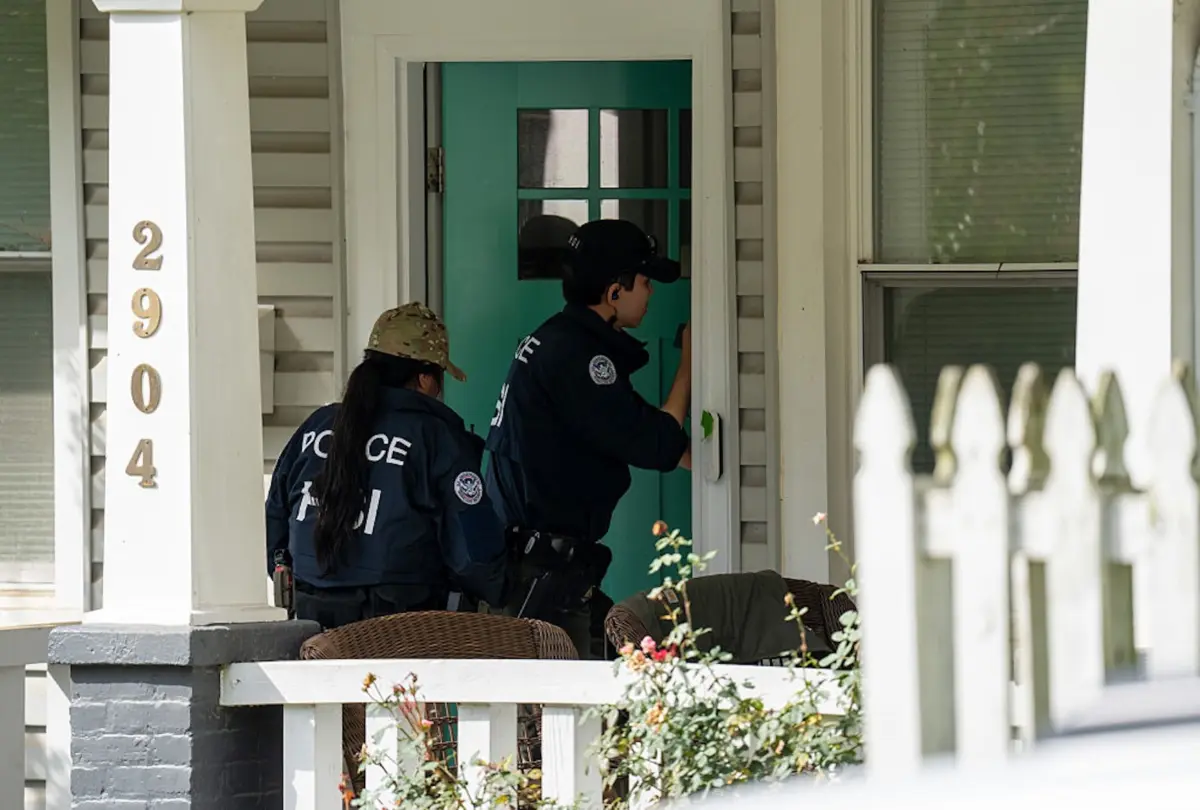
The culmination of these policies arrived on a Monday morning in mid-October 2026, when Homeland Security Investigations (HSI) and Immigration and Customs Enforcement (ICE) agents executed a high-profile search warrant on Rep. Ilhan Omar’s Washington residence.
While the judicial warrant remains sealed and the DOJ has offered little beyond designating the matter an "ongoing criminal investigation," the involvement of immigration enforcement agencies signals that the case centers on allegations of historical immigration fraud. The factual background, however, underscores the dubious nature of the prosecution: Omar’s family fled Somalia as refugees and were granted legal asylum in 1995. Five years later, Omar derived U.S. citizenship automatically under federal law when her parents completed their naturalization process.
Critics have pointed to unproven claims regarding her age at arrival, suggesting a minor discrepancy in paperwork filed over 25 years ago by her late father. Even under the worst-case scenario, any administrative error committed by a refugee minor’s guardian a quarter-century ago is being exhumed now—three weeks before the midterm elections—as a blunt instrument of political vengeance.
Supporting Context & Metrics: The Institutional Expansion of Immigration Enforcement
The ability of the executive branch to target political opponents and naturalized citizens on a mass scale is not merely a product of rhetorical hostility; it is the direct result of a massive, structural transformation of federal and local law enforcement agencies.
The Ballooning of the 287(g) Program
A cornerstone of this expansion is the radical scaling of the 287(g) program. Originally established by Congress in 1996 via the Illegal Immigration Reform and Immigrant Responsibility Act, the program permits ICE to deputize local law enforcement officers to perform federal immigration enforcement duties.
During Trump’s second term, this program has experienced exponential, unprecedented growth:
- Previous Baseline: Historically hovering around 140 memorandums of agreement.
- Current Expansion: The program has ballooned to 2,660 active agreements spanning 38 states and two U.S. territories.
By enlisting local police departments into federal immigration operations, the administration has systematically dismantled traditional constitutional firewalls that once separated local community policing from federal immigration enforcement.
Funding, Paramilitarism, and Eviscerated Accountability
Backed by an unprecedented $70 billion in immigration funding, federal agencies—including ICE, Customs and Border Protection (CBP), the Border Patrol, and U.S. Marshals—have been granted operational latitude that bypasses standard judicial oversight.
Investigative reports highlight recurring practices that bypass constitutional protections:
- Agents operating in masks while refusing to display identification badges.
- The widespread substitution of binding judicial warrants with administrative warrants—performative documents that lack neutral judicial sign-off.
- The creation of a de facto domestic paramilitary force capable of executing high-profile political sweeps with complete impunity.
The Human Cost: Denaturalizations Up, Naturalizations Down
The quantitative impact of these policies is stark:
- Denaturalizations: Federal actions stripping citizens of their legal status have risen sharply in alignment with the DHS priority memo.
- Naturalizations: Conversely, the rate of successful naturalizations has plummeted by 75%. This dramatic drop is driven by calculated intimidation tactics, including federal agents routinely ambushing applicants at green card and naturalization interviews.
Official Statements and Institutional Reactions
The federal government’s posture regarding the investigation into Rep. Omar and the broader denaturalization campaign has been characterized by strategic opacity balanced with aggressive public messaging from executive leadership.
The Department of Justice has repeatedly declined to comment on specific evidentiary details, citing the "ongoing criminal investigation" status of the sealed warrant. However, administration spokespersons have defended the actions as a routine enforcement of immigration integrity laws, rejecting accusations of political bias.
In stark contrast, legal scholars, civil liberties organizations, and congressional Democrats have condemned the raid as an authoritarian abuse of power. Constitutional law experts note that utilizing immigration enforcement mechanisms to investigate and potentially disenfranchise a sitting member of Congress sets a dangerous precedent that threatens the separation of powers.
Immigrant advocacy coalitions have emphasized that the investigation against Omar serves a dual purpose for the administration: silencing a prominent, progressive, Muslim-American critic while sending an unmistakable signal of intimidation to the millions of naturalized citizens living across the United States.
Future Outlook: A Chilling Effect on Naturalized Americans
The implications of the federal government’s actions extend far beyond Capitol Hill. Rep. Omar’s case stands as a high-stakes litmus test for the administration’s authority to execute political vendettas through administrative immigration law. Even if the Department of Homeland Security ultimately fails to denaturalize and deport the congresswoman, the psychological and political objective has already been achieved.
For naturalized citizens across the country, the message is unmistakable: citizenship is no longer a permanent legal status, but a conditional privilege subject to retroactive revocation based on political convenience.
This reality casts a heavy shadow over families preparing to return to the United States after time spent abroad. When crossing international borders, once-routine re-entries are now fraught with anxiety. The fear that historical paperwork—whether acquired via birthright or naturalization—might suddenly be subjected to hostile scrutiny forces citizens to take unprecedented precautions, from sanitizing personal digital devices of political commentary to turning off phones entirely during customs processing.
As the administration continues to weaponize the machinery of the state against its critics, the line separating citizen from non-citizen, and protected status from political target, grows perilously thin. In Donald Trump’s America, the foundational promise of equal protection under the law is being systematically rewritten, leaving millions to wonder: Could my family be next?