

Executive Overview
Deep beneath the freezing, pitch-black surface of the Arctic waters swims a creature that has quietly witnessed centuries of Earth’s history. The Greenland shark (Somniosus microcephalus) is officially recognized as the longest-living vertebrate known to science, with individual specimens surviving for an astonishing 400 years. For decades, marine biologists and physiologists have marveled at their longevity, slow metabolic rates, and mysterious biology. Yet, one enduring puzzle has persistently confounded researchers: their vision.
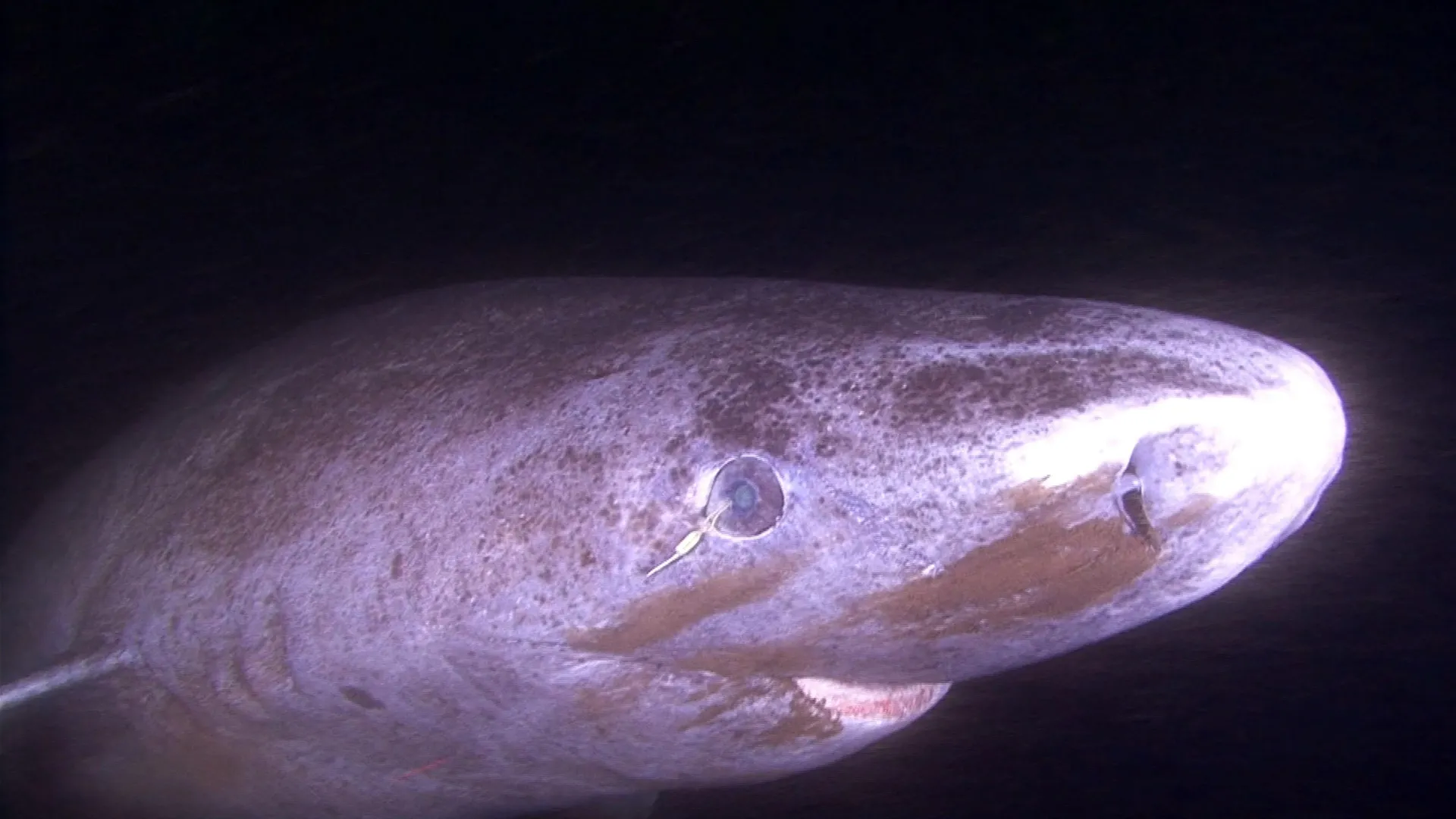
Characterized by thick gray bodies, small rounded snouts, and cloudy, lifeless-looking eyes frequently weighed down by parasitic copepods (Ommatokoita elongate), Greenland sharks have long been written off as functionally blind. In the absolute dark of the deep ocean—compounded by visual obstructions caused by parasites—conventional evolutionary logic suggests that an animal would discard the metabolic cost of maintaining a redundant sensory organ.
However, groundbreaking new research published in Nature Communications completely upends this long-held scientific assumption. Led by Dr. Dorota Skowronska-Krawczyk, an associate professor of physiology and biophysics at the University of California, Irvine, an international team of researchers has discovered that Greenland sharks possess a sophisticated, highly resilient visual system. Far from being blind, these ancient predators appear to utilize advanced DNA repair mechanisms that preserve their retinal health across centuries, shielding them from the catastrophic cellular degeneration that typically accompanies extreme aging.
By unlocking how these centuries-old apex predators maintain crystal-clear functionality in their optical tissues, scientists are not only rewriting marine biology textbooks; they are also opening radical new avenues for human medicine. The molecular pathways safeguarding the Greenland shark’s vision could eventually illuminate novel pathways for treating debilitating age-related human eye diseases, such as macular degeneration and glaucoma. This in-depth report explores the chronology of this landmark study, the meticulous laboratory work required to analyze prehistoric ocular tissue, and the profound implications these findings hold for the future of longevity science.
Detailed Chronology: From a 2016 Paper to a Baseball-Sized Eyeball
The journey toward understanding the visual capabilities of Greenland sharks did not begin in an Arctic submarine or a high-tech genomics facility. Instead, it started with a single academic paper published in the journal Science in 2016 by marine biologist John Fleng Steffensen.
Sparking Scientific Curiosity
Dr. Skowronska-Krawczyk, whose primary academic focus is the molecular landscape of age-related eye diseases and how aging systematically compromises human vision, stumbled across Steffensen’s work while researching cellular longevity.
"One of my takeaway conclusions from the Science paper was that many Greenland sharks have parasites attached to their eyes—which could impair their vision," Skowronska-Krawczyk recalls. As a physiologist, however, her intuition flagged an evolutionary contradiction. "Evolutionarily speaking, you don’t keep the organ that you don’t need. After watching many videos, I realized this animal is moving its eyeball toward the light."
That singular observation—watching archived footage of a Greenland shark actively tracking a light source on her computer monitor—ignited a multi-year investigative pursuit. To validate her hypothesis that the sharks’ eyes were not merely vestigial, degenerate organs, Skowronska-Krawczyk needed access to pristine biological samples from the deep Arctic.
Fieldwork in Disko Island
Between 2020 and 2024, an international collaborative team set out to secure these elusive samples. The group included John Fleng Steffensen of the University of Copenhagen, Peter G. Bushnell of Indiana University South Bend, and Richard W. Brill of the Virginia Institute of Marine Science.
Operating near the University of Copenhagen’s Arctic Station on Disko Island, Greenland, the researchers collected specimens using scientific long lines. Upon retrieval, the team carefully dissected the sharks’ eyes and immediately preserved them in specialized fixative solutions designed to halt cellular decay, preparing the delicate ocular structures for transport to advanced laboratories.
The Arrival at UC Irvine
Back in California, Emily Tom, a 28-year-old Ph.D. student and physician-scientist in training within Skowronska-Krawczyk’s laboratory, vividly remembers the day the Arctic samples arrived.
"I opened the package, and there was a giant, 200-year-old eyeball sitting on dry ice just staring back at me," Tom says with a laugh.
Transitioning from standard laboratory models to prehistoric marine specimens presented an immediate logistical hurdle. "We’re used to working with mouse eyeballs, which are the size of a papaya seed, so we had to figure out how to scale up to a baseball-sized eyeball," Tom explains. Operating under Skowronska-Krawczyk’s hands-on mentorship, the team developed precise protocols to defrost the giant, century-old tissue safely.
Because allowing the samples to reach room temperature would trigger rapid protein degradation and tissue ruin, every minute required hyper-vigilant oversight. The process was not without its olfactory challenges; Tom humorously notes that during the defrosting phase, "the lab smelled like a fish market."
Supporting Context & Metrics: Decoding the Molecular Machinery
With the tissue safely thawed and stabilized, Tom performed rigorous histological and vision-specific analyses. The outcomes of these assays challenged nearly every assumption regarding the physiological limits of aging tissue.
Absence of Retinal Cell Death
In typical mammalian aging—and across most vertebrate species—the passage of decades brings progressive cellular wear and tear. Retinal degeneration, characterized by widespread apoptosis (programmed cell death) in the light-sensing layers of the eye, is a hallmark of old age.
Yet, when Tom examined the histological cross-sections of the Greenland shark retinas, the results were astonishing: no evidence of cell death was found. Despite centuries of exposure to environmental stressors, metabolic byproducts, and the mechanical irritation of parasitic copepods, the retinal architecture remained remarkably pristine.
Specialized Photopigments for the Deep Ocean
Further molecular interrogation revealed that the sharks’ visual systems are masterclasses in evolutionary adaptation. The researchers discovered that rhodopsin—a crucial biological protein responsible for enabling vision in extremely dim, low-light conditions—remained fully active and functional within the shark retina.
Crucially, this rhodopsin was biochemically tuned to detect blue light. Because blue wavelengths penetrate deepest into the water column of the dark, murky Arctic ocean, this specialized adaptation ensures that Greenland sharks can maximize what little ambient light exists in their abyssal habitat.
Evolutionary and Genetic Implications
Co-authored by evolutionary researchers Walter Salzburger and Lily G. Fogg from the University of Basel in Switzerland, the study places these anatomical findings into a broader evolutionary framework. The data strongly suggests that Greenland sharks have evolved hyper-efficient DNA repair mechanisms and cellular maintenance pathways. These intrinsic protective layers prevent the accumulation of mutations and oxidative stress that normally drive age-related ocular decline.
| Research Metric / Parameter | Greenland Shark Baseline | Standard Vertebrate Comparison |
|---|---|---|
| Maximum Lifespan | Up to 400 years | Varies (typically decades to ~100 years) |
| Retinal Cell Death (Apoptosis) | Undetected in aged specimens | Increases progressively with age |
| Photopigment Status (Rhodopsin) | Highly active, blue-light tuned | Degrades or loses efficiency over time |
| Environmental Light Level | Extreme low-light / Abyssal Arctic | Varies widely by ecological niche |
| Primary Ocular Obstruction | Parasitic copepods (Ommatokoita) | Internal systemic vascular/age-related disease |
Official Statements & Expert Perspectives
The intersection of marine biology, genomics, and human aging has generated substantial enthusiasm within the scientific community. Investigators emphasize that the value of this research extends far beyond the icy waters of Greenland.
"One of my takeaway conclusions from the Science paper was that many Greenland sharks have parasites attached to their eyes—which could impair their vision," says Dr. Dorota Skowronska-Krawczyk. "Evolutionarily speaking, you don’t keep the organ that you don’t need. After watching many videos, I realized this animal is moving its eyeball toward the light."
Reflecting on the hands-on nature of the discovery and the unorthodox scale of the biological materials, Emily Tom highlights the scarcity of neuro-ophthalmological research dedicated to non-traditional model organisms:
"Not a lot of people are working on sharks, especially shark vision," Tom notes. "We can learn so much about vision and longevity from long-lived species like the Greenland shark, so having the funds to do research like this is very important."
Skowronska-Krawczyk echoes this sentiment, emphasizing the unique intellectual thrill of navigating uncharted scientific territory:
"What I love about my work is that we are the first in the world to see results—at the forefront, finding new mechanisms, rules and discoveries. Then, being able to share this joy with students—that’s the best part of it."
Future Outlook: Translating Arctic Biology to Human Medicine
As the scientific community digests the revelations published in Nature Communications, the horizon of longevity research is shifting. The discovery that a 400-year-old vertebrate can completely evade retinal degeneration provides a compelling blueprint for regenerative medicine.
Combating Human Eye Diseases
Age-related macular degeneration (AMD) and glaucoma are among the leading causes of irreversible vision loss and blindness in elderly human populations globally. These conditions are heavily driven by chronic oxidative stress, cellular senescence, and the gradual breakdown of retinal cells over time.
If future studies can successfully isolate and decode the exact molecular pathways—such as specialized DNA repair enzymes or unique protein stability factors—that protect the Greenland shark’s eyes for centuries, translational researchers may be able to synthesize therapeutic interventions mimicking these protective effects in human patients.
Navigating Funding and Policy Challenges
Despite the profound promise of these discoveries, basic scientific research faces persistent headwinds. Dr. Skowronska-Krawczyk points out that ongoing uncertainties surrounding federal research grants and shifting institutional funding priorities create undeniable anxieties for laboratories exploring unconventional, high-risk, high-reward topics.
Nevertheless, the historical resilience of science—paired with the tenacious curiosity of early-career researchers like Emily Tom—inspires confidence that exploratory projects investigating Earth’s most resilient creatures will endure.
Summary of Future Research Trajectories
- Genomic Sequencing: Deep-diving into the nuclear and mitochondrial genome of the Greenland shark to isolate specific DNA repair genes responsible for halting cellular aging.
- Protein Stability Analysis: Examining how rhodopsin and other structural proteins maintain functional integrity under extreme biological timelines.
- Translational Drug Discovery: Developing synthetic peptides or gene therapies inspired by shark cellular maintenance mechanisms to slow or reverse human retinal degeneration.
Ultimately, the humble Greenland shark—swimming silently through the freezing abyss with parasites clinging to its baseball-sized eyes—holds a mirror to human mortality. By listening to what these ancient predators have to teach us, humanity takes one step closer to preserving our own sight, light, and health well into our twilight years.