

Executive Overview
In an era defined by aggressive climate mitigation strategies, habitat fragmentation, and industrial-scale ecological remediation, a ground-breaking new study out of University College London (UCL) Geography suggests that humanity’s most effective tool for environmental restoration might simply be patience.
Led by Professor Carl Sayer, a team of ecological researchers has documented an extraordinary eleven-year transformation of an abandoned agricultural plot in North Norfolk, England. The findings, published in the peer-reviewed journal Restoration Ecology, challenge conventional conservation dogmas. For decades, conventional wisdom held that reviving species-rich grasslands from degraded, intensively farmed earth required heavy capital investment, commercial seed mixes, artificial soil amendments, and active ecological engineering.
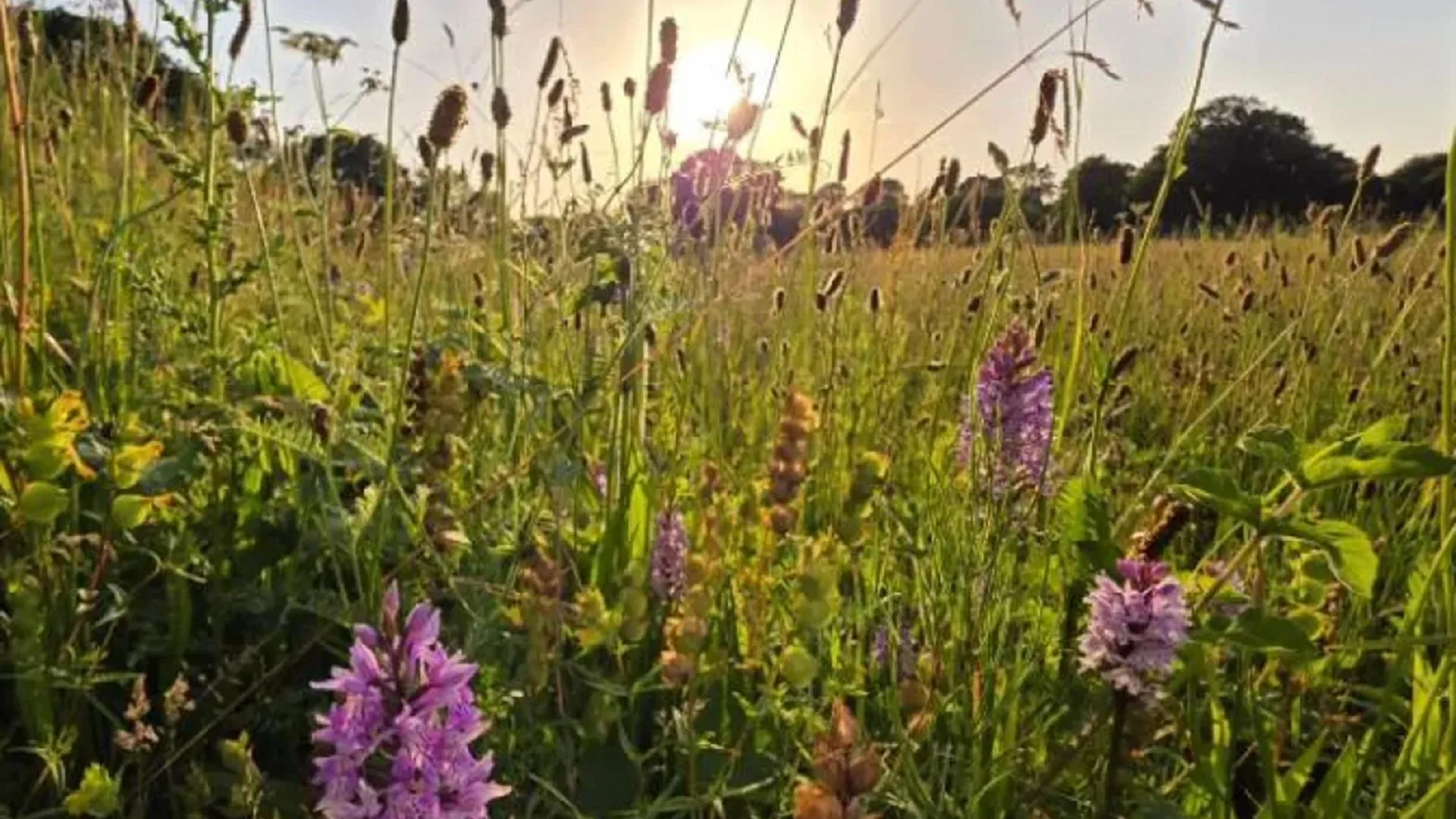
However, the UCL-led study proves otherwise. Following the cessation of farming in 2005—and save for a traditional, low-intervention annual hay cut—a two-hectare plot known locally as Sayer’s Meadow was left entirely to its own devices. Over a tracking period spanning from 2011 to 2022, the former arable field spontaneously regenerated into a dense, biodiverse, and visually striking wildflower meadow. Within little more than a decade, the site saw local plant species richness double. It spontaneously welcomed thousands of delicate southern marsh orchids, greater tussock-sedge, yellow rattle, and common centaury—species that conservationists typically struggle to establish via expensive, human-guided seeding programs.
This case study arrives at a critical political and environmental juncture. Across the United Kingdom and continental Europe, governments are frantically searching for scalable, cost-effective methods to reverse catastrophic biodiversity declines on former agricultural land. International treaties mandate the recovery of vast swaths of natural habitat, yet the financial and logistical burdens of commercial seeding often limit the scope of such projects.
By demonstrating that passive, nature-led recovery can outperform high-intervention techniques while preserving hyper-local genetic lineages, Professor Sayer’s research questions a multi-million-dollar restoration industry. It forces scientists, policymakers, and landowners to confront a provocative question: In the race to heal the planet, should we be favoring patience over the seed packet?
Detailed Chronology: The 11-Year Evolution of Sayer’s Meadow
To truly appreciate the significance of the North Norfolk study, one must examine the timeline of ecological succession that took place on the land. Long-term empirical studies examining unassisted grassland recovery are exceptionally rare in the ecological sciences. They require unwavering consistency, continuous funding, and institutional dedication over decades—luxuries that academic researchers rarely secure.
The story of Sayer’s Meadow began in 2005. The land, situated in the village of Bodham, is owned by Professor Sayer’s family and co-author Derek Sayer. Prior to its abandonment, the two-hectare plot had been used for conventional arable farming, concluding its agricultural career with a final crop of oilseed rape. However, the land proved notoriously difficult to drain, rendering it economically marginal for intensive food production. Rather than forcing the stubborn soil into continued submission, the Sayer family made a fateful decision: they stopped farming it.
While conventional agricultural advice at the time dictated that the landowner should immediately plow, harrow, and invest in expensive commercial meadow seed mixes to kickstart ecological recovery, Professor Sayer decided to test a hypothesis rooted in passive rewilding. He wanted to see what would happen if nature was simply permitted to reclaim the soil on its own terms, guided solely by a traditional annual hay cut to prevent scrub encroachment and manage soil fertility.
The Baseline: 2011
Formal, rigorous ecological monitoring of the site did not begin immediately. It commenced in 2011, six years after the final crop. Alongside collaborator Pete Robinson, Professor Sayer established a series of permanent survey plots distributed evenly across the two-hectare field.
During these initial baseline surveys, the botanical profile of the field was relatively sparse and homogenized—a typical legacy of intensive farming. Across the permanent plots, the average number of distinct plant species hovered stubbornly at around 10 per plot. The flora was dominated by hardy, competitive ruderal weeds and remnant agricultural species capable of surviving decades of nutrient enrichment and chemical applications.
The Middle Years: 2014–2018
As the years progressed, signs of profound systemic change began to manifest across the topography of Sayer’s Meadow. The dual pressures of annual hay-cutting (which systematically exports accumulated soil nutrients, starving out aggressive weeds) and the absence of synthetic fertilizers unlocked the soil’s hidden potential.
By the mid-2010s, field surveys recorded a steady, accelerating diversification of the plant community. Crucially, species that had not been intentionally sown—and which were entirely absent from adjacent agricultural land—began to appear. Among the most notable early arrivals was yellow rattle (Rhinanthus minor). A semi-parasitic plant that feeds on the roots of vigorous grasses, yellow rattle is widely regarded by restoration ecologists as the ultimate "keystone species" for meadow creation. By suppressing dominant grasses, yellow rattle inadvertently opens up ecological niches, allowing delicate wildflowers to establish roots and claim sunlight.
Following the arrival of yellow rattle, the botanical floodgates opened. The average species count per survey plot began to climb steadily, moving past 15 and marching toward a remarkable threshold.
The Milestone: 2022
By the time the final census of the eleven-year study was completed in 2022, the transformation of Sayer’s Meadow was absolute. The average number of plant species found in each survey plot had doubled since 2011, rising from roughly 10 to nearly 20.
More astonishing than the sheer mathematical increase in species richness was the composition of the flora. The meadow was now host to thousands of southern marsh orchids—a stunning, moisture-loving native orchid that had colonized the poorly drained soils without human assistance. Alongside the orchids, greater tussock-sedge and common centaury established thriving, self-sustaining populations. What was once a waterlogged, exhausted oilseed rape field had evolved into a vibrant, resilient ecosystem that mirrored ancient, centuries-old British wildflower meadows.
Supporting Context & Metrics: Challenging the Commercial Seeding Paradigm
The empirical data gathered from Sayer’s Meadow provides much-needed quantitative backing to heterodox ecological theories. To understand why these findings are causing ripples across the scientific community, one must analyze the prevailing economics and methodologies of modern habitat restoration.
The Flaws of Commercial Seed Mixes
In contemporary ecological restoration projects, the standard operating procedure is heavily interventionist. Conservation organizations, local authorities, and private developers typically spend thousands—if not millions—of pounds on commercial wildflower seed mixes. These mixes are engineered to deliver rapid, aesthetically pleasing results, ensuring that a bare field is covered in colorful blooms within a single growing season.
However, Professor Sayer’s research highlights several fatal flaws in this commercial approach:
- Genetic Homogenization: Commercial seed packets are typically harvested from mass-production farms, often located hundreds of miles away or even imported from abroad. When sown into local landscapes, these non-native or regionally mismatched genotypes interbreed with local flora, diluting and ultimately destroying the hyper-local genetic adaptations that native plants have spent millennia evolving to survive regional climate shifts, pests, and soil variations.
- High Financial Costs: By removing the requirement for commercial seed purchases, site preparation, heavy machinery deployment, and complex soil manipulation, passive restoration can dramatically reduce the financial barriers to entry for landowners. This democratizes conservation, allowing individual farmers and smallholders to restore land on modest budgets.
- Ecological Mismatches: Sown meadows often rely on species that look striking in photographs but fail to establish long-term ecological synergies with local insect populations, fungi, and soil microbiomes.
The Mystery of Dispersal: How Did the Plants Arrive?
One of the most intriguing questions raised by the North Norfolk study is logistical: how did rare, specialized plants like the southern marsh orchid manage to colonize a fenced, isolated agricultural plot with no history of rich native flora?
While definitive proof is difficult to capture in dynamic natural systems, the researchers hypothesize that wildlife played a central role. Birds, small mammals, and particularly deer—which frequently traverse the North Norfolk countryside—likely acted as biological vectors, carrying microscopic orchid seeds and plant propagules on their fur, in mud on their hooves, or through digestive tracts from nearby ancient woodland fragments and nature reserves.
This hypothesis underscores a vital truth about natural landscapes: ecosystems are not isolated islands. When given the time, space, and a clean slate free of chemical interference, landscapes possess an innate capacity for self-repair that far exceeds human imagination. The seeds were already out there in the wider landscape, waiting for the chemical shackles of intensive farming to be struck off before they could take root.
Ecosystem Services and Climate Resilience
Beyond aesthetics and botanical novelty, the transformation of Sayer’s Meadow delivers profound functional benefits. Species-rich grasslands are multi-functional powerhouses that provide critical ecosystem services:
- Pollinator Refuges: Intensive farming has decimated populations of wild bees, butterflies, and hoverflies. Diverse meadows rich in flowering plants provide continuous, high-quality nectar and pollen resources from spring through autumn.
- Carbon Sequestration and Soil Health: Deep-rooting meadow plants pump organic carbon deep into the soil profile, stabilizing earth structures and preventing the catastrophic soil erosion associated with annual plowing.
- Hydrological Regulation: In marginal, poorly drained soils like those in North Norfolk, perennial meadow vegetation acts as a giant sponge, absorbing heavy winter rainfall, slowing down runoff, and mitigating local flooding risks.
- Climate Adaptation: Ecologically diverse grasslands possess high functional redundancy, meaning they are inherently more resilient to extreme weather events—such as prolonged droughts or unseasonal deluges—than monoculture grasslands or arable fields.
Official Statements and Expert Perspectives
The publication of the UCL study has drawn commentary from leading ecologists, conservationists, and the authors themselves, illuminating the broader implications for environmental policy.
Reflecting on the emotional and scientific journey of the project, Professor Carl Sayer shared personal insights into the experiment’s origins:
"The field belongs to my family, and after an oilseed rape crop in 2005 we stopped farming it as the land was difficult to drain. I really wanted a wildflower meadow and all advice was to seed it, but I resisted the temptation, as I have always been interested in nature’s ability to recover itself."
Recalling the moment the ecosystem began to show its hand, Professor Sayer noted the profound sense of wonder that accompanied the scientific discovery:
"When the first orchids started appearing in our surveys, we were thrilled and now the meadow is unbelievably diverse, with thousands of orchids that delight locals in the village. Our study shows what can be achieved by a traditional hay cutting approach combined with nature’s brilliant spontaneity. A visit to the meadow is like stepping back through time."
Looking at the broader macro-level implications for national conservation targets, Professor Sayer emphasized the urgency of rethinking how humanity heals damaged earth:
"Our study shows that resisting seeding and allowing nature to lead may be worth trying a lot more in wildflower meadow restoration. Natural plant recovery better safeguards genetic diversity than seeding and ensures that local species thrive, making meadows less generic. As things stand the UK needs nature recovery fast, at big scales. In the push to achieve this goal our study poses the question: should we be employing patience over seed packet more often?"
Independent conservation scientists have similarly praised the study for providing empirical rigor to concepts that were previously driven more by philosophical intuition than hard data. By tracking continuous plot data over more than a decade, the UCL team has bridged the gap between theoretical rewilding and practical land management.
Future Outlook: Implications for Policy and Land Management
As governments across the United Kingdom, the European Union, and beyond grapple with legally binding biodiversity targets—such as halting species loss by 2030 and achieving net-zero carbon economies—the pressure on land managers has never been higher.
In the UK, post-Brexit agricultural subsidy frameworks (such as the Environmental Land Management scheme, or ELMs) are shifting public money away from intensive food production and toward "public money for public goods," chief among which is habitat restoration. Landowners are increasingly financially incentivized to take unproductive or marginal arable land out of production and convert it into wildlife habitats.
However, if government agencies and conservation NGOs default exclusively to interventionist, high-cost restoration models—mandating expensive seed mixes, complex mechanical ground overhauls, and prescriptive intervention guidelines—the overall scale of restoration will be bottlenecked by financial and logistical constraints.
The North Norfolk study points toward a radically different, highly scalable paradigm. If millions of hectares of marginal, abandoned, or retired farmland across Europe can be successfully restored to species-rich grassland simply by stopping artificial fertilizers, instituting an annual hay cut, and stepping back to let nature take the wheel, the economic and environmental efficiency gains would be staggering.
Recommendations for the Future of Conservation:
- Redefining Restoration Guidelines: Conservation agencies should update their advisory literature for landowners to include passive, nature-led succession as a viable, scientifically validated alternative to commercial seeding.
- Protecting Local Genetics: Policy frameworks should explicitly prioritize the preservation of hyper-local genetic lineages over the importation of generic commercial seed mixes, preventing biological pollution in delicate rural ecosystems.
- Embracing Long-Term Thinking: Funding bodies must learn to support and value long-term ecological monitoring programs. As Sayer’s Meadow demonstrates, the true magic of natural recovery unfolds over decades, not single fiscal quarters.
- Leveraging Marginal Farmland: Farmers struggling with poor drainage, low yields, or degraded soils should be given the confidence and financial support to experiment with passive rewilding, turning liability lands into community-enriching ecological assets.
Ultimately, Sayer’s Meadow stands as a living laboratory and a beacon of hope. It reminds humanity that nature is not a delicate, broken machine that requires constant, heavy-handed human tuning to function. Rather, it is a resilient, self-healing organism of astonishing complexity. When we possess the courage to step back, quiet our urge to control, and exercise a little patience, the earth possesses an extraordinary capacity to heal itself—turning abandoned furrows into fields of gold.