

While high-profile legal clashes between major media organizations—such as CNN, Politico, and MS NOW—and the White House routinely capture national headlines, a quieter, equally consequential constitutional struggle is unfolding across America’s statehouses and city halls.
From the rocky canyons of Utah to the historic chambers of the Kansas Statehouse, local and independent journalists are facing unprecedented hurdles to doing their jobs. Public officials are increasingly leveraging bureaucratic red tape, credentialing denials, and strict communication policies to stonewall the press. At its core, this localized battle is a fight for the First Amendment, raising profound questions about government transparency, viewpoint discrimination, and the rapidly narrowing window through which the public views its elected leaders.
Executive Overview
The modern landscape of American journalism is bifurcated. On one side, national outlets fight high-stakes legal battles over executive access; on the other, localized watchdogs operate on shoestring budgets while confronting systemic efforts to diminish their oversight.
For years, the relationship between the press and the government has been inherently adversarial—a dynamic designed by the Founding Fathers to ensure independent oversight. However, veteran statehouse and local reporters argue that this relationship has severely deteriorated. A convergence of factors, including the systemic decline of local newsrooms, the proliferation of hyper-targeted social media communication, and deepening political polarization, has emboldened political leaders to freeze out—and at times actively antagonize—journalists.
Rather than relying on independent intermediaries to digest policy, politicians increasingly favor self-publishing directly to constituents. When reporters push back, they are frequently met with restricted access, closed-door caucuses, astronomical rent hikes for statehouse offices, and retaliatory credential denials. The result is a fractured information ecosystem where stories take longer to report, cost more to investigate, and, in some cases, are abandoned entirely—leaving the tax-paying public in the dark.
Detailed Chronology: A Wave of Restrictions Across the States
The coordinated tightening of press access is not happening in a vacuum; it follows a timeline marked by shifting political norms, economic pressures, and targeted institutional policy changes.
The Utah Press Credentials Battle (2024–Present)
In Utah, Bryan Schott—a veteran political reporter and founder of Utah Political Watch—has been locked in a prolonged battle for press credentials to the Utah State Legislature. Having previously covered state politics for The Salt Lake Tribune, Schott applied for credentials for the 2025 legislative session under his new digital banner.
Legislative media liaisons Alex Musselman and Aundrea Peterson swiftly rejected the application, declaring that Capitol media credentials are not issued to blogs, independent journalists, or freelancers. Just days prior, Peterson had texted Schott to criticize an investigative piece detailing allegations that Senate President J. Stuart Adams had violated campaign finance disclosure laws, dismissing Schott as "someone who claims to be a journalist."
Schott filed a federal lawsuit in January 2025 alleging viewpoint-based discrimination under the First Amendment. Over the summer, a panel of the U.S. Court of Appeals for the Tenth Circuit revived Schott’s lawsuit, remanding it to a lower court to determine whether the legislature unlawfully targeted him based on his reporting. Meanwhile, Schott remains locked out of the governor’s monthly press conferences, legislative briefings, and timely press release lists.
The Iowa Credentialing and Record Roadblocks (2019–Present)
Independent journalist Laura Belin, editor and reporter for the progressive Iowa-based site Bleeding Heartland, faced a similar ordeal spanning half a decade. First denied credentials in 2019 under the premise that they are "not issued to members of the public," Belin spent years attempting to satisfy shifting administrative demands. She secured radio station contracts, incorporated the Society of Professional Journalists’ Code of Ethics into her site, and painstakingly retagged thousands of articles to cleanly separate news from commentary.
It was only after Belin filed a federal lawsuit against House Clerk Meghan Nelson in January 2024 that she was finally granted credentials for the remainder of the session. While the credentials restored her access to the press box and floor conversations, Belin notes she is still routinely omitted from campaign press lists, restricted from asking questions at Gov. Kim Reynolds’ infrequent press conferences, and forced to combat efforts to frame her as an activist rather than a journalist.
Kansas Statehouse Access Rollbacks (2025)
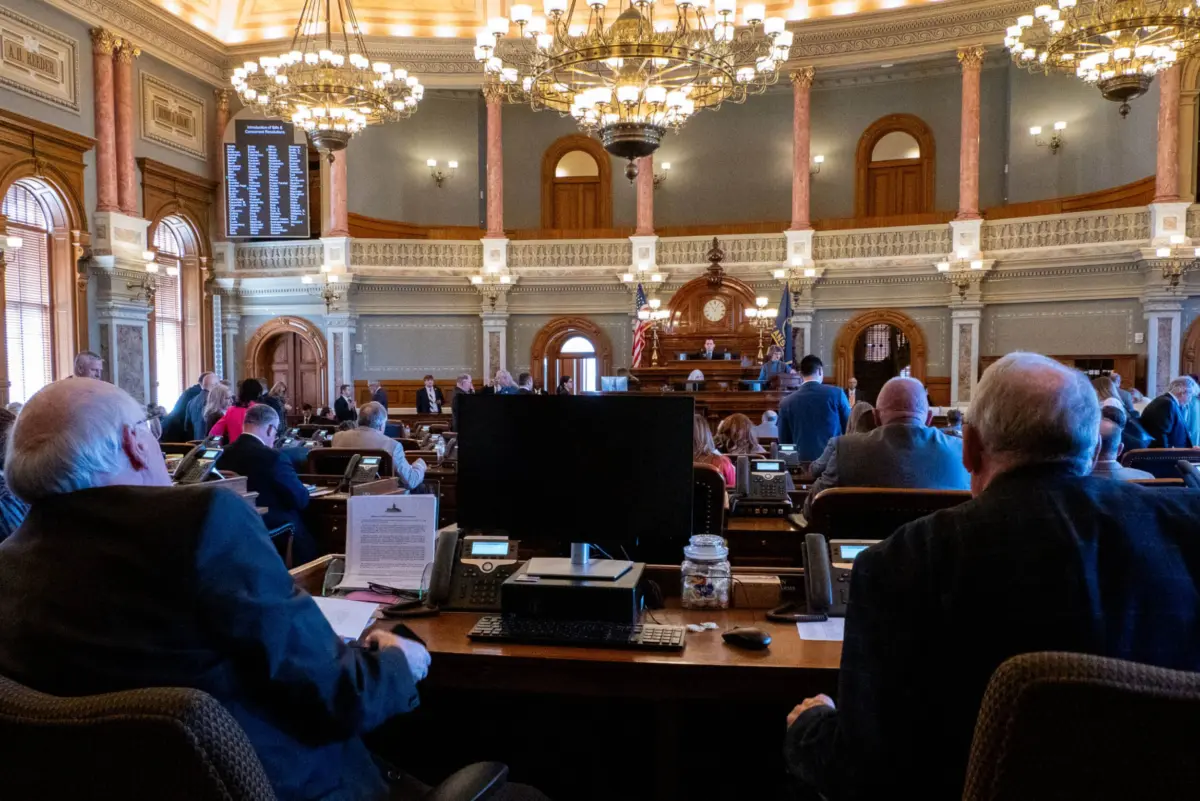
The Kansas Statehouse experienced a dramatic reduction in press accessibility following the 2024 election cycle. In January 2025, Kansas House Speaker Dan Hawkins abruptly eliminated the chamber’s designated press floor area, forcing journalists to stand against the back wall, prohibiting note-taking near lawmakers, and restricting photography angles.
Shortly thereafter, House Republicans voted to close their caucus meetings to reporters, routing legislative strategy sessions into total secrecy. Furthermore, state Senator Virgil Peck proposed an aggressive rent hike for media offices inside the statehouse, jumping from a flat rate of $100 annually to $1 per square foot per month—a move Peck explicitly tied to his frustration over what he characterized as inaccurate reporting.
Miami’s Dormant Policy Revived (2024–Present)
In South Florida, the local news ecosystem faced a severe blow when The Miami Herald—the city’s paper of record—laid off its city hall reporter. Around the time the investigative outlet Coconut Grove Spotlight launched in 2024, the City of Miami began aggressively enforcing a dormant 2011 media policy requiring prior approval for any city employee speaking to the press.
Confronted with widespread silence and ignored interview requests, the Spotlight filed a federal lawsuit in June against the city, arguing that the policy violates municipal employees’ First Amendment rights while intentionally hobbling independent newsgathering.
Supporting Context & Metrics: The Shrinking Watchdog Infrastructure
The systematic restriction of journalists occurs against the backdrop of a catastrophic contraction in local journalism infrastructure.
- The Staggering Loss of Local Watchdogs: A comprehensive 2026 study conducted by Muck Rack and Rebuild Local News revealed that the total number of full-time local journalists across the United States has plummeted by a staggering 75% since 2002.
- Statehouse Reporting Shifts: While a 2022 Pew Research Center study indicated that the gross headcount of statehouse reporters had slightly risen from 2014 levels, it underscored a troubling trend: fewer reporters are covering state government on a full-time, dedicated basis, leaving legislative bodies largely unmonitored between major cycles.
- The Economics of Information: Public records requests—often the last line of defense when officials stonewall reporters—have become prohibitively expensive and routinely delayed. Outlets frequently wait upwards of six months for basic transparency documents, forcing cash-strapped newsrooms to abandon crucial investigative series due to legal expenses and prolonged administrative silence.
Sherman Smith, editor-in-chief of the Kansas Reflector, highlights the human cost of this infrastructure collapse. Where major committee hearings once drew half a dozen dedicated beat reporters who could collectively demand accountability from lawmakers, today single journalists often sit alone in sprawling committee rooms. This lack of institutional memory and physical presence makes it effortless for political bodies to isolate and marginalize non-profit and digital-first outlets.
Official Statements and Institutional Responses
Throughout these cascading legal battles, the defense offered by public officials has frequently been characterized by silence or defiant public rhetoric regarding media accuracy.
- The Justification for Control: Reflecting on the motivations driving elected officials, Bryan Schott noted the fundamental calculus motivating modern politicians: "Why do we need to have our message filtered through a reporter… when just as easily, we can decide what is said about our policies? Why should we give equal access to the media who might not report things the way that we want?"
- Blaming the Messenger: Lawmakers pushing punitive measures have openly cited editorial content as justification for administrative penalties. In Kansas, Senator Virgil Peck defended his proposed rent hikes for statehouse journalists by telling constituents: "You are only charging $100 a year for the press to write stories about you… that frequently are inaccurate." Similarly, local council members in Fountain Hills, Arizona, stripped press tables from municipal chambers explicitly to "send a message" regarding critical coverage by the Fountain Hills Times Independent.
- Refusals to Comment: Multiple key figures named in ongoing litigation—including Kansas House Speaker Dan Hawkins, Iowa House Clerk Meghan Nelson, Utah legislative liaisons Alex Musselman and Aundrea Peterson, and representatives for the City of Miami—either declined or failed to respond to repeated requests for comment from journalists covering these developments.
Future Outlook: The Stakes for American Democracy
The ongoing collision between government officials and local watchdogs points toward a defining crossroads for American press freedom.
As independent and digital-first journalists increasingly fill the vacuum left by the contraction of legacy newspapers, they are confronting institutional frameworks built for a 20th-century media model. By weaponizing credentials, enforcing archaic communication policies, and treating independent reporters as partisan actors, public officials risk creating an information vacuum.
Yet, despite the mounting legal fees, restricted sightlines, delayed public records, and explicit hostility, the resolve of the local press remains unbroken. Across every statehouse and city hall facing restrictions, the uniform sentiment among besieged journalists echoes a singular, defiant truth: "They can’t stop me from continuing to report on them."
Whether the federal judiciary will ultimately draw a firm constitutional boundary protecting independent watchdogs from viewpoint-based exclusion remains to be seen. But as these landmark cases wind their way through the appellate courts, the health of American local democracy hangs directly in the balance—dependent entirely on whether the public’s right to know can survive the calculated erosion of its guardians.