


Executive Overview
The landscape of American journalism and political access is undergoing a profound and contentious transformation. Tensions between the White House and major news organizations reached a boiling point following a legal ultimatum issued by CNN to the Department of Justice regarding restricted access to Air Force One and the Oval Office. This ongoing legal skirmish is just one front in a broader, systemic restructuring of executive branch media relations under President Donald Trump’s second term.
Simultaneously, the Trump administration has floated radical proposals to dismantle the traditional White House press briefing room and convert it back into an indoor swimming pool—a symbolic gesture that underscores a wider adversarial posture toward mainstream media institutions. These institutional conflicts unfold against a backdrop of rapid digital disruption. According to recent data from the Pew Research Center, TikTok has firmly established itself as a primary news source for one in five Americans, driven heavily by younger demographics and communities of color.
Furthermore, the complexities of modern public storytelling have sparked intense internal debate within newsrooms, highlighted by The New York Times’ retrospective look at Nikole Hannah-Jones’ viral essay regarding public school segregation and maternal responsibility. This comprehensive report examines the intersection of executive power, press freedoms, digital shifts, and the evolving ethical boundaries of contemporary journalism.
Detailed Chronology: The White House Media Ban and Legal Escalation
The ongoing standoff between the executive branch and traditional news media has escalated steadily through the autumn of 2026, punctuated by legal maneuvers, selective travel bans, and fundamental shifts in how presidential access is managed.
The September 18 Catalyst
The current crisis traces back to September 18, when the Trump administration enacted a sweeping ban, barring journalists from CNN, Politico, and MS NOW from key physical spaces within the White House complex. In response, a joint legal coalition comprising the affected outlets filed a lawsuit against the administration, arguing that the blanket exclusions violated constitutional protections and longstanding protocols governing the access of the free press to the seat of government.
While a federal judge subsequently issued a preliminary injunction that restored a degree of physical access to the White House grounds, the administration continually circumvented the spirit of the ruling by denying these outlets entry to vital mobile press environments. Specifically, CNN has been systematically excluded from boarding Air Force One and participating in the rotating "pool"—the coordinated collective of journalists responsible for traveling alongside the president and documenting official business for the broader media ecosystem.
The Weekend Excursions and "Secondary TV" Shifts
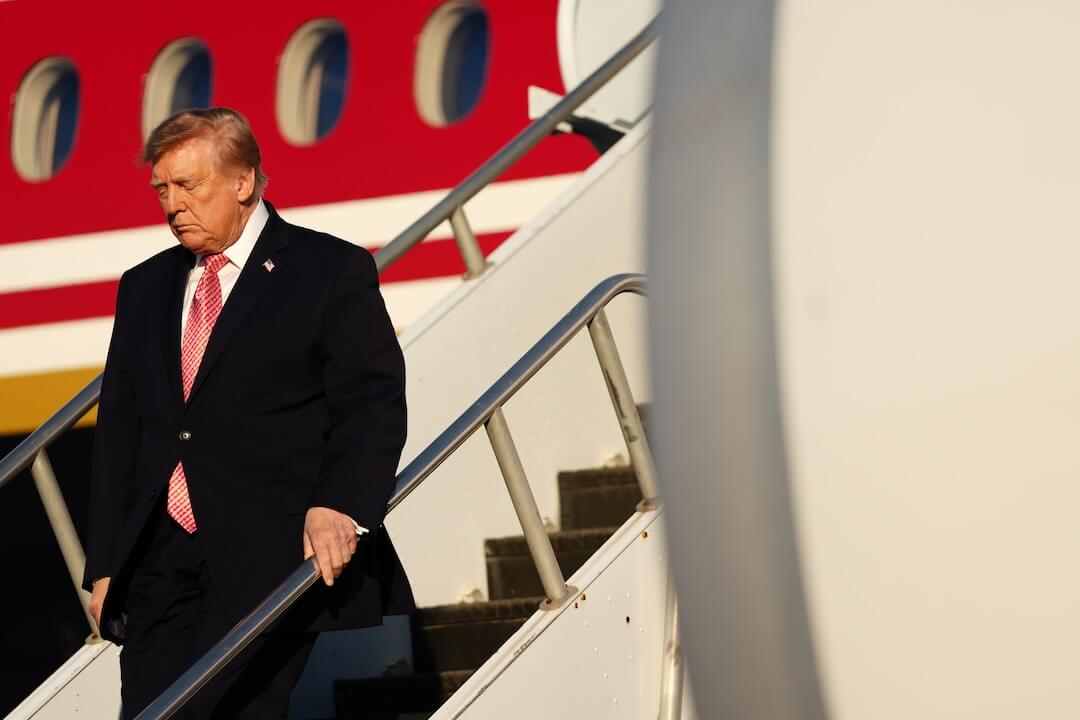
The practical consequences of these travel bans played out starkly over a weekend in October, when CNN was barred from accompanying President Trump on official trips to Georgia and Florida. In a display of industry solidarity—or logistical impasse—the four other major television networks (ABC, CBS, Fox, and NBC) declined to fill CNN’s vacant slot in the designated travel pool. Consequently, the president traveled without mainstream television network coverage.
To fill the broadcast void, the administration utilized a mechanism granting access to conservative outlet Real America’s Voice. Under existing alternative pool protocols, Real America’s Voice routinely assumes the "secondary TV" slot whenever CNN is systematically barred from participating. This dynamic effectively alters the nature of the pool reports distributed to the American public, substituting mainstream network correspondents with alternative media operators.
The DOJ Ultimatum
The legal tension culminated on a Monday in October, when CNN issued a formal warning to the Department of Justice through outside counsel Ted Boutrous. Describing the administration’s ongoing exclusion tactics as "mistaken, counterproductive, and unlawful," Boutrous demanded that the DOJ confirm by Thursday evening that the White House would completely abandon its policy of freezing CNN out of the Oval Office and Air Force One.
The stakes of this exclusion are exceptionally high. Statistical tracking reveals that since the beginning of his second term, President Trump has addressed more than 4,700 questions in the Oval Office, on Air Force One, and along airport tarmacs. By contrast, he has taken a mere 150 questions within the formal confines of the White House press briefing room. Depriving an outlet of tarmac and aircraft access effectively silences its ability to question the executive in high-frequency engagement zones. Despite the gravity of the legal warning, the Department of Justice did not immediately respond to requests for comment.
Supporting Context & Metrics: The Changing Face of Media Access and Consumption
The friction between the White House and the press corps does not exist in a vacuum; it mirrors broader, structural shifts in how information is gatekept, distributed, and consumed across the United States.
Shifting Geographies of Power: The Briefing Room Swimming Pool Proposal
Beyond physical access bans, the administration has targeted the structural architecture of the press corps itself. Reports surfaced that President Trump repeatedly pressured former White House press secretary Karoline Leavitt to spearhead an effort to dismantle the White House press briefing room and restore it to its original incarnation: an indoor swimming pool.
Originally constructed for President Franklin D. Roosevelt, the pool was covered during the Nixon administration to accommodate the growing operational needs of the modern press corps. While previous administrations—notably under First Lady Hillary Clinton—flirted with the idea of altering the space, the current push carries distinct symbolic weight. Dismantling the briefing room would physically sever the visible, decades-old proximity between the American media and executive power.
This proposal aligns with a broader pattern of structural reconfiguration. Last October, the administration restricted uninvited access to West Wing offices utilized by senior communications staff. Furthermore, it created a dedicated "new media" seat in the briefing room, routinely allocating prime positioning to nonpartisan digital upstarts, independent commentators, and conservative podcasts while sidelining legacy institutions. By taking over the management of the press pool—a logistical duty historically overseen by the independent White House Correspondents’ Association—the administration has consolidated total authority over who chronicles the presidency.
The TikTok Phenomenon: 1 in 5 Americans Turn to Short-Form Video for News
While battles rage over White House credentials and briefing room real estate, the broader American public is migrating rapidly toward digital and decentralized platforms for daily information. A comprehensive analysis released by the Pew Research Center underscores a seismic generational shift in media consumption.
Pew Research: Share of Americans Regularly Getting News on TikTok
==============================================================
Overall U.S. Adults:       20% (1 in 5)
Ages 18–29:                39%
Ages 30–49:                25%
Ages 50–64:                11%
Ages 65 and Older:          4%
==============================================================
By Demographics:
Black Adults:              32%
Hispanic Adults:           35%
White & Asian Adults:      14%
==============================================================
By Political Lean:
Democrats / Leaners:       22%
Republicans / Leaners:     15%
The data, compiled from a survey of 5,166 U.S. adults, reveals that 20% of Americans now regularly consume news via TikTok—a staggering leap from just 3% six years prior. Among young adults aged 18 to 29, reliance on the short-form video platform reaches 39%. This utilization drops steadily across older cohorts, registering at 25% for ages 30 to 49, 11% for ages 50 to 64, and just 4% for those 65 and older.
The survey also highlighted notable demographic and partisan divergences. Black and Hispanic adults are significantly more likely to rely on TikTok for news (32% and 35%, respectively) compared to White and Asian adults (both at 14%). Politically, Democrats and Democratic-leaning independents (22%) outpace Republicans and Republican-leaning independents (15%) in regular TikTok news consumption. These metrics illustrate a fracturing information ecosystem where traditional executive reporting models compete against algorithmic, decentralized video feeds.
Official Statements and Institutional Responses
The clash between institutional journalism and executive strategy has generated intense public commentary from legal minds, communications officials, and veteran journalists.
-
Ted Boutrous (CNN Outside Counsel): In his correspondence with the Department of Justice, Boutrous characterized the administration’s actions as a direct assault on constitutional norms, writing that the exclusion of CNN from mobile presidential spaces is legally untenable:
"The White House’s ongoing efforts to block CNN from the Oval Office and Air Force One are mistaken, counterproductive, and unlawful. We expect the department to confirm that the administration will abandon any policy of exclusion by Thursday evening or face additional legal action."
-
Steven Cheung (White House Communications Director): Addressing speculation regarding the potential dismantling of the press briefing room and the broader restructuring of media facilities, Cheung maintained an open, non-committal stance underscoring the administration’s fluid approach to press relations:
"All options remain on the table, and we will make an announcement when appropriate."
-
Nikole Hannah-Jones (Award-Winning Journalist and Author): Reflecting inward on the personal and professional ethics of modern reporting during a Times Insider interview regarding her viral essay on public education and segregation, Hannah-Jones emphasized the burden of transparency:
"When I wrote the first piece 10 years ago, so many people responded… and here was my child saying, I had a different experience. And so, as a journalist, as just a person who tries to walk through the world with integrity, I felt I had to be honest about how it went. My daughter has been kind of this symbol ever since she appeared on the cover… and she deserved for me to be honest about that she did bear a cost."
Future Outlook: The Intersection of Law, Access, and Integrity
As the legal deadline set by CNN’s counsel approaches, the immediate future of White House press relations hangs in the balance. Should the Department of Justice fail to provide assurances that travel bans and spatial exclusions will cease, the federal courts will likely become the primary arena for defining the boundaries of executive transparency. A protracted legal battle over the management of the presidential press pool could establish historic legal precedents regarding whether an administration possesses the constitutional latitude to curate its chroniclers based on ideological alignment or coverage tone.
Concurrently, the symbolic threat of converting the press briefing room into a swimming pool highlights a deeper administrative desire to decouple the presidency from traditional journalistic gatekeepers. Even if physical renovations never materialize, the strategic marginalization of legacy networks has permanently altered the daily cadence of political reporting.
Ultimately, these structural battles within the halls of power occur alongside profound existential questions within the journalistic profession itself. As highlighted by the intense public discourse surrounding personal accountability in investigative storytelling—exemplified by the national dialogue over Nikole Hannah-Jones’ reflections on family, race, and education—journalists are forced to navigate both external political hostility and internal ethical complexities.
With audiences increasingly migrating toward decentralized social platforms like TikTok for breaking information, legacy news organizations face a dual challenge: defending their constitutional right to question executive power while adapting to an information landscape that is faster, younger, and infinitely more fragmented than ever before.