

Executive Overview
In the hyper-saturated landscape of modern marketing and advertising, the traditional levers of differentiation have largely eroded. For decades, independent agencies relied on unique operating structures, geographic footprints, or specialized service bundles to stand out. Today, however, those advantages have vanished under the weight of market ubiquity. Almost every mid-to-large-scale agency offers a familiar matrix of strategy, creative, media execution, and production, supplemented increasingly by artificial intelligence frameworks. When capabilities are standardized and scalability can be outsourced or engineered, what remains to separate one agency from another?
According to industry veterans, the answer is as deceptively simple as it is frequently neglected: the agency’s own brand.
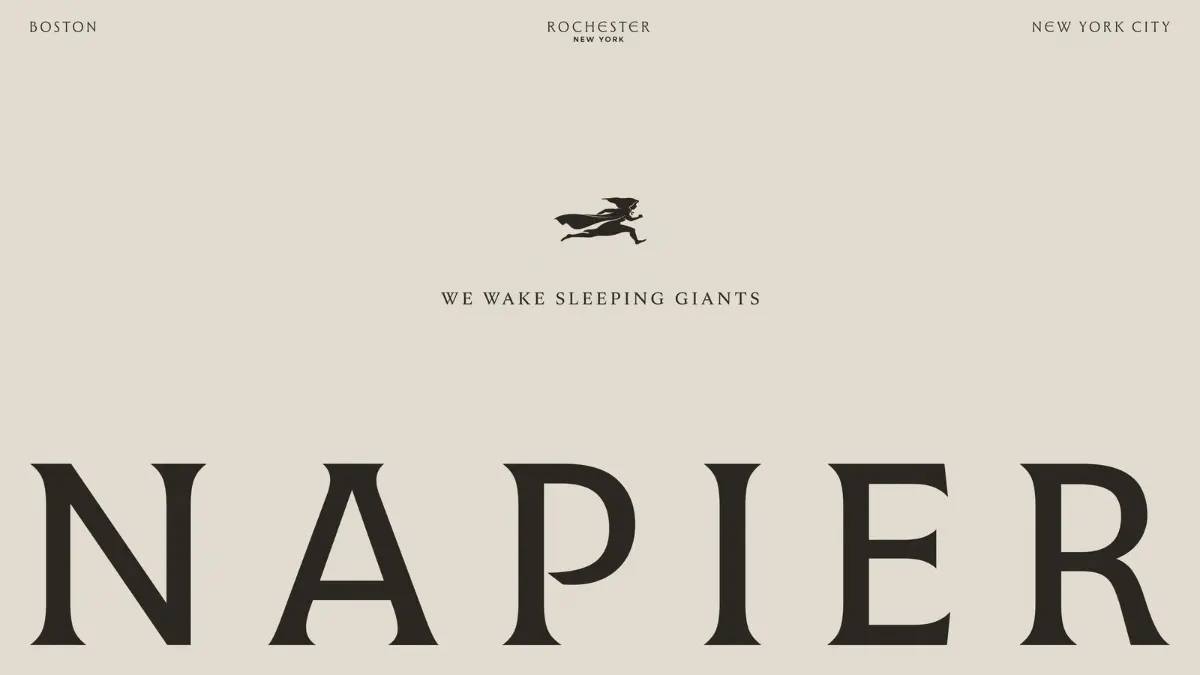
This core realization drove the 22-year-old marketing stalwart formerly known as Partners + Napier to undergo a profound metamorphosis. On October 22, the Rochester, New York-founded agency officially unveiled a comprehensive rebrand, shedding its legacy name to become simply NAPIER. The strategic overhaul encompassed a stripped-down visual identity, a sharpened market positioning targeted at "sleeping giants," and a bold leadership experiment wherein the founder intentionally stepped aside to let her executive team dismantle and rebuild the agency’s identity from the ground up.
This feature explores the structural imperatives driving modern agency rebrands, traces the rich chronology of NAPIER’s journey from a management buyout in 2004 to an employee-owned subsidiary of Project Worldwide, and examines the broader lessons agency leaders must learn about investing in their own brand equity rather than exclusively focusing on client portfolios.
Detailed Chronology: From the ‘Brave 40’ to NAPIER
To understand why a successful agency would intentionally disrupt its own hard-earned equity, one must trace the timeline of its evolution. NAPIER’s story is not one of sudden pivot, but of a decades-long accumulation of grit, adaptation, and structural reinvention.
2004: The Management Buyout and the ‘Brave 40’
The genesis of the agency’s modern identity dates back to 2004. Faced with an existential threat that risked the company’s survival, a leadership team spearheaded by the agency’s long-serving leader orchestrated a high-stakes management buyout.
At the time, the future was entirely uncertain. Yet, 40 foundational employees—affectionately and permanently dubbed the "Brave 40"—believed deeply in the organization’s potential. In a poignant display of solidarity and entrepreneurial faith, these employees pooled their personal financial resources to purchase the physical sign that would hang above the agency’s new doorway. Operating out of Rochester, New York, the agency positioned itself as a scrappy, intelligent, and fiercely independent challenger determined to prove that world-class creative concepts are not the exclusive domain of Madison Avenue megalopolises.
2012: The Partnership with Project Worldwide
As the agency scaled its client roster and operational scope, the limitations of pure independence began to present challenges regarding heavy infrastructure and global scaling power. In 2012, leadership made the strategic decision to sell the agency to Project Worldwide, an independent, employee-owned holding and agency network rooted in Detroit.
This acquisition was deliberately chosen. Project Worldwide’s industrial grit aligned culturally with the agency’s Rochester origins, while its ownership model protected the unique soul and operational autonomy that defined the company’s internal culture. Under this umbrella, the agency raised its performance bar across the board, refining its recruitment parameters, elevating the tier of creative execution, and attracting larger, more complex national brands.
2024–2025: Outgrowing the Legacy Name
Over the next decade, the agency expanded its capabilities and footprint. However, a common psychological trap of the agency world took hold: while the firm was busy architecting dynamic brand transformations for its corporate clients, its own corporate identity stagnated.
The name "Partners + Napier" no longer reflected the sophisticated, unified, and modernized entity the organization had become. Crucially, it had lost the razor-sharp edge of soul and rebellious energy that characterized its founding era. The leadership recognized that a visual and strategic overhaul was non-negotiable if the agency wished to attract a higher caliber of client and stay ahead of marketplace homogenisation.
October 22: The Birth of NAPIER
In a move that bucked contemporary industry trends—where many agencies strip away founder names in favor of abstract, tech-sounding monikers—the leadership team chose the exact opposite path. On October 22, the agency officially debuted as NAPIER. The new identity codified a mindset of resilience, outthinking larger competitors, and owning heritage rather than hiding from it. Simultaneously, the agency recalibrated its ideal client profile, pivoting away from scattershot challenger brand acquisition to focus explicitly on "sleeping giants"—established enterprises possessing immense market equity that require aggressive strategic disruption to unlock their full potential.
Supporting Context & Metrics: The Crisis of Differentiation
The strategic calculations behind NAPIER’s rebrand highlight broader structural transformations within the global marketing services sector. Industry analyses and executive observations point to several key market dynamics:
- The Capability Commoditization Trap: Modern pitch decks across agencies look remarkably similar. According to industry surveys, over 85% of mid-sized agencies pitch an identical triad of strategy, creative execution, and integrated media, supplemented recently by proprietary AI workflows. When every agency claims to offer end-to-end capabilities, capabilities cease to be a differentiator.
- The "Cobbler’s Children" Syndrome: Research into professional services branding reveals that creative agencies spend an average of less than 3% of their annual operational bandwidth on their own marketing and brand positioning—prioritizing client billable hours over enterprise equity. This creates a severe perception lag in the marketplace.
- The Rise of the "Sleeping Giant": NAPIER’s strategic focus on legacy brands with underutilized equity taps into a burgeoning market segment. Data indicates that Fortune 500 companies founded before the digital revolution often struggle with organizational inertia, making them prime targets for agencies skilled in heritage-backed modernization.
- Employee Ownership Resilience: Industry data consistently shows that employee-owned agency models or agencies tied to independent networks (such as Project Worldwide) exhibit lower employee turnover and higher retention of institutional knowledge during economic downturns compared to private-equity-backed agency roll-ups.
Official Statements and Leadership Philosophy
What makes NAPIER’s rebrand fundamentally unique is not just the visual outcome, but the internal political process that produced it. Breaking with authoritarian executive traditions, the agency’s primary leader executed a masterclass in corporate trust.
Reflecting on the decision to step away from the steering wheel of her own agency’s rebrand, the leadership noted:
"I’ve always believed in leading from a place of abundance, and making room for more people and ideas. That means trusting the people around you to see things you might not. I let go, and the rest of the leadership team led the rebrand with the freedom to challenge everything, including the name on the door."
Rather than an insular exercise in corporate vanity, the executive team subjected the initiative to rigorous external stress testing. They hired independent external consultants to challenge their internal assumptions and tested the proposed market positioning with professional search consultants and brand auditors to gauge market resonance.
The overwhelming feedback from the external audits was unequivocal: "Whatever you’re saying, go further. Don’t be afraid to be provocative."
This insight challenged the leadership to reject safe, corporate-speak nomenclature. Addressing the decision to simplify rather than obscure the founder’s heritage, leadership emphasized:
"The team chose NAPIER because it represented a mindset and a spirit that had been with us since 2004. That founder who risked everything because she believed in her team, and the people who stuck by her to bring it to life. We’ve always had to outthink, outwork and outshine agencies many times our size. And now we’re owning our roots in a new way, with a simpler name that carries more power."
Future Outlook: Implications for the Agency Ecosystem
The successful rollout of the NAPIER brand serves as an urgent wake-up call and a strategic blueprint for agency founders and holding company executives globally.
As artificial intelligence flattens the execution curve and media fragmentation accelerates, clients are increasingly searching for partners who possess moral courage, intellectual conviction, and a distinct point of view. Agencies that hide behind safe, generic names and boilerplate capabilities will likely find themselves trapped in a race to the bottom on price.
NAPIER’s trajectory suggests three critical imperatives for the future of agency leadership:
- Brand Stewardship Starts at Home: Agencies must treat their own brand equity with the exact same rigor, financial investment, and strategic intensity they demand for their most valued corporate clients. Waiting for a macroeconomic crisis or a major account loss to refresh an agency identity is a reactive trap.
- The Power of Relinquishing Control: True leadership in creative industries requires organizational abundance. By empowering next-generation leadership teams to challenge sacred cows—even down to the name on the brass plaque—founders can unlock fresh perspectives that secure long-term legacy rather than short-term stagnation.
- Double Down on Heritage: In an era dominated by synthetic media and algorithmically generated sameness, human heritage, organizational grit, and authentic origin stories provide an un-replicable moat.
By dropping the plus and standing boldly on the name NAPIER, the agency has not merely updated its visual lexicon; it has re-anchored its identity in the rebellious spirit of the Brave 40 who pooled their savings in 2004. For the broader marketing ecosystem, the message is clear: if agencies expect their clients to have the courage to evolve and stand out, they must first possess the conviction to do the exact same thing themselves.
