

Executive Overview
For years, modern frontend web development has operated under an unwritten axiom: if you need a feature, there is a library for it. From formatting dates and parsing complex JSON payloads to handling focus traps, managing modal dialogs, and deep-cloning data structures, the JavaScript ecosystem has thrived on an ever-expanding registry of third-party packages. Developers install a dependency once, watch the automated tests pass, and move on. Over time, these transient decisions compound, leaving package.json bloated with utilities that quietly drain bandwidth, prolong execution times, and introduce supply-chain vulnerabilities.
However, the landscape of the web platform has undergone a quiet revolution. Browsers are no longer static engines rendering basic HTML and CSS; they have transformed into extraordinarily powerful, highly capable application runtimes. Features that once demanded dedicated, heavy third-party packages—such as internationalization formatting, advanced array grouping, structural object cloning, native popovers, and CSS anchor positioning—are now built directly into the web platform.
This article outlines a practical, data-driven methodology for auditing your application dependencies. By leveraging the Baseline initiative—a cross-industry standard that tracks browser support maturity—development teams can safely shed between 60KB and 90KB (minified and gzipped) of redundant code from a typical mid-sized JavaScript application. Far from a reckless exercise in deleting code, this migration represents a strategic alignment with modern platform capabilities, trading unnecessary abstraction layers for raw browser performance.
Detailed Chronology: The Evolution of Web Platform Capabilities
To understand how we arrived at this pivotal crossroads of dependency minimalism, it is necessary to examine how web standards have evolved over successive eras of browser engineering.

The Era of Polyfills and Fragmented Standards (2010–2018)
In the early 2010s, building robust web applications required aggressive polyfilling. Major browser engines (Blink, Gecko, WebKit, and Internet Explorer’s MSHTML) frequently implemented specifications inconsistently, or failed to implement them at all. Developers routinely turned to libraries like Moment.js for date manipulation, Lodash for fundamental data structures, and a constellation of custom plugins to normalize DOM interactions. During this period, reliance on third-party libraries was not merely a convenience; it was a structural necessity for cross-browser survival.
The Rise of Modern Standardization and the WebDX Initiative (2019–2023)
As web tooling matured, browser vendors committed to closing the feature gap. However, developers still struggled to answer a fundamental question: When is a web feature safe to use in production without relying on explicit polyfills?
To resolve this ambiguity, the WebDX Community Group introduced Baseline. Baseline acts as a clear, unified metric for web platform maturity. By tracking interoperability across the four core browser engines (Chrome, Edge, Firefox, and Safari), Baseline designates features into two critical categories:
- Newly Available: Supported across all major browser engines, marking the beginning of safe usage periods.
- Widely Available: Having achieved thirty months of continuous support across all major engines, signaling that a feature can be adopted unconditionally across virtually any target audience.
This classification system fundamentally changed how engineering teams evaluate technical debt. Instead of guessing whether a native API is safe, developers can rely on transparent interoperability metrics.

The Modern Platform Dominance (2024–Present)
Today, we inhabit an era where modern JavaScript runtimes natively support complex architectural paradigms. Modern engines parse, compile, and execute native implementations significantly faster than equivalent user-space JavaScript abstractions. Features such as native object grouping (Object.groupBy), structural cloning (structuredClone), the <dialog> element, and the Popover API have systematically eradicated the justifications for maintaining redundant utility libraries.
Supporting Context & Metrics: The Real Cost of Bloat
When evaluating technical debt, engineering management often fixates on security vulnerabilities flagged by automated tools like npm audit. Yet, performance audits rarely ask the most critical architectural question: Is this library still executing tasks that the browser can now handle natively?
The Bundle Math of Common Clusters
In a typical mid-sized JavaScript application, dependencies cluster into specific domains. Analyzing these clusters reveals striking opportunities for payload reduction:
- Internationalization (Intl Namespace): Traditional packages like
timeago.js,pluralize,numeral, andhumanize-durationconsume roughly 14 KB gzipped. Modern browsers natively handle these exact use cases viaIntl.RelativeTimeFormat,Intl.NumberFormat, andIntl.ListFormat. - HTTP Clients: Heavyweight abstraction layers such as
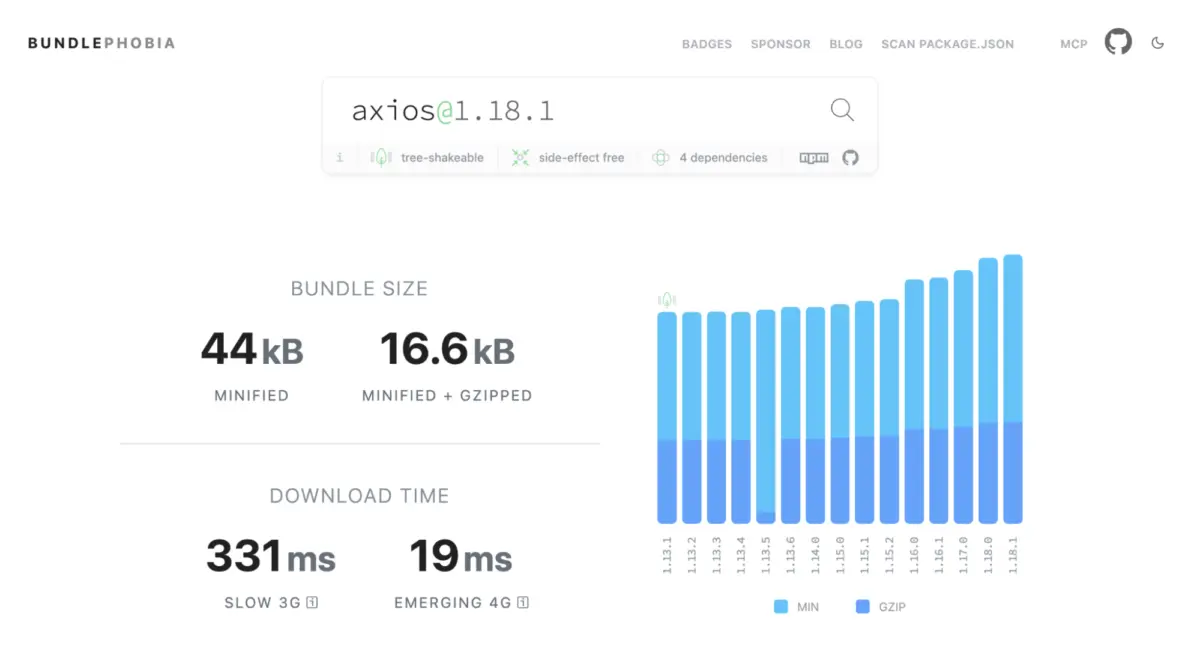
axios(approx. 17 KB gz) andsuperagent(approx. 19 KB gz) are frequently deployed for basic data fetching. For standard requests, nativefetchcombined withAbortControllerandAbortSignal.timeout()provides a zero-dependency alternative. - UI Primitives: Modal dialog managers, focus-trap utilities (
focus-trapat 6.6 KB gz), scroll-locking libraries (body-scroll-lockat 1.3 KB gz), and tooltip positioning packages (tippy.jsat 14 KB gz) accumulate nearly 24 KB gzipped. These can be completely replaced by the native<dialog>element, the Popover API, and CSS anchor positioning. - Utility Libraries (Lodash Subsets): Individual imports like
lodash.clonedeepandlodash.groupbyaccount for another 8 KB gzipped of redundant transformations that are now natively executed bystructuredCloneandObject.groupBy.
When aggregated, these optimizations allow teams to strip between 60KB and 90KB of gzipped code from their production bundles—translating to hundreds of kilobytes of uncompressed JavaScript that the browser engine no longer needs to parse, compile, and evaluate.

Official Statements and Architectural Frameworks
Transitioning away from third-party libraries requires a disciplined decision framework. Blindly executing a find-and-replace operation across an entire codebase can destabilize user experiences. Architectural leaders recommend evaluating every potential dependency removal against three precise criteria:
- Is the native replacement Baseline-safe for my audience?
Engineers must analyze their actual user analytics orbrowserslistconfiguration. B2B dashboards dominated by modern desktop browsers can adopt "Newly Available" features immediately, whereas consumer-facing applications with long tails of legacy mobile devices must exercise caution or implement progressive enhancement. - What does the swap actually cost?
Dropping a lightweight library in favor of a native API must not accidentally introduce a heavier polyfill. For example, attempting to replace a simple date utility with the advancedTemporalAPI prior to its widespread stable release can force the inclusion of a polyfill that dwarfs the original dependency. - Does the platform feature cover my actual use case?
Third-party libraries often provide ancillary conveniences (such as request interceptors in HTTP clients or advanced fallback heuristics in deep-cloning utilities). Teams must audit their actual codebase usage to ensure native replacements are truly drop-in compatible.
Future Outlook: What Lies Ahead for the Web Platform
The momentum of the web platform shows no signs of slowing down. As we look toward the horizon of web development over the next several years, several upcoming platform capabilities promise to further narrow the gap between native runtimes and third-party utility libraries:
- Universal Temporal Support: While the
TemporalAPI represents the definitive future of date and time manipulation in JavaScript, its current adoption requires careful monitoring. As Safari and other engines finalize stable releases, the need for external date libraries will sharply decline. - Advanced CSS Anchor Positioning Fallbacks: As browser vendors refine CSS anchor positioning specifications, complex layout calculations currently managed by JavaScript positioning engines will move entirely into the browser’s rendering pipeline.
- Expanded Built-in Data Structures: Future ECMAScript proposals continue to target common developer pain points, ensuring that data manipulation, collection processing, and asynchronous coordination become core primitives of the language itself.
Conclusion: Your Action Plan
Reducing bundle size through the strategic adoption of Baseline features is not a one-time chore; it is an ongoing maintenance habit. Engineering teams should commit to a quarterly dependency audit: list production dependencies using npm ls --omit=dev --depth=0, measure their real-world impact using bundle analyzers, check native platform alternatives against modern Baseline standards, and progressively phase out redundant code.
By reclaiming the web platform, developers can ship leaner applications, accelerate execution performance, and deliver resilient, high-speed experiences to users worldwide.